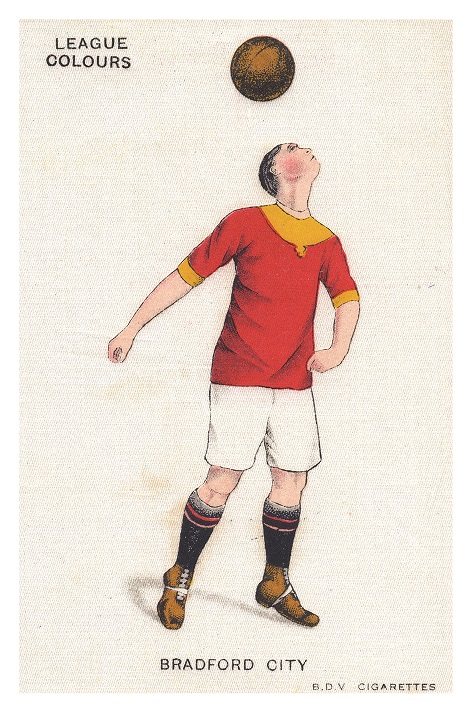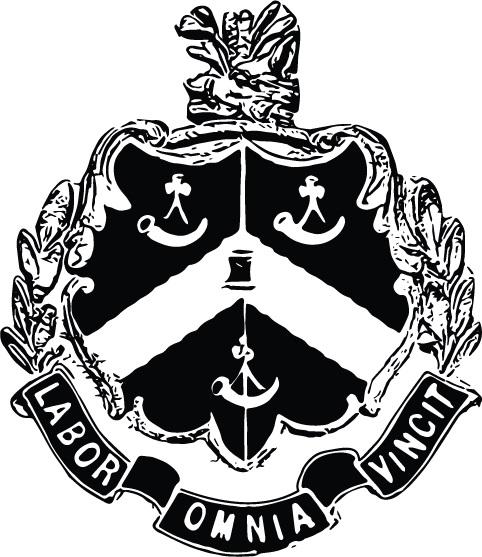
Attendances 80 years ago

The following is my feature in the Bradford City programme v Northampton Town on 13 January, 2018:

On Saturday, 8 January, 1938 all three of the senior Bradford clubs played at home and their games were watched by a total of just under 38,000 people. At Valley Parade there were 13,088 spectators to witness City’s FA Cup Third Round tie against Chesterfield; at Park Avenue, 12,700 to see the Third Round tie against Newport County; and at Odsal, 12,000 watched Bradford Northern. Whilst there would have been away supporters in attendance, it is unlikely to have been a significant number such that it could reasonably be said at least 35,000 Bradfordians were seeing their teams in action.

Yet it was not the highest gathering of football followers in Bradford. That was on 15 February, 1936 when a total of 57,980 attended the Fifth Round FA Cup games in the city – 33,927 at Valley Parade to see the tie with Derby County and 24,053 at Park Avenue to see that with Spurs.

The statistics are notable by way of illustrating the extent to which the three clubs competed for spectators and diluted the available catchment. It was a factor that undermined the finances of each organisation and goes a long way to explain the fate of Bradford soccer in the twentieth century.

For much of the 1920’s, it had been Bradford RFC – the amateur side at Lidget Green – who commanded the interest of rugby enthusiasts and it was not until Bradford Northern relocated from Birch Lane to Odsal in 1934 that attendances were boosted, arguably at the expense of soccer.

City had traditionally been the better supported of the two soccer clubs but there tended to be a good number of people who floated between them according to the fixtures. Many had been disgruntled with the policy of the Bradford City directors to sell a number of the club’s leading players, considered a contributory factor to relegation to Division Three (North) in 1937. Of course City remained in exile from the higher divisions until 1985.

Not surprisingly given the status of Bradford (PA) as members of Division Two, gates at Park Avenue had been higher during 1937/38. Yet whilst it may have been unexpected that the attendance for the cup game at Valley Parade should exceed the crowd at Park Avenue, it came down to the draw – a potential giant-killing against second division Chesterfield was probably more appealing than Avenue’s tie with lower division opposition. Nevertheless, those attending Park Avenue would have considered the home side’s 7-4 victory more entertaining than City’s 1-1 draw and Bradford went on to reach the Fifth Round whilst the Paraders were eventually defeated by Chesterfield.

The gates at Valley Parade and Park Avenue that day were above the average for those attending league games in 1937/38 and for City in particular, it provided welcome respite to the club’s finances. The economics of two Bradford clubs was based on a decent cup run and bumper derby gates. With 19,005 having watched the clash at Park Avenue in August, 1936 and 28,236 the return game at Valley Parade in December, 1936 the revenues were significant. The loss of the derby fixture further compounded the problems at Valley Parade where average crowds dropped from 10,046 in 1936/37 to 6,011 in 1937/38 although it is notable that despite the loss of the derby game, average attendances at Park Avenue increased from 10,424 to 11,111 with the benefit of ‘floaters’.

NB Contrary to what has been quoted in the press, it is a myth and an idle claim that there were regular crowds of 35,000 at Park Avenue. Had there been, the ground would not now be derelict nor attracting archaeologists and botanists. Indeed, the record attendance at the ground was 32,810 and on only five other occasions did crowds ever exceed 30,000.

  • Read more about the early history of Bradford soccer in my books ROOM AT THE TOP and LIFE AT THE TOP If you are interested in Bradford sport history visit VINCIT: https://www.bradfordsporthistory.com

Thanks for visiting my blog. Apart from publishing my BCAFC programme articles I also upload occasional articles of historical interest. Scroll down for details about my books in the BANTAMSPAST History Revisited series which tell the history of sport in Bradford – and in particular football. The books seek to explain why things happened as they did instead of simply recording what occurred and readers may be surprised at the extent to which they contradict many of the myths and superficial narratives that have circulated previously. You won’t get fancy art school graphics but you will find substance and historical accuracy in the content. Of course if you prefer an abundance of pictures accompanied by text written for a Year 5 schoolchild you’ll find them ball-achingly boring. Tweets @jpdewhirst

On a siding

Bradford shield

For more than 150 years Bradfordians have bemoaned the fact that their city lacked a through line and a rightful place on the national rail network. Prior to World War One numerous schemes were proposed to achieve this objective but none progressed. And yet in 2018, we anticipate the possibility that a Bradford through-line could form part of the plans for a high speed railway in the North of England. [1]

The following is the story of the various historic schemes for a cross town link in Bradford, taken from my book ROOM AT THE TOP which explains the origins of professional sport in Bradford and the significance of the railways…

Bradford, a railway town

Just as we do not consider Bradford to have been a military town, neither do we think of it as having been a railway town yet the railways (as well as the military) had a major influence on Bradford sport and where it was played. Because so little remains it is difficult to believe their significance yet the urban geography of Bradford was dictated by the railways.

Railway mania was late coming to Bradford but when it did, it was no less intense than in other parts of the country and no less significant in shaping the urban footprint of the town and surrounding district. At its peak in 1914, the railway network in the Bradford district comprised 75 miles of track. Today little more than 40 survives and almost all of the sidings and yards have disappeared. Three companies dominated Bradford’s network and it was competition between them that conspired to leave Bradford without a through line.

The symbolism of two principal stations at the end of sidings is also apt when we consider the fate of Bradford soccer in the twentieth century. Football in Bradford was likewise subject to a mania and the competition between two stubborn rivals shaped how Bradford’s football would evolve. Co-operation in both cases would have ensured a better inheritance for today. However what railways and football in Bradford had in common is that they were at the mercy of the topography. Those hills have so much to answer for.

The railway first came to Bradford in 1846 with a connection from Leeds and the Leeds & Bradford Railway was later absorbed into the Midland Railway. The town’s first station became known as the Midland Station, situated closer to the centre than the modern day Forster Square terminal. In 1847 this line was extended to Bingley and Keighley with a station at Saltaire in 1856. A link to Ilkley and Otley opened in 1865. Many other branch lines and goods depots sprouted though Bradford’s hills and valleys. But more than 130 years ago the perception of Bradford was of a siding:- ‘As it was in the beginning – Bradford on a siding – is now – Bradford on a siding – and ever shall be – Bradford on a siding – world without end – Bradford on a siding.’

These words were quoted in the Leeds Times in January, 1884 following the collapse of a scheme to construct a through line in Bradford. To this day we have two railway stations and no prospect of a main line whilst investment in national rail links has bypassed the city. As things stand Bradford remains on a siding.

As a boom town in the nineteenth century, manufacturers in Bradford were as anxious to get rail links as railway companies were to provide them. A Bradford spinner, William Murgatroyd was said by local historian George Sheeran to have invested £62,000 in railways in the 1840s, later to become a director of the Midland. Similarly, the mayor of Bradford in 1862/63 and between 1871-73, M W Thompson was a director of the Midland Railway so it could hardly be said that the town never had influence within the railway establishment.

And yet Bradford ended up ‘on a siding’ with poor connections. This may be attributed to the local topography (ie the hills) as well as competition between competing railway companies to control the network. However, railway development in Bradford affected many other aspects of life: it had a major influence on urban development and land use in the town which had corresponding impact on where sport could be played.

How railways dictated the development of sport in the district

The significance of the railways came from where stations were built as well as where they were proposed and indeed, they impacted on places where they were not developed. Much the same as Bradford came to have two senior football clubs it ended up with two principal stations. The railways ultimately had a major role in defining the history of football in the town.

Railways brought people to games as players and as spectators and early venues were selected in the vicinity of stations such as Apperley Bridge (opened 1846), Frizinghall (1875), Bowling (1854) and St. Dunstans (1878). The Quarry Gap showground and racing venue had likewise benefited from the opening of Laisterdyke (1854). Bolton Bridge station (1868), which came to be known as Manningham was used by teams visiting Peel Park, Lister Park and later Valley Parade. The prospects of the Park Avenue development owed much to the opening of Horton Park station (1880) and even in the twentieth century Low Moor station (1848 to 1965) helped make Odsal Stadium a feasible proposition.

The strategic importance of railway links for sporting events had long been established – well before the emergence of football – with excursion trains conveying people to racing events as well as ‘nurr & spell’ contests (hitting a small wooden ball with a stick over distance). A good example of this was reported in Bell’s Life in London of 29 May, 1853, in respect of the nurr & spell contest that took place between Joseph Coward of Baildon and Matthew Thompson of Barnsley at Doncaster race ground. ‘A special train with thirty carriages brought 1,800 from Bradford and another from Barnsley brought 1,200.’ The total crowd was estimated at 6,000. The event was for £50 stakes and there was reported to be much gambling. It ended in a near riot with numerous ‘pugilistic encounters’.

There are many accounts of excursion trains booked to convey footballers and supporters to away grounds and railway timetables would have determined both the choice of opposition as well as the time of kick-off. In this way railways helped define the earliest sporting rivalries.

Railways determined where it was practicable to establish a sports ground. The Bradford Daily Telegraph of 17 July, 1878 quoted the treasurer of Bradford Cricket Club regarding the search for a new ground: ‘He thought that there would be no difficulty getting a ground, but they would not get one so central as the old one (ie at Great Horton Road), and as other towns had done, they might go outside and get a ground near a railway station.’ Another correspondent on 11 September, 1875 suggested that Bradford CC should move to the ground of Eccleshill CC on account of it being ‘within three minutes’ walk from the station and the fare is 21/2 d.’ Lack of railway connections also explains why they were not developed in certain districts. Railway speculation overshadowed the tenure of the ground at Four Lane Ends, Girlington and in the final event determined the availability of the site at Valley Parade. [1] Bradford City, like Manningham FC between 1886 and 1903, had the Midland Railway as its landlord, as did Manningham Cricket Club at Whetley Lane between 1878 and 1895.

Railway origins and development in Bradford

Although Bradford’s railways are nowadays a fraction of what once existed and what was planned, their legacy remains. Although redundant stations have long since been demolished, there are sufficient surviving civil engineering structures in the Bradford district to remind us that the railways had a major impact.

Lobbying for a rail connection to Bradford dated back to 1830 with proposals for a line to Leeds that would link to the Leeds-Selby route but this scheme was abandoned in 1831 as a result of opposition from canal owners. (The Bradford Canal that ran 3.5 miles and climbed 86 feet from Shipley to the centre of town, had opened in 1774.) Alan Whitaker, in his book Bradford Railways Remembered states that in 1832 there was another scheme to connect Leeds and Bradford to Manchester and Liverpool but this also fell through. By 1840 industrialists were concerned about being cast adrift from the railway boom and plans were revived. In all likelihood it was railway mania that made the difference with the Leeds & Bradford Railway Company being established in 1843.

In the years before 1846 railway investment opportunities had been much advertised in the local press. The Bradford Observer was prescient in cautioning against the emerging bubble and questioned whether all schemes were likely to be successful: ‘We feel some hesitation seeing that we are all bitten with the mania. We doubt not there are some good schemes amongst the many afloat, and amongst the rest, some Yorkshire ones; but we may doubt whether there is not some lurking fallacy on railways in the public mind…A manufacturer expands his mill slowly, and as his means increase. A railway is a gigantic undertaking at once, and may vastly overshoot demand, as we know by many costly experiments.’ The same could have been said four decades later when there was a football boom in Bradford.

Railways speeded up reality. It was recounted in the Bradford Observer of 1 November, 1855 that the journey to London had previously taken 4 days with only 4 coaches passing through the town each day. It stated there to be then 22 trains leaving the Midland station every day, 22 from the Lancashire & Yorkshire and 12 from the Great Northern and estimated that as many as 4,032 people entered and departed from Bradford daily. This was in contrast to around 80 people per day in the age of stage coaches. Not only that, the journey time to London was by that time only 6 hours.

The writer saw the railways as evidence of progress, adding ‘The Bradford Canal was commenced AD 1776. It would be a great blessing to this town if this canal could be dried up. The amount of mephitic and noxious vapour which arises from it is enough to breed pestilence and death amongst the pollution. I have heard of the gas, in dry weather, being set on fire with a lucifer match.’

By 1850 Bradford had a second station at Drake Street operated by the Lancashire & Yorkshire Railway (L&Y). The Great Northern Railway (GN) opened a third in 1854 at Adolphus Street (at the bottom of Wakefield Road) with connections to Leeds and the Spen Valley via its junction at Laisterdyke. Adolphus Street became a goods depot in 1867 when the GN operated from an enlarged Bradford Exchange. In 1870, the travel time from Bradford to Keighley along the Aire valley was around thirty minutes; the journey to Manchester could be anything up to two-and-a-half hours.

The Halifax Guardian’s description of the town’s links reflected the feeling that it was an unsatisfactory state of affairs: ‘Bradford is approached by the Lancashire & Yorkshire line down a steep and dangerous gradient; and by the Great Northern by a meandering line on a steeper gradient still; whilst it is simply on a branch line from the Midland at Shipley.

Paranoia existed in Bradford that its rail connections remained undeveloped and that other towns were likely to derive advantage at Bradford’s expense. The Leeds Times of 19 January, 1884 reflected that feeling: ‘The town could not flourish if it were left behind – the very essence of success in our modern times was to be on the broad main line of intercommunication between production and consumption, between the buyer and the seller of the articles which were manufactured in any locality.’ While there was sensitivity about the status of Leeds compared to Bradford, prior to the 1880s it was probably Halifax’s rival rail links that were viewed as the biggest threat.

Bradford’s lack of a through line troubled the town’s leaders who considered it to be a major disadvantage in terms of status as well as lost opportunity and inconvenience for industry and residents. Until World War One there was continuing speculation about linking the two stations and developing a main line that would not only improve connections with other towns but enhance connections within Bradford.

We underestimate the extent to which the two sides of the valley north from Bradford were considered to be cut-off. Railways were seen as the obvious way to connect the west and east sides of the town and another topic was that of access to Peel Park which was the only park in Bradford prior to the opening of Lister Park in 1875. There were many letters to the Bradford Observer with suggestions for railway development including the proposal of a branch line from Manningham with a terminus station opposite Peel Park Gates.

———————————————————————————————————-

Mr Angry of Horton

One of the most prolific correspondents to the Bradford Observer was smuggler and American Civil War volunteer William Hartley. Born in 1841, he had fought for the US Army in the latter stages of the American Civil War. I cannot say whether he had fought for the North as a mercenary or as a matter of principle. Liberals in Bradford were keen supporters of the Federal cause and one of the town’s MPs, William Forster was a leading figure among anti-slavery campaigners in Britain.

In May, 1871 Hartley admitted ‘the annoyance of writing long letters is a regular nuisance to me, but if I get an idea into my cranium which I think should be carried out, and no-one else proposes it, I cannot resist sending it to the papers…’ His was a world in which Bradford was rapidly expanding ‘like a central planet, surrounded by a milky way of satellites’ as he described his home town in 1870. He offered numerous suggestions about possible railway schemes and his letters invariably contained estimates of the costs and benefits.

Prior to leaving for America he had written under the pen name of ‘Ignoramus‘ and on his return as ‘Hortonian‘, revealing his residence on Horton Lane. In the midst of speculation about new railway routes across the Bradford district he wrote in April, 1870 on the subject of making Bradford the ‘principal railway centre of the north: ‘Here is a town with not a single main line of communication through it. There is not another town of such importance in the country treated so shabbily, neither do I think a place of like magnitude would succumb to it. However we have natural facilities for making Bradford the main thoroughfare of traffic from North, South, East and West.‘

Between 1870 and 1873 he offered suggestions for just about every conceivable suburban route and it illustrated the confidence of the Victorians in the power of railways to transform urban transport. In May, 1870 ‘Hortonian’ offered a scheme to ‘make Bradford as well-roaded as almost any place in the country.’ He was without doubt an urban planner before his time.

In June, 1877 Hartley was convicted of tobacco smuggling alongside his clerk, Henry Hardacre. It was alleged he had used his trade as a paper merchant to cover smuggling tobacco from Hamburg. The two were fined £1,344 and £1,112 respectively in lieu of tobacco duty which would suggest that he was at the centre of a massive undertaking. The prisoners were told they would remain in prison until the money was paid. Needless to say nothing was heard from him after that.
———————————————————————————————

Strategic links to Eccleshill and other schemes

Railways connected the people and produce of Bradford with the rest of Great Britain as well as other parts of the surrounding area. Although we might consider lines joining Laisterdyke and Shipley via Eccleshill (opened in 1874) and that from Bradford to Keighley and Halifax via Queensbury (opened in stages from 1878) to have been ludicrous ventures, from the Victorian point of view they represented strategic investments. The Great Northern Railway’s extension from Laisterdyke to Shipley allowed heavy freight and mineral traffic with limestone for Bowling and Low Moor iron works from the Yorkshire Dales and stone from Idle Moor. Similarly, its railway to Thornton was considered equally important to carry textile manufactures and raw materials as well as coal for the mills.

In 1864, the Bradford Junction & Thornton Valley Railway Company was formed to finance the construction of a railway from Bowling on the Lancashire & Yorkshire line to a point between Bradford and Shipley on the Midland line near to Bolton Lane. Two years later the Midland announced plans for a station at Bolton Bridge which was later known as Manningham station, situated off Queens Road, with the location designed to serve Peel Park. This was to run through Little Horton Green and Shearbridge to cross Thornton Road near its junction with Brick Lane – what is today Hollings Road – and continue on the lower side of Manningham Lane through a tunnel (see plans below). A second line was proposed from the first at Thornton Road, proceeding in a westerly direction up the valley to Clayton and Thornton with a branch to Queensbury from Hole Bottom. The line was considered valuable to provide a direct route from London to Scotland.

P9291014.JPG

Alfred Illingworth was among those industrialists who supported the project and was likely to make a lot of money from his property interests around Four Lane Ends. A station was proposed at Thornton Road to provide passenger services and in particular heavy goods traffic. But in November, 1865 it was announced that the scheme had been abandoned on account of expense.

Hilly terrain would have presented a major challenge but so too any tunnelling project across Manningham was complicated by the fact that it would have been under built-up land. The line of the tunnel appears to have been from Thornton Road, under Westgate and Lumb Lane, terminating in fields lying between Eldon Place and Trafalgar Street off Manningham Lane, to join the Midland route.

The abandonment of the scheme also had much to do with disagreements between the three railway companies in Bradford regarding their wider interests. By providing a link to the north the GN and L&Y had much to gain, at the expense of the Midland. However, by this time the GN was already exploring other possibilities with the Laisterdyke to Shipley route, first proposed in 1862.

Shortly after the collapse of the Bowling-Manningham link scheme, in 1866 and 1867 the GN obtained parliamentary approval to establish its own route from the south of Bradford to the north. Construction was delayed and the line did not open until 1875. Its promoters claimed it would provide a direct route to the north from Doncaster via Wakefield. But with reliance upon the Midland for use of its line northwards from Shipley, the GN never realised this potential and by 1931 the stations at Eccleshill, Idle, Thackley and Windhill had closed.

In 1870 the Bradford & Thornton Railway Company was formed to build a track from Bowling to pass through Little Horton, Horton, Great Horton and Clayton to Thornton. A second line from Horton to terminate on the south west side of Thornton Road was part of the scheme. The bill for the realisation of this scheme was submitted to Parliament in July, 1873 and included a further route from Queensbury to Halifax; assent was given and the railway was eventually constructed between 1874 and 1879, extended to Keighley in 1884. The line to Thornton was only 6 ¼ miles in length (compared to the existing cart road of four miles) yet it was two years before the line opened to goods traffic and not until 1878 that it was completed for passengers. The cost of this section alone was £750,000. Surviving viaducts are monuments to the feats of engineering that were required to overcome challenging terraiin and during the period of its construction the Leeds Times was wont to refer to it as the ‘slaughtering line’ on account of various accidents and fatalities. The station at Horton Park (1880), of which there are no remains, served Park Avenue.

The prime beneficiary of the Thornton railway scheme was again the Great Northern and not surprisingly the Midland objected, although in vain. In November, 1873 the Midland submitted its own scheme to connect the Midland line near Spring Gardens diagonally in a cutting to Nesfield Street and then to a 748 yard tunnel underneath Manningham Lane, Hanover Square, Lumb Lane and White Abbey Road emerging near the end of Whetley Lane in Girlington. The latter portion would have been parallel to Thornton Road, behind the mill belonging to Alfred Illingworth. It was then proposed to build a station at Whetley Lane close to the junction with Thornton Road. The line then went via Lady Royd through Allerton and Thornton, under Clayton Edge to Northowram and Halifax and thence to Huddersfield. The project would have meant that northbound trains from Huddersfield and Halifax could effectively bypass Leeds.

The Midland scheme of 1873 would have been parallel to the GN Queensbury railway, taking a similar route but with a less steep gradient. Nevertheless, it was an expensive proposition involving as it did tunnels for three of the fifteen miles between Bradford and Halifax. With considerable opposition from the L&Y and the GN, Parliament rejected the Midland’s bill in May, 1874. Alfred Illingworth had championed the Midland’s plans and much of his land would have been used for its construction. The course of the proposed line also had direct implications for sport in Bradford by placing the Four Lane Ends ground at Girlington in doubt. I would therefore assume that Bradford FC were given notice by Illingworth, its landlord, to vacate and at the start of the 1874/75 season the club relocated from Girlington to Apperley Bridge.

The Great Northern emerged from these battles for pre-eminence in a strong position and in 1878 announced the extension of its line from Thornton to Keighley, which opened in 1884, providing a further challenge to the Midland. Also, in December, 1879 the GN announced its own scheme to link its existing terminal at City Road with the Midland line by way of a tunnel. This became known as the Bradford Central Railway scheme with City Road becoming the site of a new joint station to be shared by all three companies. In anticipation, Bradford Rangers FC was forced to relocate from Four Lane Ends to Apperley Bridge in 1880, another illustration of how the development of railways had impact on Bradford sport.

The timing of the Bradford Central Railway scheme was opportune because at this stage both the Midland and the L&Y were looking at expansion of their respective stations but had yet to incur costs. But the scheme was abandoned in January, 1884 with the two companies being reluctant to abandon their existing investments. It was argued that the site would be too small to accommodate the trains of all three operators and hence the original plans for the redevelopment of the Exchange and Midland stations commenced shortly after – the L&Y completed its redevelopment of the Exchange in 1889 and the Midland’s new station opened in 1890 (as well as the adjacent Midland Hotel). By the 1970s Bradford’s mainline stations were as derelict as its main football grounds and neither of the Victorian station structures celebrated a centenary, disappearing around the same time as the Edwardian stadia at Park Avenue and Valley Parade.

Railway schemes continued to be proposed including in January, 1890 a route from Bradford to Preston via Haworth, Trawden and Colne. Unsurprisingly this scheme did not progress. There was one final scheme for a cross-Bradford line that adopted a direct route through the centre of town yet whilst it appeared straightforward to achieve, in practice it again demanded considerable engineering effort.

In 1897 the Midland proposed a line from Royston Junction near Dewsbury to Bradford through the Spen Valley which became known as the West Riding Lines scheme. This reduced the length of the line from Bradford to London by eleven miles and promised to reduce the length of the Midland’s line to Scotland by six miles. Parliamentary approval was originally granted in 1898 but subsequent revisions required further bills to be agreed.

Midland through line map

The scheme involved a two-and-a-half mile tunnel from Oakenshaw to a point between Manningham and Frizinghall with a new underground station at Forster Square. When costings became prohibitive this was later amended to a tunnel from Low Moor to Ripleyville in Bowling and then another under Broomfields and Wakefield Road before crossing Bradford city centre on a viaduct. The minor issue of a 70ft height differential between the Forster Square and Exchange stations was then proposed to be resolved through high level platforms at Forster Square, descending by the time the connection reached Manningham station at Queens Road.

Revisions to the plans caused delay and a gradual loss of enthusiasm on the part of the Midland. By the end of 1906 an impasse existed in relation to the distruption of water supplies to the Ripley dyeworks and in April, 1907 this was further complicated by the objections of the Lancashire & Yorkshire Railway to the effect that Bradford Corporation had given preferential treatment to the Midland. As a consequence of the various delays it meant that the issue of the cross-Bradford rail link was particularly pertinent at the time of the debate about the amalgamation of the two Bradford clubs.

On its part Bradford Corporation was anxious for the link to be achieved and in September, 1907 the Lord Mayor admitted that the Corporation had previously turned down an approach by promoters of a new line from Sheffield to Newcastle, ‘passing at high level through Bradford, and placing the city on a most advantageous through line North and South’ in preference to the Midland. Frustration about delays became a political issue in Bradford with the feeling that the city was being messed about. However, the Midland held all the cards and it also had a direct stake in the football amalgamation debate. The potential relocation of Bradford City to Park Avenue would have impacted on passenger revenue to/from Manningham station, the opportunity cost of which being all the greater if a link was built and the club won promotion to Division One. In a delicious irony it then begs the question whether the issue of a central through station in Bradford compromised the chances of the two clubs joining together. The Midland for example had every incentive to keep Bradford City at Valley Parade and was therefore willing to promise security of tenure.

In the final event development work did not extend beyond the construction of a section of line between Royston and Thornhill and the undertaking of surveys. Despite Parliamentary consent for extensions being granted in subsequent years, no work had been undertaken by the outbreak of World War One. The scheme was finally abandoned in 1919, with the land that had been acquired through compulsory purchase in the centre of Bradford by the Midland being bought by Bradford Corporation. In the years preceding the war, doubt and uncertainty over the scheme had been a major frustration for the Corporation, much the same as the delayed Westfield development in the centre of Bradford between 2006 and 2014.

The Midland’s scheme for a cross Bradford route collapsed as a result of co-operation between the different railway companies rather than conspiracy which had been the case previously. It had become more cost effective for the Midland to share existing lines rather than compete head to head with others through separate routes; had there been co-operation in prior years Bradford might have had its main line route.
It was telling that the Leeds Mercury in September, 1920 commented that when the plans for a through line (from Bradford to Royston) were revealed ‘there was a section of Leeds commercial men who opposed the scheme because they saw that it would leave Leeds on a roundabout loop‘. Undoubtedly there were vested interests content that Bradford never got its through line.

Even after 1919 there were attempts to revive the Midland scheme and then in December, 1922 came proposals for an underground loop line through Bradford. There was a further suggestion that this might form the basis of a work creation scheme.

In the midst of World War Two – as people contemplated how peace might deliver a brave new world – there was no shortage of ambitious development proposals for the city. In 1943 for example a scheme was discussed that included the rebuilding of Forster Square and Exchange stations so that they could have bus depots and car parks overhead and, over Forster Square a central airport for the use of helicopters. (NB The post-war Development Plan for Bradford – better known as the Wardley Plan –  referenced land reserved for a helicopter station between St.Dunstans Railway Station and Bolling Road.)

In 1944 attention was once again given to a through line. Neither the LNER and LMS railway companies had the appetite – or more to the point, the finance – for an ambitious development given the pressing need to invest in the existing network. Not surprisingly, by the following year the proposal was flatly rejected. It was not the last of it however and representatives of Bradford Corporation investigated options for a through line in February, 1947 in the context of plans for the redevelopment of the city.
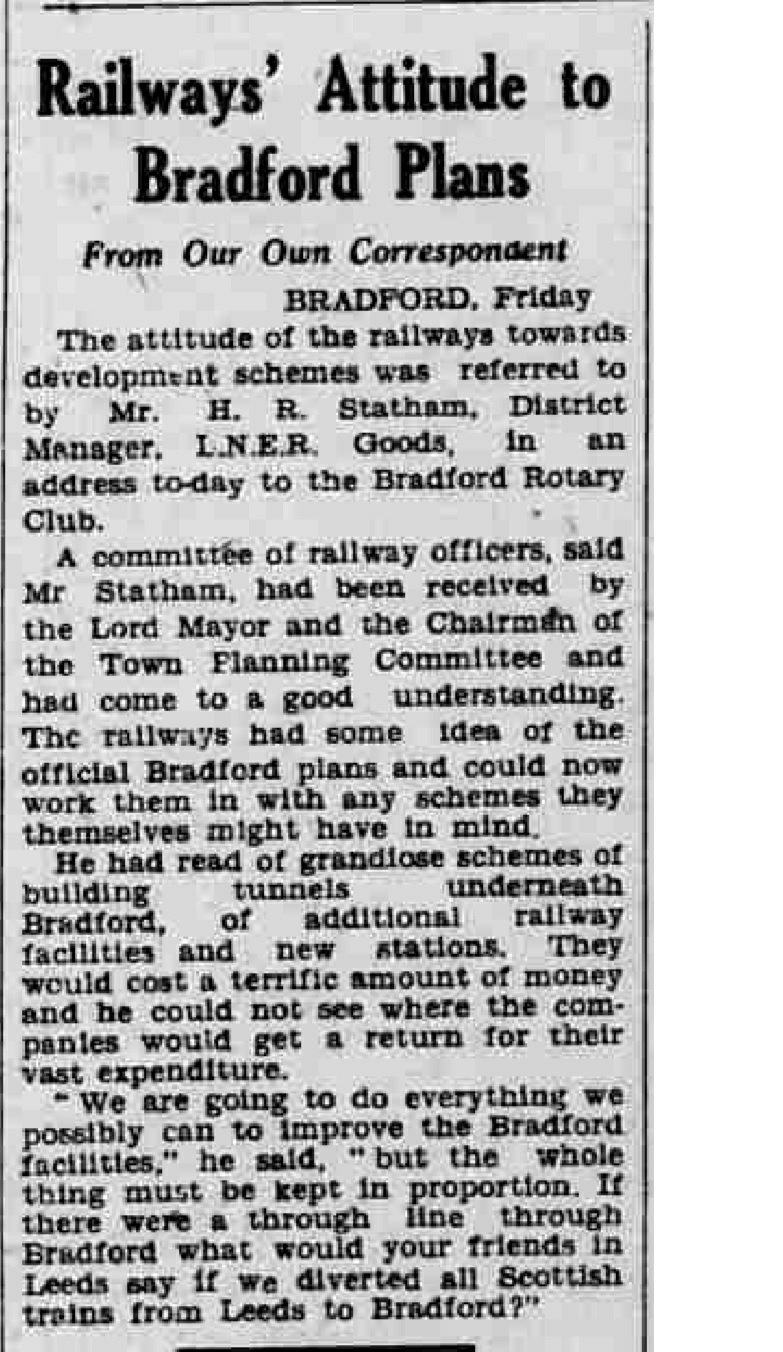
The 1947 scheme involved a tunnel from Birksland Street (LNER) to Manningham Station (LMS), the scrapping of Forster Square and the building of a new station near the Exchange. Once more it came to nothing and it was claimed that impending railway nationalisation represented a stumbling block to discussions. Another ongoing theme in the wider discussion about Bradford’s needs was the competing interests of Leeds and its own lobbying for preferential treatment in the allocation of funds.

There is no mention of  joining the Exchange and Forster Square stations in either the Centenary History of Bradford published in 1947 (that gave coverage to Wardley’s plans for the redevelopment of Bradford) nor in the Bradford Development Plan that was approved by the Ministry of Housing & Local Government that was published in 1953. Instead the emphasis was upon developing the city’s road network, and in particular a new central radial road. The plan concluded that ‘the principal problem to be solved is the improvement of the city’s main terminal buildings and station amenities and the convenient linking of the principal goods depots to the new proposed road system and the proposed Ring Road in particular’. Whilst this likely reflected Wardley’s own bias towards private motor vehicle transport, it was probably also a pragmatic assessment that a through line was unlikely to be achieved. However it also reflected the fact that the existing Bradford rail network was not going to be able to serve new residential suburbs and hence the prioritisation of road networks that would also serve the needs of local industry through better access to goods depots. 

Hence, despite the ambition of the Bradford Development Plan to modernise the urban landscape there was no consideration of how Bradford’s rail links could be transformed nor any evaluation of developing a light rail network within the district. In that era the railways of Bradford primarily served freight as opposed to passenger traffic and the intention was to develop public transport through the bus network and new bus stations. Any talk of a through rail line was then put to rest until around twenty years ago when the planned redevelopment of Broadway and demolition of buildings in Forster Square led to discussion about the feasibility of joining the city’s two stations. How seriously this was taken by local government is questionable, short of saying that also came to nothing.

Just over 70 years later we have speculation that Bradford could yet have a through line, championed by Transport for the North in January, 2018. Although no plans (and ominously no costings) have been released there appear to be two generic options. The first would be an upgraded station bypassing the city centre, presumably at Low Moor and the second would be a line through the centre of the city. Nonetheless, the city centre route would not involve a link between the Forster Square and Interchange stations and hence does not represent the long sought after north-south ‘through-line’. Instead it would be better described as bringing the east-west Lancashire & Yorkshire route northwards to run through the city centre.

An iconic city centre station could be built close to the site of the old Adolphus Street station near Wakefield Road – opened in 1854 but closed to passengers as long ago as 1867 and to freight in 1972 – but the option is likely to be prohibitively expensive and difficult to construct. The parkway alternative at Low Moor would be much cheaper and meet the declared aim of providing Bradford with a high speed connection albeit involving a shuttle into the centre. The Parkway choice however would be unlikely to achieve regeneration objectives for the centre of Bradford. We hold our breath.

The saga of a through line impacted on the urban development of Bradford and delayed its modernisation. Unlike most other large English towns and cities at the end of the nineteenth century, there remained considerable uncertainty in Bradford about the configuration of its railway connections. Elsewhere this had been resolved at least thirty years before. The uncertainty, in conjunction with depressed trading conditions and a collapse in land prices after 1874, impacted on property speculation in Bradford. This resulted in various sites remaining undeveloped or unoccupied in the midst of surrounding construction.

The railway companies were themselves big land-owners and in 1874 the Midland had committed to a programme of compulsory purchase to secure land for its own expansion – the origins of the Midland’s ownership of Valley Parade. For sports clubs this uncertainty created doubts about security of tenure – the case of Four Lane Ends being the prime example. Similarly, doubts remained in respect of the Valley Parade site until the Midland confirmed in 1907 that it would not be used for railway purposes. But where there was doubt there was also opportunity. In 1872 the newly formed Girlington Cricket Club took advantage of the vacant field at the bottom of Whetley Lane set aside for a possible station – later the home of Manningham CC between 1878 and 1895. Similarly, Manningham FC was another tenant of the Midland Railway, occupying the Valley Parade site which the company had previously intended for a warehouse in the 1870s. The land had remained undeveloped and the collapse of the Central Railway scheme in 1884 made railway development less likely; this meant that the site was vacant when Manningham FC needed to relocate from Carlisle Road in 1886.

When you consider how little has survived, the scope of railway speculation in Bradford in the second half of the nineteenth century is all the more astounding. The fact that Bradford has two stations, each of them on a siding does not do justice to the original intent to develop a cross-town, main line link. Difficulty was caused by the topography but competition between the railway companies proved to be a disadvantage in terms of the final outcome. The Victorian inheritance remained until the 1960s and it was the Beeching Reports of 1963 and 1965 that shaped the restructuring of Britain’s railways and the rationalisation of lines around Bradford. Similarly the Norman Chester Report of 1968 recommended merger of the two Bradford Football League clubs but in this case rationalisation came from the financial failure of Bradford (Park Avenue) AFC.

A Network Rail map (2018) would have us believe that Bradford had a cross-town line…

Despite the demand and need for a central station it never happened. Two stations. Two football clubs. By 1974 Bradford Exchange Station was being demolished, Park Avenue was abandoned and both Forster Square station and Valley Parade were derelict and forlorn. The symmetry is striking and had as much to do with the geography of Bradford as the competition between the respective organisations. Unfortunately, in both cases it left Bradford on a siding.

By John Dewhirst

Refer also:

The origins of Valley Parade and Midland Road

When Thomas the Tank Engine tried to cross Bradford and crashed down an embankment

From my book ROOM AT THE TOP, Bantamspast 2016 which also includes images / maps relating to the c19th railway network in Bradford and plans for its development.

If anyone wishes to reproduce this text the author expects due credit to be given for his research. Tweets: @jpdewhirst or @woolcityrivals

This feature on VINCIT explains the influence of Bradford’s railways in the nineteenth century on the development of sport in the town.

You can find links to features I have written about the history of Bradford sport as well as book reviews from the drop down menu above.

Post Script: It wasn’t just ambitious plans for a cross-town railway line in Bradford that never happened. This from 1960…

bfd heliport 1960

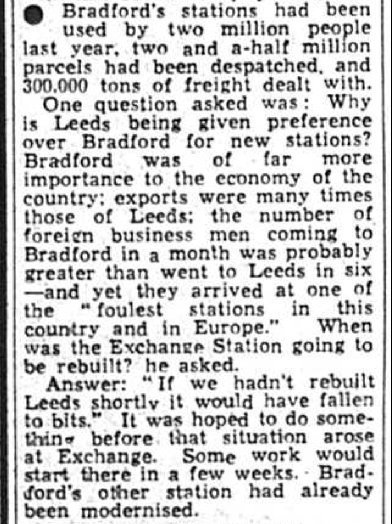
From the same year, complaints about under-investment in Bradford’s stations which remains a topical theme…
[1] In November 2021 it was announced that HM Govt had dismissed the proposals of Transport for the North in respect of a new Bradford station and a West / East mainline through connection. My observations about that decision.
About this blog

On this site you will find my features published in the Bradford City AFC programme, 2017/18 and links to articles I have written for other websites.

This blog provides background about my books which have been published in the BANTAMSPAST History Revisited series. I am currently working on my final volume Fall from the Top  which has a working title of Wool City Rivals and examines the rivalry of Bradford City AFC and Bradford Park Avenue AFC in the twentieth century. This builds on my study of the rivalry of the predecessor clubs, Manningham FC and Bradford FC in the nineteenth century.

My interest is principally (association) football and I have an extensive collection of soccer memorabilia. However, notwithstanding that I have no patience for the game itself, I confess that I have found the history of nineteenth century rugby football particularly fascinating…

The following are articles that I have written which are published on VINCIT, an online journal of Bradford Sport History:   http://www.bradfordsporthistory.wordpress.com

The significance of sport in shaping a Bradford identity https://bradfordsporthistory.wordpress.com/2017/07/16/a-tale-of-two-cities-the-significance-of-sport-in-the-bradford-identity/

History of the Bradford Charity Cup: https://bradfordsporthistory.wordpress.com/2017/04/21/the-forgotten-pot-the-story-of-the-bradford-charity-cup/

Compendium of Bradford sports club names  https://bradfordsporthistory.wordpress.com/2017/11/24/compendium-of-bradford-sports-club-names-2/

The late development of soccer in Bradford https://bradfordsporthistory.wordpress.com/2017/09/23/the-late-development-of-soccer-in-bradford/

Bradford sporting identity  https://bradfordsporthistory.wordpress.com/2017/07/16/a-tale-of-two-cities-the-significance-of-sport-in-the-bradford-identity/

What’s in a name? Semantics about Bradford City and Park Avenue  https://bradfordsporthistory.wordpress.com/2017/07/01/whats-in-a-name/

John Nunn, Bradford physical aesthete: https://bradfordsporthistory.wordpress.com/2017/03/31/jack-nunn-and-physical-aesthetics-in-bradford/

150th anniversary of football in Bradford: https://bradfordsporthistory.wordpress.com/2016/12/30/455/

The history of Bradford rugby and the case to reassess the split in English rugby in 1895: https://bradfordsporthistory.wordpress.com/2016/12/22/262/ My findings from investigation of the origins and development of Bradford football provide sufficient evidence to challenge the orthodox view that the split in English rugby was driven by social class as opposed to the economics of sport.

Bradford’s rugby heritage  https://bradfordsporthistory.wordpress.com/2016/09/21/recognition-of-bradfords-rugby-heritage/

Further articles are planned for publication including the background to junior rugby clubs in Bradford, their mushrooming and subsequent disappearance in the final decade of the nineteenth century.

Other articles by myself published on Playing Pasts…

The case of Bradford FC and the origins of football as a business:  https://www.playingpasts.co.uk/articles/football/another-origins-debate-part-one/

The origins of professional football in Bradford: http://www.playingpasts.co.uk/articles/football/the-origins-of-professional-football-in-bradford/

Reconsidering 1895 – a Bradford perspective: http://www.playingpasts.co.uk/articles/team-sports/rethinking-1895-a-bradford-perspective/


Published on the World Rugby Museum website:
Bradford’s contribution to rugby history https://worldrugbymuseumblog.wordpress.com/2016/10/31/how-the-city-of-bradford-helped-shape-the-early-history-of-rugby-football/


I am interested to hear from anyone with artefacts that could be featured in WOOL CITY RIVALS. I am happy to assist others studying the origins of football in the UK and provide comparative information about what happened in Bradford.

When the Corinthians came to Bradford

My feature in the BCAFC match day programme from 30th December, 2017 (Oxford United, League One)

One of the most prestigious fixtures in the history of Bradford soccer took place on this day in 1897 when the Corinthians visited Park Avenue to play Bradford AFC in an exhibition friendly game.

By this stage English football was dominated by northern professional clubs and the Football League was already in its ninth season. Nevertheless the Corinthians club was still considered one of the leading sides and although it never competed in the FA Cup on grounds on principle, could boast a number of celebrated victories over professional sides. Its players were regularly selected for England and during the 1880s the majority of England players were Corinthians. Even in 1897 the team that played Bradford AFC included three internationals.

Formed in 1882 the Corinthians had a strong amateur ethos with talk of the ‘Corinthian spirit’. Although based in London the club organised tours much in the same way as the Barbarians rugby club who had been frequent visitors to Park Avenue prior to the secession of Bradford FC from the Rugby Union in 1895.

Bradford AFC was the soccer section of the Bradford Cricket, Athletic & Football Club whose principal sport remained that of rugby as members of the Northern Union (forerunner to the Rugby League). The section had been established in 1895 when the parent club looked to soccer as a possible contingency option in the midst of the uncertainty surrounding the split in English rugby.

During 1897/98 Bradford AFC finished second to bottom of the ten strong inaugural Yorkshire League and was defeated in the first qualifying round of the FA Cup. Its league rivals included local West Yorkshire sides from Hunslet, Halifax, Huddersfield and Leeds (the last three also sponsored by the respective rugby clubs) as well as the reserve teams of five South Yorkshire clubs: Sheffield United, The Wednesday, Doncaster Rovers, Mexborough and Barnsley St Peters. The West Yorkshire clubs were very much the weaker and the standard of the Bradford team was poor as judged by its league position that season. Average crowds were unlikely to have exceeded one thousand

The match with the Corinthians was considered a means of promoting soccer in the district as well as providing competitive experience for the Bradford players. However, neither the 1-6 result nor the attendance of only five hundred was particularly encouraging. With regards the gate, it probably didn’t help that the game was staged on a Thursday afternoon but it was symptomatic of the lukewarm attitude towards soccer at Park Avenue that the fixture was not afforded a prime date in the calendar. Enthusiasm within the BCA&FC for the rival football code was on the wane and in 1899 funding support for the loss-making soccer section was finally abandoned which led to the dissolution of Bradford AFC.

The visit to Bradford of the Corinthians in December, 1897 was not the only one made by the club. During the 1903/04 season attempts were made by the committee of the newly formed Bradford City to secure a fixture at Valley Parade. Whilst this proved impossible, the Corinthians came to Manningham in February, 1932 and a crowd of 4,662 witnessed a 1-0 home victory. It was however the last occasion and in 1939 the Corinthians disappeared, merging with the Casuals to become the Corinthian-Casuals club.

  • Read more about the early history of Bradford soccer in my books ROOM AT THE TOP and LIFE AT THE TOP.
    • Thanks for visiting my blog. Apart from publishing my BCAFC programme articles I also upload occasional articles of historical interest and next month will be publishing a feature on the various schemes that have been proposed for a cross-Bradford rail link – a topical theme given the possibility that such a scheme could be revived as part of the northern high-speed rail project.
    • Scroll down for details about my books in the BANTAMSPAST History Revisited series which tell the history of sport in Bradford – and in particular football. The books seek to explain why things happened as they did instead of simply recording what occurred and readers may be surprised at the extent to which they contradict many of the myths and superficial narratives that have circulated previously. You won’t get fancy art school graphics but you will find substance and historical accuracy in the content. Of course if you prefer an abundance of pictures accompanied by text written for a Year 5 schoolchild you’ll find them ball-achingly boring. Tweets @jpdewhirst

    If you are interested in Bradford sport history visit VINCIT: https://www.bradfordsporthistory.com

PS Happy new year!

Along the Midland Road

My programme article from the League One fixture, BCAFC v Peterborough United on 26 December, 2017

Happy Birthday, 21 today. I have no excuse to forget when the current Midland Road stand at Valley Parade was opened because it was the day that my eldest daughter, Sarah was born. A fixture with Sheffield United on Boxing Day, 1996 marked the occasion, for the record a 1-2 defeat and a 7lb 3oz bouncing baby. Her morning arrival allowed me to attend the game and I’ve had a season ticket in the stand ever since.

For the best part of fifty years Valley Parade had lacked a respectable grandstand on the lower side of the ground but you need only walk down Holy Well Ash Lane to appreciate the challenge of constructing a grandstand on such a slope. Little wonder that for so long the club could simply not afford such a project.

When the ground was opened in 1886, the east side of Valley Parade along the Midland Road was nothing more than a narrow, uncovered (and undeveloped) strip alongside the pitch that accommodated spectators, maybe half a dozen deep. Behind them was a steep earth slope with a winding pathway down to Midland Road street level which must have been a safety risk when people left the ground. On Christmas Day, 1888 there was a fatality when a boy sitting pitch side in front of a picket fence was crushed when the touchline fence timbers gave way to the weight of the crowd. (Concerns about public safety could well have been one of the reasons why Manningham FC was not afforded many prestige fixtures by the Northern Union between 1895-1903.)

Following election to the Football League in 1903, a fifteen foot high pitch length advertising hoarding was erected along the Midland Road side and surviving film of the club’s first fixture against Gainsborough Trinity in September, 1903 shows people sat atop to gain optimal vantage of the game. The hoarding at least filled the void and helped disguise the fact that Valley Parade was relatively under-developed. Indeed, it was not uncommon for there to be unfavourable comparisons made with the facilities at Park Avenue. The main stand on South Parade for example was not covered until January, 1904 and not covered for its full length until November, 1907.

Plans for a new stand on the Midland Road side were announced in May, 1908, designed by the pre-eminent football grounds architect Archibald Leitch. Constructed from ferro-concrete, it was not fully ready until Christmas Day, 1908 for the game against Bristol City that was attended by a reported thirty-six thousand. The stand was originally intended to be seated with a capacity of four thousand but instead it was terraced so that double the number could be accommodated.

The elevated position of the grandstand made it vulnerable to gale damage and in January, 1928 a sixty foot section of the roof was blown off landing on Midland Road and the railway embankment. Surprisingly perhaps, in 1907 the club had considered the erection of two cantilever stands on either side of the pitch that would have been even more exposed.

In the wake of the Burden Park disaster in March, 1947 where 33 people had been crushed to death there was the introduction of more stringent safety requirements and scrutiny by local authorities who assumed responsibility for licencing football stadia. Urban legend has it that Avenue sympathisers within Bradford Corporation were responsible for an adverse rating of the Midland Road stand but this is another of the myths that have existed about Bradford football, favoured as superficial soundbites and propagated on the internet. There was no basis to conspiracy theory, you only have to consider the potential safety risks that then existed from the single steep exit to the road below. What conspired against the stand was the cost of repairs that the club could not afford and in the end it became more cost effective to close it.

At first the stand was partially closed and then in 1952 it was finally demolished. For most of two decades, Valley Parade was essentially a three-sided ground. The cost of developing a replacement stand was prohibitive and the absence of suitable foundations made it a challenging proposition. Between 1954-62 and then from 1968-96 there was a shallow covered shelter where people could stand around half a dozen deep. Latterly the roof was used for a TV gantry and cameramen were accommodated in a garden shed structure. It was also the practice for a volunteer to stand on the roof as a look out in cases where a ball was kicked over to assist its retrieval.

When the new stand opened 21 years ago it came to signify the ambition of then chairman Geoffrey Richmond and it was truly a landmark event for the Midland Road to again have a self-respecting structure. Even more astonishing was that within five years, it would be overshadowed by the redevelopment of the Kop and Main Stand.

Read more about the origins of Valley Parade in my books ROOM AT THE TOP and LIFE AT THE TOP.

  • Thanks for visiting my blog. Scroll down for details about my books in the BANTAMSPAST History Revisited series which tell the history of sport in Bradford – and in particular football. The books seek to explain why things happened as they did instead of simply recording what occurred and readers may be surprised at the extent to which they contradict many of the myths and superficial narratives that have circulated previously. You won’t get fancy art school graphics but you will find substance and historical accuracy in the content. Of course if you prefer an abundance of pictures accompanied by text written for a Year 5 schoolchild you’ll find them ball-achingly boring. Tweets @jpdewhirst

If you are interested in Bradford sport history visit VINCIT: https://www.bradfordsporthistory.com

The Boar’s Head identity

My previous article about Bradford City’s ‘bantam’ identity in the BCAFC match programme has prompted feedback about the club’s earlier boar’s head identity…

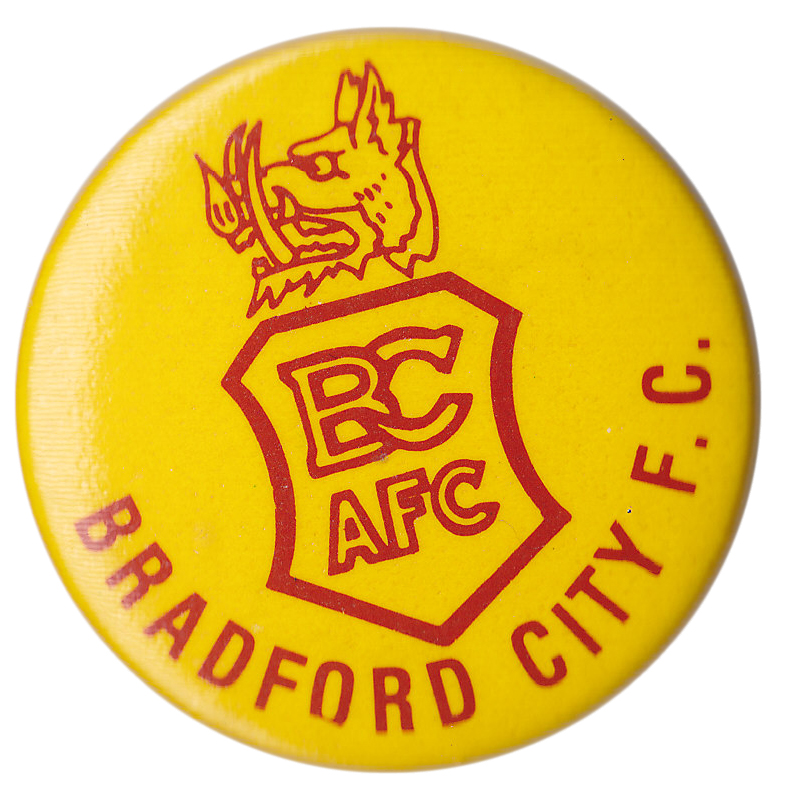
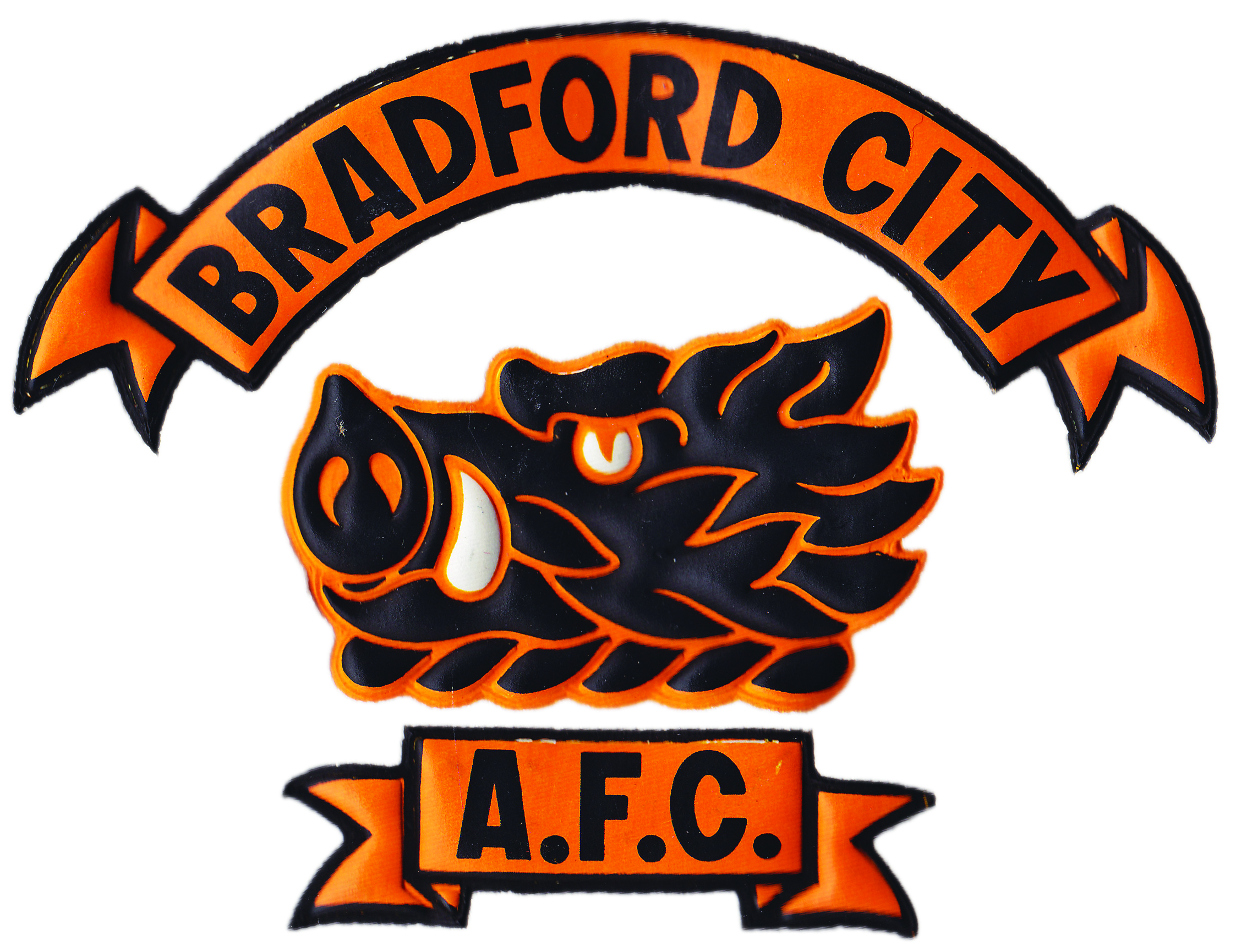
The (tongueless) boar’s head is derived from the old coat of arms of the city of Bradford – the one worn on the shirts of the 1911 FA Cup winning team. A boar’s head badge with BC-AFC monogram was adopted by Bradford City AFC as a club crest between 1968-74 and then 1985-91. (NB Chairman Stafford Heginbotham had introduced this design in 1968 and sponsored its return after the 1983 insolvency, initially adopted as blazer badges for club officials in 1984 and then used in club merchandise and printed matter.)

Scan_20200422 (61)

This blog provides some background to the Bradford civic crest and personal thoughts about how it could be revived as a sporting identity shared by all clubs of the district, irrespective of code or status.

bc1986 button

The boar’s head badge was essentially a civic identity and a statement of civic patriotism whereas the bantam identity signified a state of mind or attitude (and as I explained previously, was introduced for motivational purposes). To that extent the boar’s head and the bantam are entirely compatible.

boars head 1990 shirt badge.jpg

The following provides detail about Bradford’s coat of arms and is taken from my book A HISTORY OF BCAFC IN OBJECTS.

The Bradford coat of arms, 1908-74

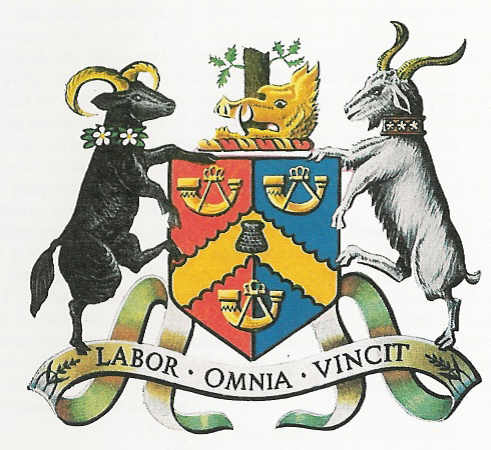
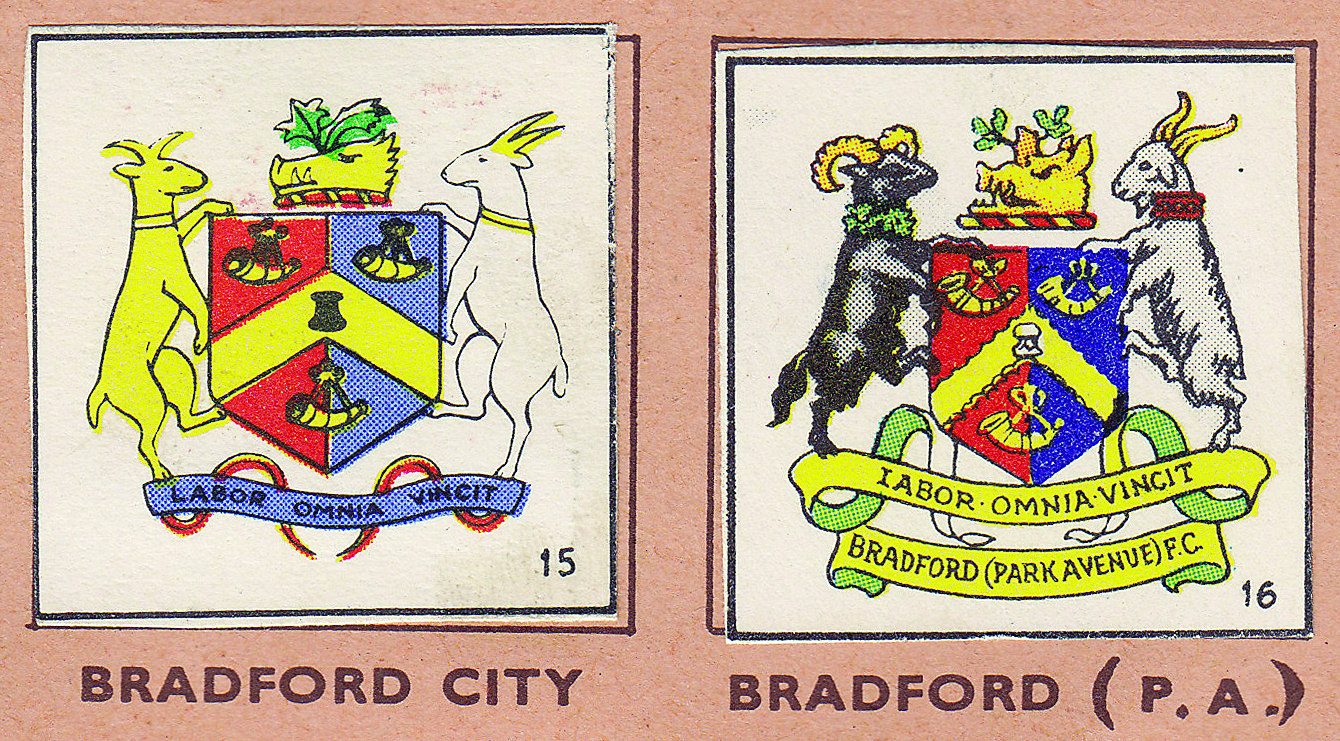
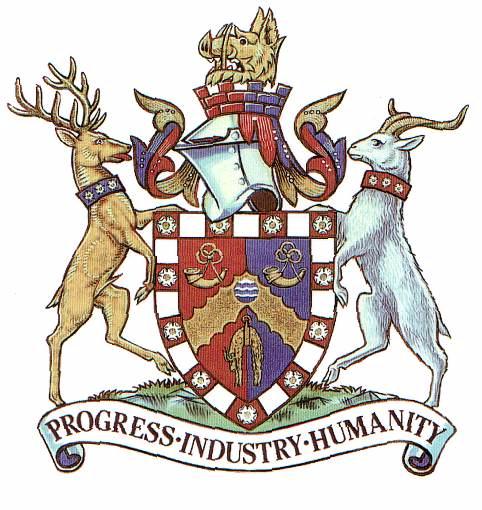
The City of Bradford was awarded a coat of arms on 31st December, 1907 (albeit ten years after Bradford had been granted city status) and this was embraced by most local institutions. It became commonplace in the city, most visibly on the side of trams and buses. The ram and the angora goat signified the textile industry.

The original city of Bradford coat of arms as granted to the city in 1907.

The Bradford shield, 1847-1908

Bradford shield

Prior to 1908 the ‘badge’ of Bradford was the (tongueless) boar’s head and Bradford shield (without the ram or goat), the shorthand of which was the boar’s head. Despite the new coat of arms (above) the Bradford shield with boar’s head continued to be used, probably because the design was easier to apply but also well recognised.

In an article in The Bradford Antiquary in 1895, William Cudworth describes how the Bradford arms were derived from the Bradford family who settled at Warmfield, Heath, and Stanley near Wakefield but who had owned land in Bradford in the sixteenth century. The original Bradford shield dates from 1847 when Bradford was a county borough. On the shield are three hunting horns.

  • The Bugles

The bugles recall the traditional custom of blowing the horn on St. Martin’s day in the forenoon in the Market Place at Bradford. This commemorates part of the service in which the manor of Bradford was granted by John of Gaunt, the Earl of Lancaster, to John Northrop of Manningham.

  • The Well

The well in the middle of the shield is attributed to signify either the Bradford Beck or Boar’s Well.

  • The Boar’s head

The boar’s head refers to a 14th century legend about a dangerous boar which drank from a well in Cliffe Wood that terrorised the local population. The reward of a piece of land was offered by John of Gaunt to anyone who killed the boar. A hunter killed the animal but the carcass was too heavy to carry so he cut out the tongue as proof to claim the reward. However someone else found the body, cut off the head, and took that as evidence of his kill. The second person tried to claim the bounty first but the arrival of the original hunter with the tongue ensured that the rightful person got the prize.

  • Branch and leaves

The branch and leaves that accompany the boar’s head represent Cliffe Wood. As an aside, the location of Boar’s Well in Cliffe Wood (off Bolton Road) is visible from the main stand at Valley Parade.

The motto

According to The Bradford & Wakefield Observer; and Halifax, Huddersfield, and Keighley Reporter in October, 1847 at the time of incorporation the original motto of Bradford was intended to be ‘perseverantia vincit‘. However, the Heralds’ Office could not allow this as it was associated with the Bradford family from Arksey, near Doncaster and hence the alternative, ‘labor omnia vincit’.

The motto, ‘labor omnia vincit‘ – ‘hardwork overcomes all‘ came to symbolise a Bradford mindset in all aspects of life, sport included.

The significance of the Bradford identity

20190511_1145186144019250477243403.jpg

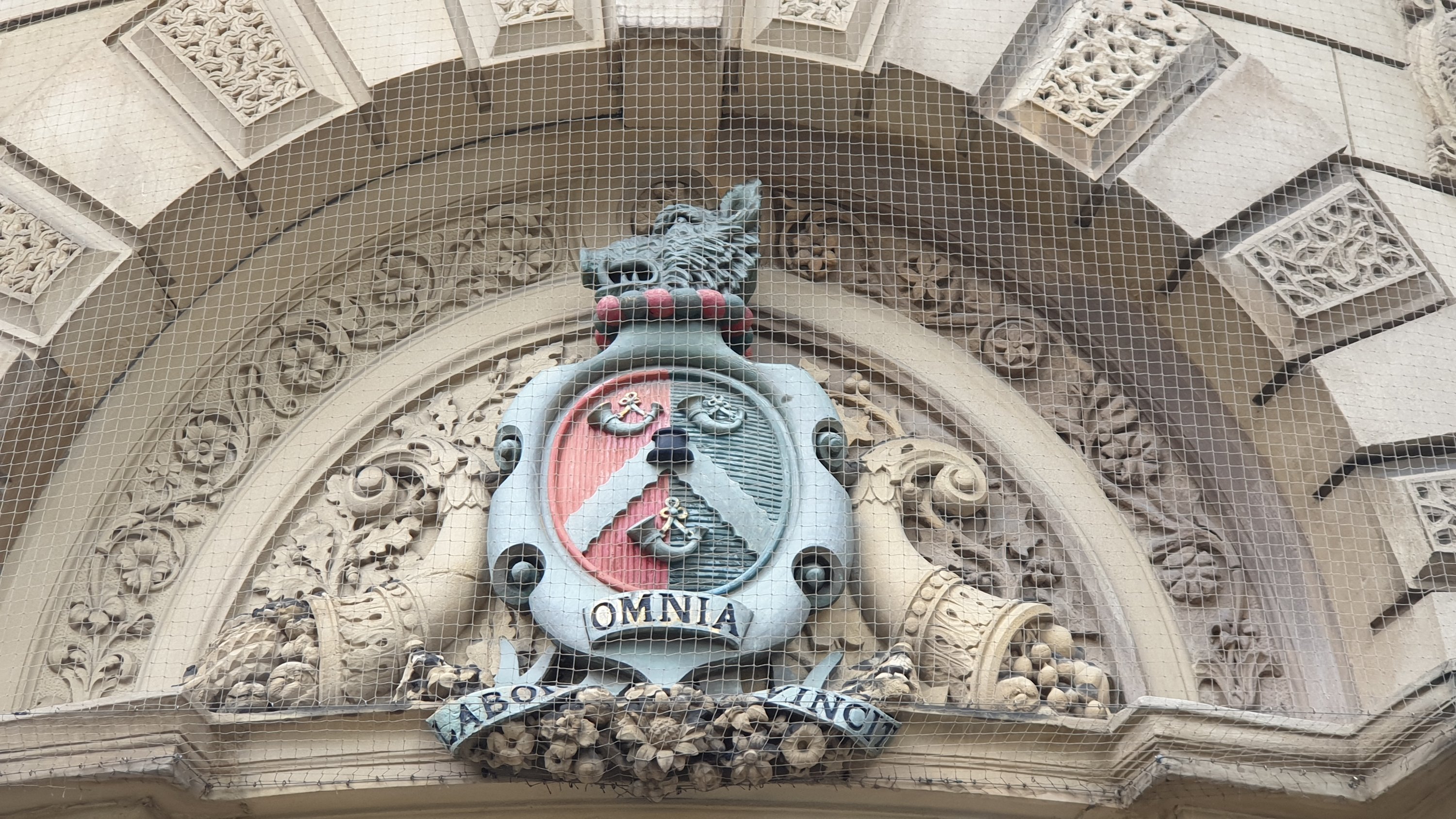
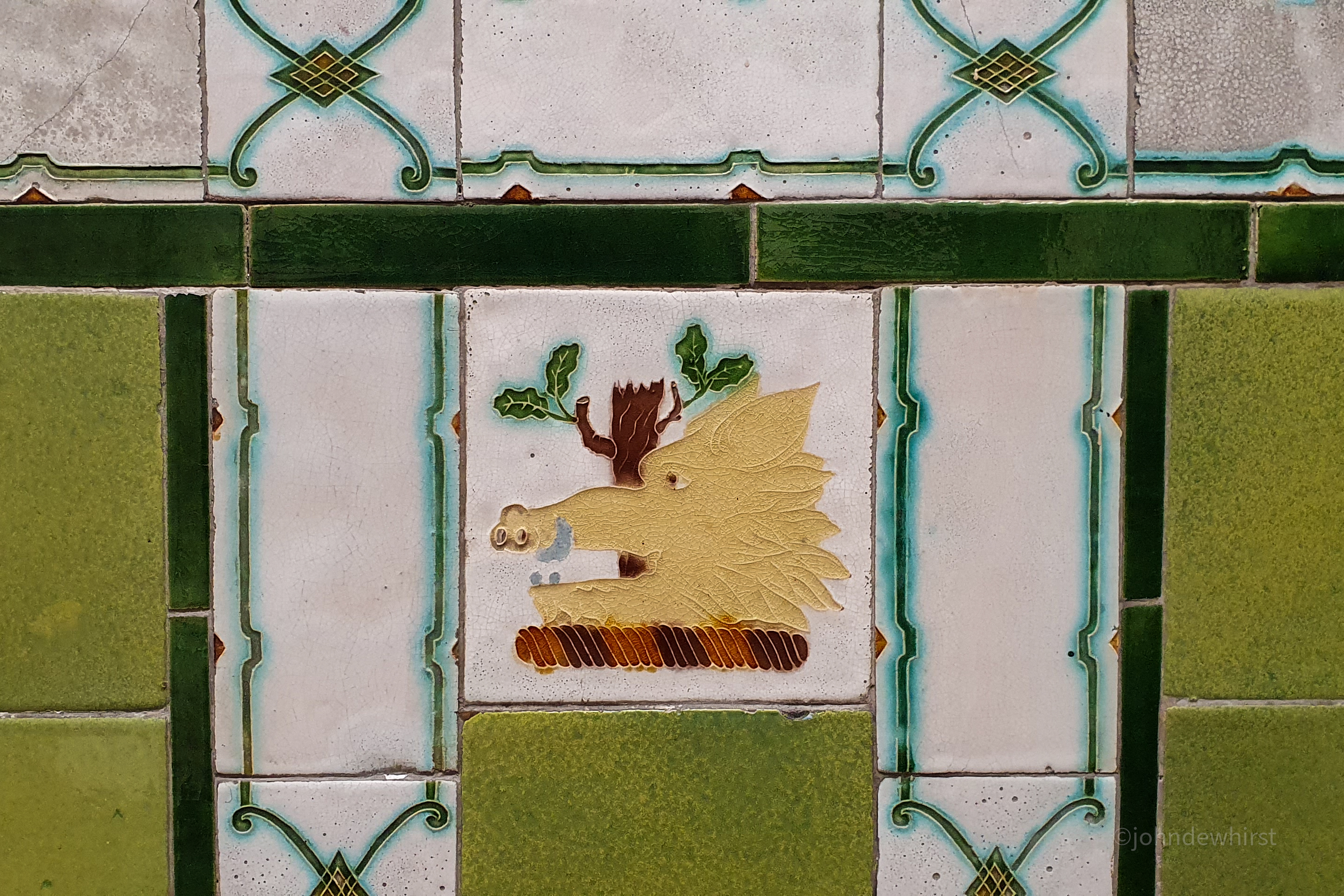
Evidence of this original Bradford identity dating from 1847 abound on surviving Victorian and Edwardian buildings in the city. The shield was instantly recognisable as being ‘of Bradford’ and its application can be seen across different areas of civic life. The boar’s head motif has been applied in the same way. I sense that they had considerable psychological value to Bradford given the circumstances of its rapid growth in the nineteenth century. For example rapid industrialisation had been associated with mass immigration and also dirty working conditions. They provided a degree of respectability whilst also fostering a common identity. I question whether this offers a lesson for today?

In the sporting world the Bradford shield was embraced by Bradford’s sporting clubs who were effectively ambassadors of the town/city. The provincial rivalry of northern towns extended beyond civic themes to the sports field and the Bradford shield was thus an expression of identity.

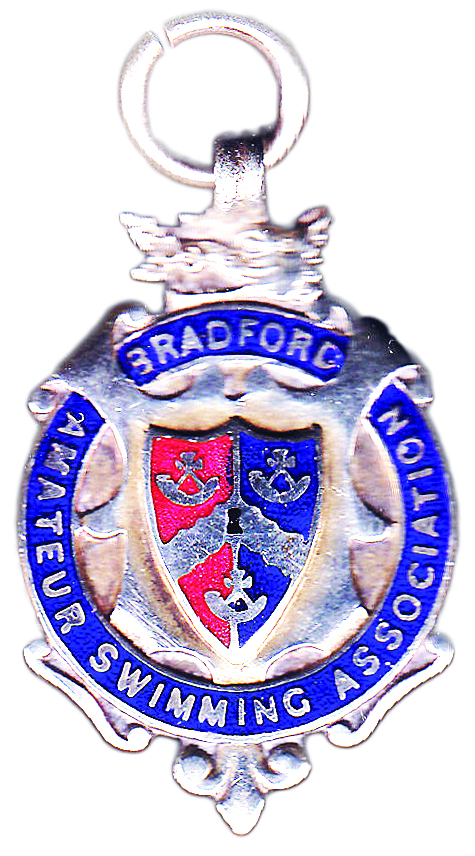
swimming

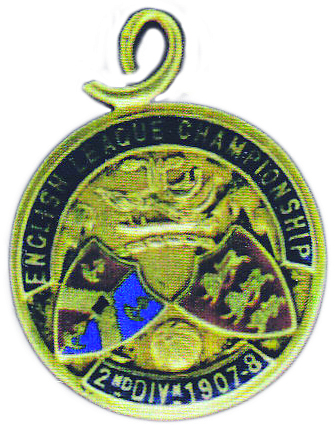
Enamel badges and medals with the Bradford shield were manufactured in considerable numbers by Messrs Fattorini of Bradford. Examples included the medals presented to the players of BCAFC’s successful League Division Two championship side of 1907/08. The application of a civic crest to a football medal was not unique, for example medals presented to the Everton players who were League champions in 1914/15 carried the ‘Liver’ bird of Liverpool.

1908 (1).jpg

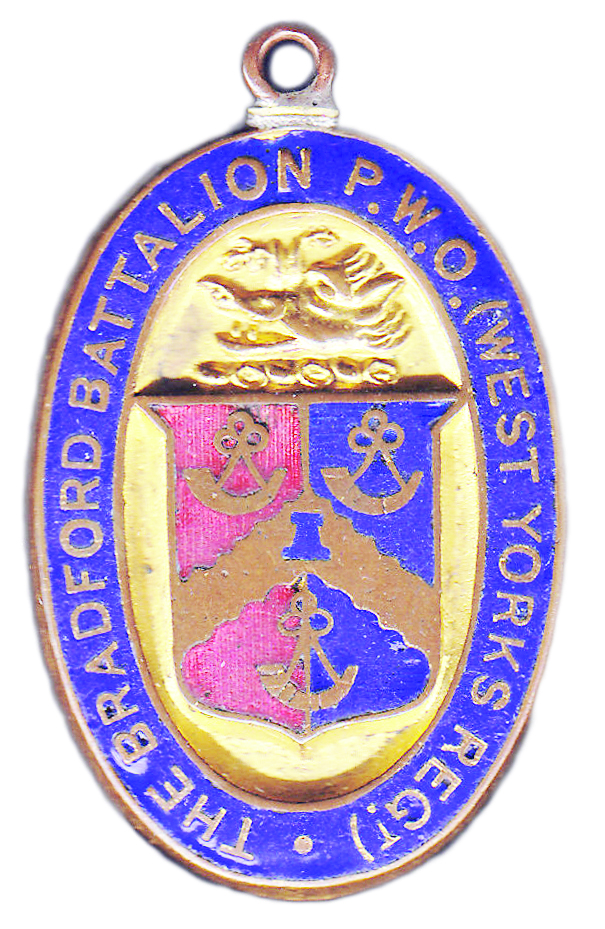
The Bradford shield and boar’s head was ominpresent. Just about every badge of every historic Bradford club / society / organisation adopted it, one of the best examples of which being the Bradford Pals in World War One.

west_yorks_btn.jpg

Could the civic identity be re-adopted by Bradford City AFC?

In recent years civic identities have been restored and actively incorporated in club crests; in that regard clubs as diverse as Wolverhampton Wanderers, Bristol City and Luton Town come to mind. However the original city of Bradford coat of arms was abandoned on April Fools’ Day 1974 with the introduction of the metropolitan district authority and the subsequent arms now incorporate identities from Keighley, Baildon, Bingley, Silsden, Queensbury and Shelf.

The obvious question therefore is that if BCAFC was to re-adopt a Bradford civic crest should it be the original December, 1907 version or the current? The traditionalist in me favours the former but the club can hardly encourage a retreat to the original city of Bradford boundaries given that a high proportion of its supporters live beyond them.

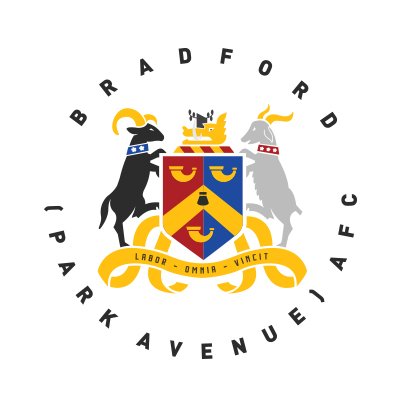
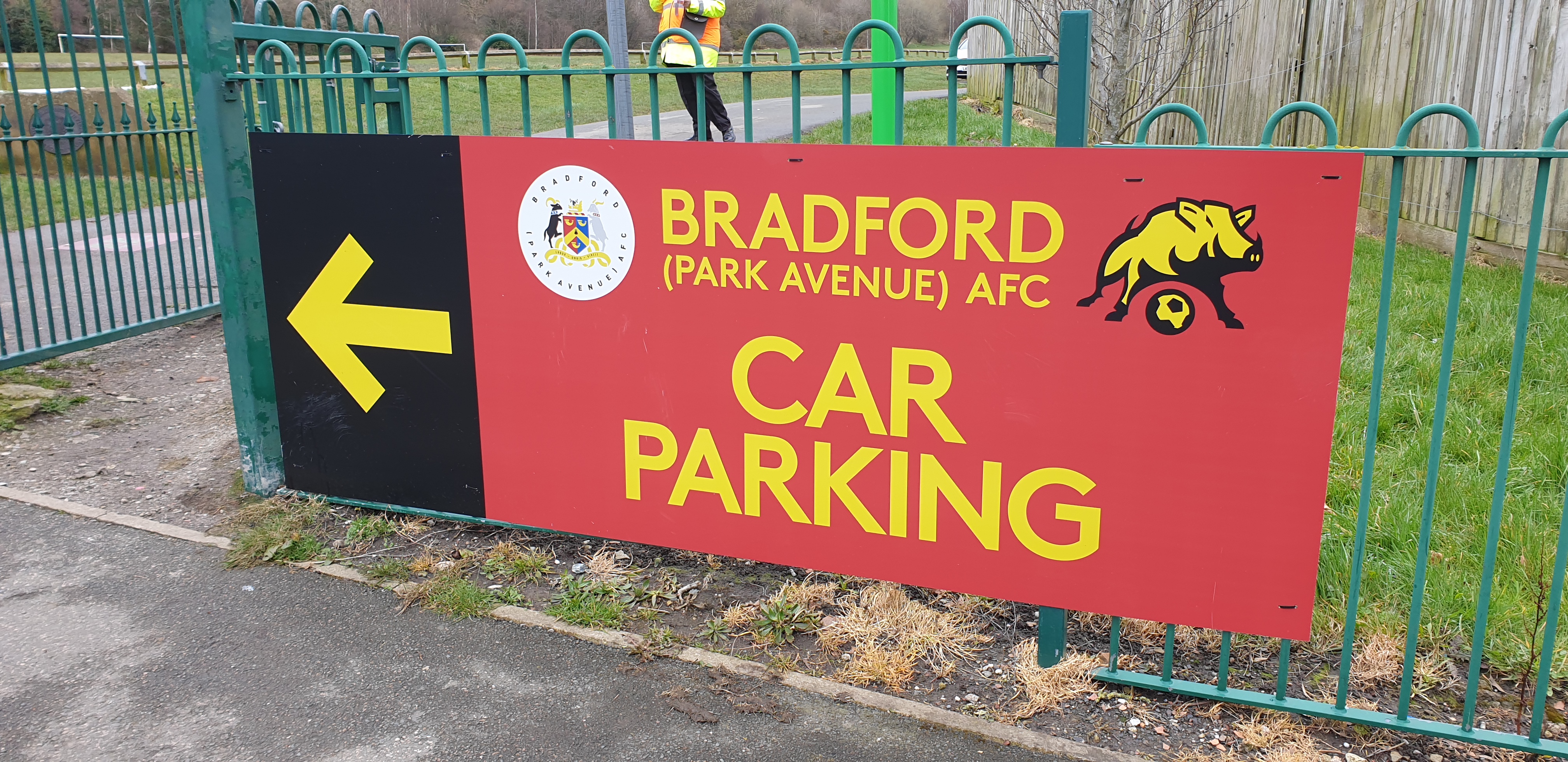
In 1988 the reformed Bradford Park Avenue revived the old civic arms as its badge. Ironically the original club had been liquidated in 1974, coincidentally the same year as the old coat of arms was abandoned. Yet whilst a critic could claim that this is anachronistic, the manner in which the identity is now being applied is anything but. In 2019 the club introduced a new version of the crest based on a new digital reworking consistent with the traditional dimensions. Few will argue otherwise that it looks good (compare to the original below).

Bradford Park Avenue has wholeheartedly embraced the traditional Bradford identity as part of a wider initiative to promote community sporting engagement. The totem is being promoted as part of its #onebradford campaign and there is a good chance that this will encourage further application of the boar’s head motif.

tiger badges hires.jpg

I am not convinced that the current Bradford District coat of arms (below) would offer an inspiring option for a new club crest. The most obvious civic identity that has been unchanged since 1974 is the boar’s head and I consider it a shame that it wasn’t kept as a club logo (being displaced in 1991). There is surely no reason why the club couldn’t have a formal civic crest but retain the ‘bantams’ identity as a shirt badge for instance.

Bradford

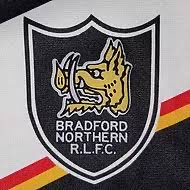
The design of the boar’s head in the civic crest introduced in the first half of the 1980s (as above) was adopted first by Bradford Northern (below) and then by Bradford City in 1985 (refer to button badge at top of page).

Bfd Northern

NB In 2017 Bradford Met Council itself undertook a digital reworking to simplify the lines of the current civic crest, the simplified version as below.

wordpress-post-simplified-logo1 BMDC 2017.png

A common Bradford sporting identity to drive regeneration

If sporting failure undermined self-belief and self-respect in Bradford in the second half of the last century, since the late 1990s we have seen glimpses of the potential that sport has to offer the district – its contribution to a feel-good factor can be gauged by the experience of the last four years at Valley Parade and the mood in the district at the beginning of this century when the Bulls dominated their code. Dare I suggest that sport has also demonstrated its capability to be a social unifier.

Bradford Council has discovered for itself that grandiose regeneration schemes have been singularly unsuccessful and nor is a ‘Greater Leeds’ rebranding exercise going to solve the city’s problems and deliver a magic solution. Crucially there has been no initiative to encourage a sense of pride and belonging. Anyone serious about trying to revive the Bradford brand can do worse than consider the potential of sport to generate a common identity of our own.

Whilst the lead flag bearers would inevitably be Bradford City (and hopefully Bradford Bulls, maybe even Bradford Park Avenue), there is no reason why junior sports teams in the city – from rugby to athletics to cricket – cannot be engaged as ambassadors for Bradford with all concerned wearing a common emblem. Another lesson of history was the enthusiasm with which Bradford clubs and societies at the turn of the twentieth century adopted the Bradford shield and coat of arms as their common identity – a tribute in part to the marketing nous of the Fattorinis who sold countless enamel badges.

Summary

The official crest of Bradford City AFC has traditionally been the coat of arms which was replaced in 1968 by the boar’s head crest. Between 1974-85 and then since 1991 the club’s crest has been of a ‘non-civic’ derivation (officially the bantams 1981-85 and then 1991 to date).

The club’s name – Bradford City – was selected to emphasise its civic roots and the fact that it represented the city of Bradford. A civic crest was thus consistent with this.

A boar’s head signifies being ‘of Bradford’ and is firmly a Bradford identity.

The bantam nickname was adopted to emphasise the state of mind / attitude of the club and its players as a motivational identity.

The club was simultaneously ‘of Bradford’ but also ‘bantams’.

There are other instances with clubs with a strong civic identity alongside a distinctive nickname – for example Newcastle United / Magpies or Bristol City / Robins. For BCAFC to adopt a civic crest alongside the bantam signifies that the club represents Bradford and declares the culture of the club (ie underdog fighters). It is entirely compatible to have a civic crest alongside a nickname identity.

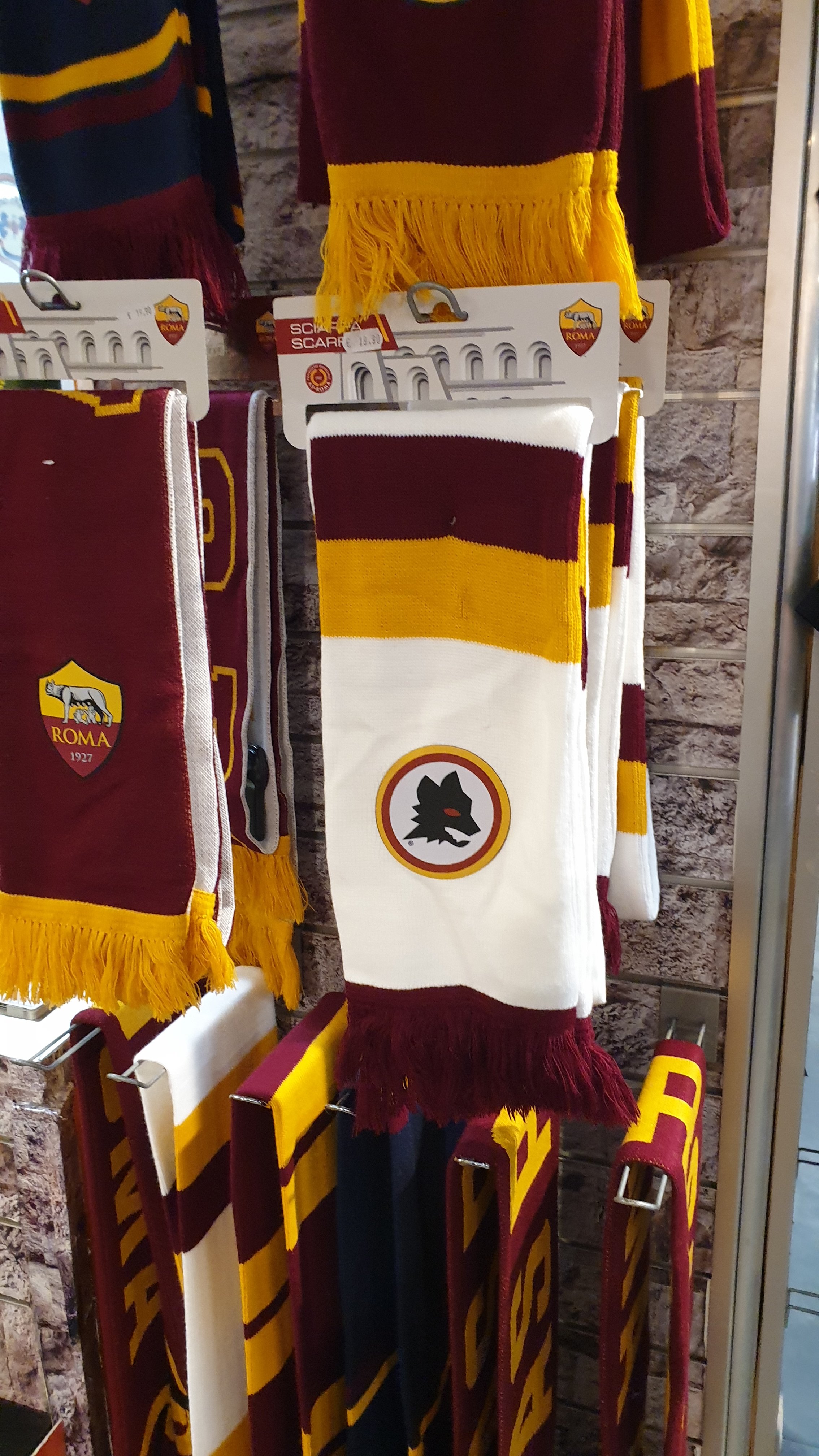
BCAFC could adopt a formal civic crest yet still retain a bantams identity as a shirt badge and/or for merchandising. Such a dual badging approach is far from unique as the claret and amber example of Roma FC demonstrates.

The boar’s head – as a Bradford motif – has wider potential as a shared identity for all Bradford sports clubs and could be encouraged much in the same way as the Manchester bee has been rediscovered to foster a common identity among people living in Manchester. (In terms of regeneration, Bradford’s problem is as much that of identity as image. The boar’s head is a longstanding Bradford identity with strong historical heritage that should not be overlooked or forgotten.)

Manchester has rediscovered its bee, isn’t it time for Bradford to revive its own boar’s head as a common Bradford brand?

Adoption of a boar logo by Bradford Park Avenue in 2019:

20200314_131859

LINK HERE to BBC feature about the boar’s head

By John Dewhirst

(My books ROOM AT THE TOP and LIFE AT THE TOP narrate the origins of sport in Bradford and how sport played a big part in shaping a distinctive Bradford identity before World War One, a phenomenon that I strongly believe has relevance today.

Thanks for visiting my blog. For details about my books in the BANTAMSPAST History Revisited series which tell the history of sport in Bradford – and in particular football visit http://www.bantamspast.net The books seek to explain why things happened as they did instead of simply recording what occurred and readers may be surprised at the extent to which they contradict many of the myths and superficial narratives that have circulated previously. You won’t get fancy art school graphics but you will find substance and historical accuracy in the content. Of course if you prefer an abundance of pictures accompanied by text written for a Year 5 schoolchild you’ll find them ball-achingly boring.

Tweets: @jpdewhirst and @woolcityrivals

Features on the BCAFC identity:

Application of the Bradford civic crest

How Bradford City became known as the Bantams

The ‘bc’ logo of 1974-81

Bantam identity of the 1980s

The BSA Bantam character

The City Gent

Toilet decor in City Hall, Bradford

The origins of the Bradford City nickname, ‘The Bantams’

How and why Bradford City came to be called the Bantams… and why the identity is equally relevant today.

My column in the BCAFC programme v Rochdale, 9 December, 2017:

One of the most common questions asked about the history of Bradford City is how we came to be called ‘The Bantams’. Pictured below, matchday mascot ‘Billy Bantam’.

JPD03816x

If you go back to the nineteenth century, the nicknames ‘Valley Paraders’ and ‘Paraders’ were frequently used in press reports from around 1890 to describe Manningham FC. During the early history of Bradford City the club was variously referred to as ‘The Citizens’ and ‘The Paraders’ but all of this was the product of journalistic licence as opposed to any attempt by the club itself to encourage nicknames.

After promotion to Division One in 1908 it was considered appropriate for the club to follow the fashion among other leading sides and adopt a nickname. The suggestion that the club needed a new good luck charm to replace a lost silver horse-shoe – and that it was the idea of (club director) Tony Fattorini’s daughter – makes it seem that the choice of a bantam identity was almost accidental and arbitrary.

On the contrary it was a calculated branding strategy by Fattorini, one of the leading sporting goods entrepreneurs of his age. The characteristic of bantams as small but fearless fighting creatures suited the self-image of the club and typified its personality. Manningham FC had always considered itself as a challenger to much bigger sides (in particular Bradford FC at Park Avenue) and Bradford City had inherited the same sense of being an underdog. As the club struggled to consolidate in the first division, the notion of bantam fighting spirit was equally motivational for players and supporters alike.

The origins of the ‘bantams’ identity can thus be traced to November, 1908 and the timing at the end of the month came when Bradford City were adrift at the bottom of Division One with only one win out of 13 games. Introduced for the fixture with League leaders, Everton at Valley Parade the bantam identity proved totemic and inspired a recovery: a draw with Everton was followed by two successive victories at the beginning of December.

In the context of the age, a bantam metaphor had a cultural resonance. For a start, bantams were popular show birds and thus well-known at the time as attractive yet fierce birds. People were also familiar with the practice of journalists – and newspaper cartoonists – portraying two competing sports teams as animals in combat. For example I have seen specific instances of local journalists referring to a less-fancied team (particularly in a cup contest) as bantams. And even if the practice had been outlawed since 1835, covert cock-fighting contests still took place. In other words, the symbolism of bantams as underdog fighters would have been understood.

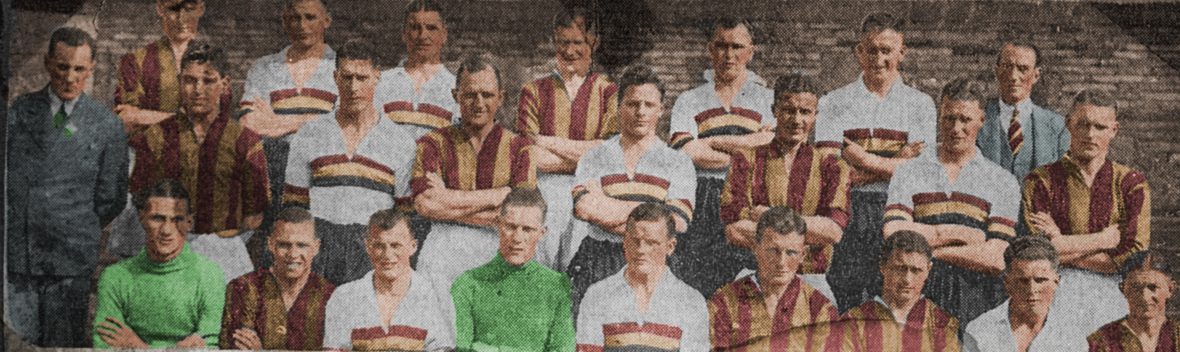
The naming of the club in this way captured the imagination of the City faithful, no less the players who managed to avoid relegation on the last day of the campaign. The following season a new shirt was adopted by the club with a yoke collar said to resemble a bantam’s plumage – the same shirt that was worn when City won the FA Cup in 1911. Nevertheless the club continued to be referred to as the Paraders or the Citizens in newspaper reports with a bantam representing more of a totemic mascot.

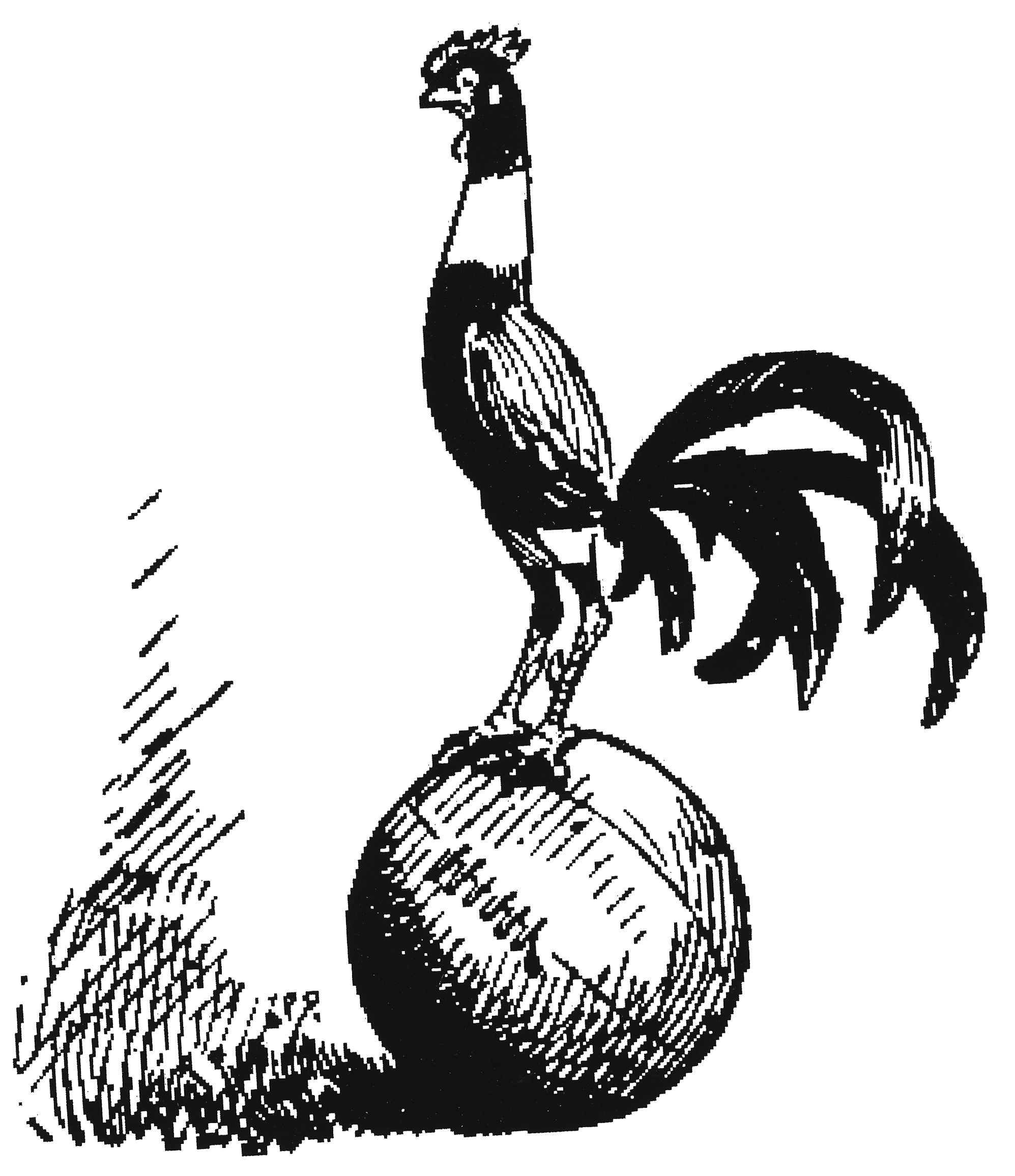
The club’s handbook for the 1909/10 season similarly featured a bantam on its front cover and the drawing was based on a Staffordshire breed descended from a fighting bird that was popular among bird fanciers.

bantam graphic 1909.jpg

Although hens were known to have been kept at Valley Parade in earlier years, there is no record of the club having adopted a live bantam as a mascot. Nevertheless, there are reports from before World War One that refer to bantams being taken to games by supporters. One example was in February, 1909 when a ‘dummy bantam’ was put on the crossbar at the Kop End during the half-time interval of the FA Cup tie with Sunderland. It was reported that this remained in place for the second half and a week later when City visited Roker Park for a League game, a bantam was released on the pitch.

The bantam identity inspired a new playing shirt at the beginning of the 1909/10 season, as later worn in the 1911 FA Cup final. Note the resemblance of the yoke on the shirt to the bantam plumage.

1909 BDV silk

*** Coventry City adopted the same ‘Bantams’ nickname in December, 1908. According to Wikipedia ‘Coventry were first called the Bantams in December, 1908 after the local newspaper noted that they were one of the few clubs who did not have a nickname. Being the lightweights of the Southern League, the Bantams was suggested and stuck with the press and supporters.’ Around this time it was common among English clubs to look for nicknames / mascots and it is not inconceivable that the choice of Bantams was copied from Bradford City who were then a much bigger club than Coventry City (elected to the Southern League in 1908 and only elected to the Football League in 1919).

Read more about the origins of the different crests adopted by Bradford City AFC in my book A HISTORY OF BCAFC IN OBJECTS.

You may also be interested to read my feature on Bradford City AFC & the Boar’s Head identity

Feature on VINCIT about origins of City and Avenue nicknames

Other features on the BCAFC identity:

Application of the Bradford civic crest

How Bradford City became known as the Bantams

The ‘bc’ logo of 1974-81

Bantam identity of the 1980s

The BSA Bantam character

The City Gent

  • Thanks for visiting my blog. Scroll down for details about my books in the BANTAMSPAST History Revisited series which tell the history of sport in Bradford – and in particular football. The books seek to explain why things happened as they did instead of simply recording what occurred and readers may be surprised at the extent to which they contradict many of the myths and superficial narratives that have circulated previously. You won’t get fancy graphics but you will find substance and historical accuracy in the content. Tweets @jpdewhirst

If you are interested in Bradford sport history visit VINCIT: https://www.bradfordsporthistory.com

Long distance football

From the matchday programme, Bradford City v Plymouth Argyle FAC R2 2nd December, 2017:

This is the first time that Bradford City and Plymouth Argyle have met in the FA Cup. Games between our sides have been relatively few in number but on this occasion, there is a certain familiarity about the encounter given the League fixture only three weeks ago. Credit is due to those visiting supporters who have repeated the 660 mile round trek to Bradford today.

Long distance travel is part and parcel of being a Plymouth supporter although it probably helps that the products of the club’s local sponsor are sold in most motorway service stations. The furthest that Bradford City have ever had to travel for an FA Cup game was in December, 1947 when we were drawn away at Bournemouth & Boscombe in the second round (a 0-1 defeat). By road, Bournemouth is 275 miles distant but seventy years ago the journey was made by train and it appears to have been a particularly enjoyable occasion notwithstanding the result. In fact, there is surviving film of the trip which shows the Bradford City players accompanied by the directors and a small number of supporters.

The film was commissioned by former chairman, Bob Sharp whose fund-raising efforts (and personal contribution) during the war years kept the club solvent. Twenty years ago, the footage was shown at Pictureville in Bradford but can nowadays be accessed via the Yorkshire Film Archive website.

Older supporters have their own stories about trips to Plymouth and one in particular stands out. In February, 1978 we were due to play Argyle in a third division fixture. City were rooted at the bottom of the table and the game with Plymouth who were a few places above us was something of a four pointer (there being two points for a win). Despite poor away form the game was eagerly anticipated because the City team had been strengthened by a couple of record signings, Mick Wood and David McNiven whose transfers from Blackburn (£15,000) and Leeds (£25,000) respectively had been funded by the club’s lottery proceeds.

Sadly the game was abandoned – the consequence of a major snow storm – with City leading 1-0. The fun began shortly after when the City Travel Club bus got stranded in the snow. Ian Hemmens was one of the fans there that day and recalls that ‘we were accommodated in the Royal Marines barracks at Devonport until the Wednesday following. Before mobile phones we made the headlines on BBC Look North to confirm our safety… all in all, an eventful few days!’ The rearranged game took place at the beginning of May, 1978 by which time we were already relegated and the 0-6 defeat is best forgotten.

I first travelled to Plymouth in February, 1983 and having made my way to the town from London arrived much sooner than the other City supporters travelling with the CTC’73 coach. I bought a programme in the Home Park shop and was greeted by the Argyle club secretary who gave me a tour of the ground. I will never forget the friendliness of the people and confess that I have always had a soft spot for Plymouth – as well as a liking for Ginster cornish pasties.

John Dewhirst

Thanks for visiting my blog. Scroll down for details about my books in the BANTAMSPAST History Revisited series which tell the history of sport in Bradford – and in particular football. The books seek to explain why things happened as they did instead of simply recording what occurred and readers may be surprised at the extent to which they contradict many of the myths and superficial narratives that have circulated previously.

If you are interested in Bradford sport history visit VINCIT: http://www.bradfordsporthistory.wordpress.com

Civic Identity

My column published in Bradford City programme on 21 November, 2017 v Scunthorpe United:

On 31 December, 1907 the city of Bradford was granted a formal coat of arms which remained the civic crest of Bradford until the formation of the metropolitan district in 1974. It comprised the red/blue Bradford shield with three bugles, a boar’s head on top with a ram and a goat on either side. Its replacement (which is still used) was derived from an amalgam of characters from the constituent parts of the new authority, the most obvious change being the stag of Keighley and a knight’s helmet.

In 1908 the Bradford arms were featured prominently on the new Midland Road stand. Across at Park Avenue, the grandstand constructed in 1907 incorporated the traditional Bradford shield on the two end gables. Both clubs were eager to portray themselves as representatives of Bradford and in 1909 the coat of arms began to appear on the BCAFC club shirt, famously worn when the club won the FA Cup in 1911. Avenue similarly adopted the badge (although not on shirts).

The Bradford coat of arms remained the official club crest at Valley Parade until 1966 when it was replaced by a boar’s head atop a shield containing a BC-AFC monogram. In turn that was retained until 1974 when replaced by a modernist graphic that lasted only 7 years. Anxious for a fresh image, chairman Bob Martin revived the club’s historic bantam identity in December, 1981 and with the exception of a revival of the boar’s head (with the BC-AFC shield) between 1985-91, a bantam has continued to be the main feature of the club crest ever since.

Despite the boar’s head (without a tongue) being a traditional emblem of Bradford, derived from the legend about the killing of the wild boar in Cliffe Wood (on the hillside opposite Valley Parade) in the 14th century, it is no longer used by either of the city’s two senior clubs, City or Bulls (the latter who relaunched itself in the Super League in 1996 with a new identity).

Bradford City is not the only club to have spurned a civic identity. The traditional crest of Scunthorpe United was similarly the civic coat of arms, the central feature of which was a chain of five links representing the constituent villages that formed the town. Desperate for a makeover, Scunthorpe United advertised a competition for a new crest in the club programme for the fixture with Bradford City on 3rd October, 1981 and the following season it abandoned its all-red strip for claret and blue whilst also introducing a radically different badge.

That new emblem was the so-called ‘Unity fist’ that incorporated the chain of the old crest in a clenched gauntlet with the epitaph ‘unity’. The club retained the design until 1990 when it was dropped in favour of the current style of badge that features an iron girder. I understand the ‘Unity fist’ was abandoned on account of being considered unsuitable as a family brand but was revived in 2014 on the club’s third shirt following a campaign by Scunthorpe supporters for a return to a ‘traditional’ design.

scunthorpe badge 1982What Scunthorpe fans might not appreciate is that I was the person who designed their ‘Unity fist’ badge and that it was sketched on a sandwich wrapper en route home to Bradford on a supporters’ coach. It spoke volumes about amateurish branding in 1981 that Scunthorpe should rely upon my efforts but I am flattered that the design achieved popular acclaim and its place in the history of our visitors today.
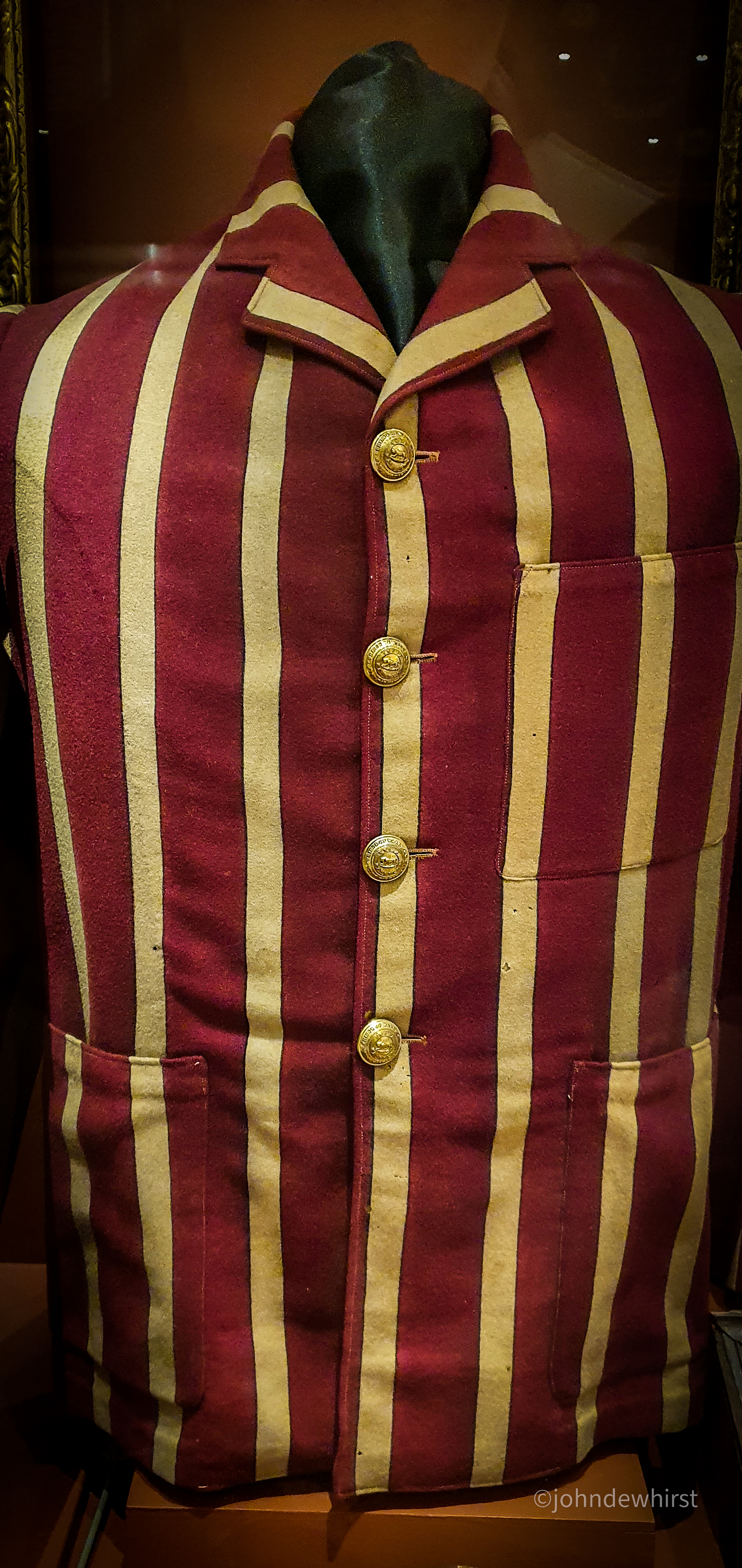
  • Thanks for visiting my blog. Scroll down for details about my books in the BANTAMSPAST History Revisited series which tell the history of sport in Bradford – and in particular football. The books seek to explain why things happened as they did instead of simply recording what occurred and readers may be surprised at the extent to which they contradict many of the myths and superficial narratives that have circulated previously. You won’t get fancy graphics but you will find substance and historical accuracy in the content! Tweets @jpdewhirst
  • More here about the BCAFC boar’s head crest
  • If you are interested in Bradford sport history visit VINCIT: www.bradfordsporthistory.com

The military connection

The following was published in the Bradford City AFC matchday programme on 11th November, 2017 (Plymouth Argyle):

When I undertook my research on the origins of football in Bradford, it became apparent that the historic links between sport and the military in Bradford had long since been forgotten. This is ironic given the constant reminder provided by the traditional club colours of City and Avenue / Northern having been derived from military connections. My belief is that after the carnage of the Great War the military heritage tended to be overlooked, not necessarily for ideological reasons but because it was probably seen as outdated, if not irrelevant as people looked to the future. Nonetheless it is unforgivable that the military links have been forgotten and surprisingly overlooked by aspiring academics.

The early history of Manningham FC – established in 1880 and the predecessor of Bradford City AFC in 1903 – had strong links with the citizen soldiers of Bradford. The generation of men involved with establishing ‘football’ clubs in Bradford during the second half of the 1870’s was typically connected with the Volunteer – or territorial – army units in the town and ‘athleticism’ in the widest sense was considered to be a form of military training by virtue of its health benefits.

The Volunteers had been established in 1859 to provide a home defence force to protect the UK from invasion and in Bradford the principal units were the 3rd Yorkshire (West Riding) Rifle Volunteer Corps (3rd YWRRVC)and the 2nd Yorkshire (West Riding) Artillery Volunteers Corps.

One reason for the popularity of the Volunteers was that they provided recreational opportunities and in particular access to new sporting activities such as gymnastics and ‘football’ (which in Bradford meant rugby). There was even a dedicated side, Bradford Rifles FC established in 1875 which comprised of a high proportion of Bradford Caledonian FC players (one of the oldest clubs, established in 1873 and also the biggest), a number of whom became associated with Manningham FC in leadership roles.

This connection encouraged a natural sympathy towards the military but so too did the proximity of Valley Parade to Belle Vue barracks where the 3rd YWRRVC was based. The facilities were used on various occasions (in addition to the former artillery barracks on Valley Parade) for meetings as well as changing and training facilities by Manningham FC and the infant Bradford City club.

The dominant political culture at Valley Parade and Park Avenue prior to World War One was unquestionably Conservatism and it was second nature for the two clubs and their membership to espouse patriotism. A good example of this was the decision to adopt claret and amber in 1884. These were the regimental colours of the West Yorkshire Regiment which had been established in 1881 from the 14th Regiment of Foot as part of a reorganisation of the military to assign a fixed recruiting area. In the same year the Childers reforms had resulted in the 3rd YWRRVC becoming the volunteer battalion of The Prince of Wales’s Own (West Yorkshire Regiment).

The occasion of Manningham FC adopting claret and amber  in 1884 came at a time of patriotic fervour associated with the Sudan crisis and the excitement that Bradford men might actually go to war. Arguably it was the same enthusiasm thirty years later with spectators at Valley Parade being actively encouraged to enlist to fight on the western front.

In 1884 the new Manningham shirts were hooped with the width of the claret being twice the width of the amber, consistent with the blazer design below (stripes apart).

The traditional sporting colours of Bradford were red, amber and black whose origin can be traced to the original Bradford Volunteers of the Napoleonic era.

Further detail of Bradford’s military history and the circumstances surrounding the adoption of claret and amber is told my book ROOM AT THE TOP, available from Bantamspast.net 

This feature published on VINCIT tells the story of the Bradford Rifles

John Dewhirst

Bury FC has a similar military link to claret and amber (link to Bury blog)

  • Thanks for visiting my blog. Scroll down for details about my books in the BANTAMSPAST History Revisited series which tell the history of sport in Bradford – and in particular football. The books seek to explain why things happened as they did instead of simply recording what occurred and readers may be surprised at the extent to which they contradict many of the myths and superficial narratives that have circulated previously.
  • If you are interested in Bradford sport history visit VINCIT: http://www.bradfordsporthistory.wordpress.com

A sporting jacket in the regimental colours of the West Yorkshire Regiment from c1900 on display at York Army Museum.