For more than 150 years Bradfordians have bemoaned the fact that their city lacked a through line and a rightful place on the national rail network. Prior to World War One numerous schemes were proposed to achieve this objective but none progressed. And yet in 2018, we anticipate the possibility that a Bradford through-line could form part of the plans for a high speed railway in the North of England. [1]
The following is the story of the various historic schemes for a cross town link in Bradford, taken from my book ROOM AT THE TOP which explains the origins of professional sport in Bradford and the significance of the railways…
Bradford, a railway town
Just as we do not consider Bradford to have been a military town, neither do we think of it as having been a railway town yet the railways (as well as the military) had a major influence on Bradford sport and where it was played. Because so little remains it is difficult to believe their significance yet the urban geography of Bradford was dictated by the railways.
Railway mania was late coming to Bradford but when it did, it was no less intense than in other parts of the country and no less significant in shaping the urban footprint of the town and surrounding district. At its peak in 1914, the railway network in the Bradford district comprised 75 miles of track. Today little more than 40 survives and almost all of the sidings and yards have disappeared. Three companies dominated Bradford’s network and it was competition between them that conspired to leave Bradford without a through line.
The symbolism of two principal stations at the end of sidings is also apt when we consider the fate of Bradford soccer in the twentieth century. Football in Bradford was likewise subject to a mania and the competition between two stubborn rivals shaped how Bradford’s football would evolve. Co-operation in both cases would have ensured a better inheritance for today. However what railways and football in Bradford had in common is that they were at the mercy of the topography. Those hills have so much to answer for.
The railway first came to Bradford in 1846 with a connection from Leeds and the Leeds & Bradford Railway was later absorbed into the Midland Railway. The town’s first station became known as the Midland Station, situated closer to the centre than the modern day Forster Square terminal. In 1847 this line was extended to Bingley and Keighley with a station at Saltaire in 1856. A link to Ilkley and Otley opened in 1865. Many other branch lines and goods depots sprouted though Bradford’s hills and valleys. But more than 130 years ago the perception of Bradford was of a siding:- ‘As it was in the beginning – Bradford on a siding – is now – Bradford on a siding – and ever shall be – Bradford on a siding – world without end – Bradford on a siding.’
These words were quoted in the Leeds Times in January, 1884 following the collapse of a scheme to construct a through line in Bradford. To this day we have two railway stations and no prospect of a main line whilst investment in national rail links has bypassed the city. As things stand Bradford remains on a siding.
As a boom town in the nineteenth century, manufacturers in Bradford were as anxious to get rail links as railway companies were to provide them. A Bradford spinner, William Murgatroyd was said by local historian George Sheeran to have invested £62,000 in railways in the 1840s, later to become a director of the Midland. Similarly, the mayor of Bradford in 1862/63 and between 1871-73, M W Thompson was a director of the Midland Railway so it could hardly be said that the town never had influence within the railway establishment.
And yet Bradford ended up ‘on a siding’ with poor connections. This may be attributed to the local topography (ie the hills) as well as competition between competing railway companies to control the network. However, railway development in Bradford affected many other aspects of life: it had a major influence on urban development and land use in the town which had corresponding impact on where sport could be played.
How railways dictated the development of sport in the district
The significance of the railways came from where stations were built as well as where they were proposed and indeed, they impacted on places where they were not developed. Much the same as Bradford came to have two senior football clubs it ended up with two principal stations. The railways ultimately had a major role in defining the history of football in the town.
Railways brought people to games as players and as spectators and early venues were selected in the vicinity of stations such as Apperley Bridge (opened 1846), Frizinghall (1875), Bowling (1854) and St. Dunstans (1878). The Quarry Gap showground and racing venue had likewise benefited from the opening of Laisterdyke (1854). Bolton Bridge station (1868), which came to be known as Manningham was used by teams visiting Peel Park, Lister Park and later Valley Parade. The prospects of the Park Avenue development owed much to the opening of Horton Park station (1880) and even in the twentieth century Low Moor station (1848 to 1965) helped make Odsal Stadium a feasible proposition.
The strategic importance of railway links for sporting events had long been established – well before the emergence of football – with excursion trains conveying people to racing events as well as ‘nurr & spell’ contests (hitting a small wooden ball with a stick over distance). A good example of this was reported in Bell’s Life in London of 29 May, 1853, in respect of the nurr & spell contest that took place between Joseph Coward of Baildon and Matthew Thompson of Barnsley at Doncaster race ground. ‘A special train with thirty carriages brought 1,800 from Bradford and another from Barnsley brought 1,200.’ The total crowd was estimated at 6,000. The event was for £50 stakes and there was reported to be much gambling. It ended in a near riot with numerous ‘pugilistic encounters’.
There are many accounts of excursion trains booked to convey footballers and supporters to away grounds and railway timetables would have determined both the choice of opposition as well as the time of kick-off. In this way railways helped define the earliest sporting rivalries.
Railways determined where it was practicable to establish a sports ground. The Bradford Daily Telegraph of 17 July, 1878 quoted the treasurer of Bradford Cricket Club regarding the search for a new ground: ‘He thought that there would be no difficulty getting a ground, but they would not get one so central as the old one (ie at Great Horton Road), and as other towns had done, they might go outside and get a ground near a railway station.’ Another correspondent on 11 September, 1875 suggested that Bradford CC should move to the ground of Eccleshill CC on account of it being ‘within three minutes’ walk from the station and the fare is 21/2 d.’ Lack of railway connections also explains why they were not developed in certain districts. Railway speculation overshadowed the tenure of the ground at Four Lane Ends, Girlington and in the final event determined the availability of the site at Valley Parade. [1] Bradford City, like Manningham FC between 1886 and 1903, had the Midland Railway as its landlord, as did Manningham Cricket Club at Whetley Lane between 1878 and 1895.
Railway origins and development in Bradford
Although Bradford’s railways are nowadays a fraction of what once existed and what was planned, their legacy remains. Although redundant stations have long since been demolished, there are sufficient surviving civil engineering structures in the Bradford district to remind us that the railways had a major impact.
Lobbying for a rail connection to Bradford dated back to 1830 with proposals for a line to Leeds that would link to the Leeds-Selby route but this scheme was abandoned in 1831 as a result of opposition from canal owners. (The Bradford Canal that ran 3.5 miles and climbed 86 feet from Shipley to the centre of town, had opened in 1774.) Alan Whitaker, in his book Bradford Railways Remembered states that in 1832 there was another scheme to connect Leeds and Bradford to Manchester and Liverpool but this also fell through. By 1840 industrialists were concerned about being cast adrift from the railway boom and plans were revived. In all likelihood it was railway mania that made the difference with the Leeds & Bradford Railway Company being established in 1843.
In the years before 1846 railway investment opportunities had been much advertised in the local press. The Bradford Observer was prescient in cautioning against the emerging bubble and questioned whether all schemes were likely to be successful: ‘We feel some hesitation seeing that we are all bitten with the mania. We doubt not there are some good schemes amongst the many afloat, and amongst the rest, some Yorkshire ones; but we may doubt whether there is not some lurking fallacy on railways in the public mind…A manufacturer expands his mill slowly, and as his means increase. A railway is a gigantic undertaking at once, and may vastly overshoot demand, as we know by many costly experiments.’ The same could have been said four decades later when there was a football boom in Bradford.
Railways speeded up reality. It was recounted in the Bradford Observer of 1 November, 1855 that the journey to London had previously taken 4 days with only 4 coaches passing through the town each day. It stated there to be then 22 trains leaving the Midland station every day, 22 from the Lancashire & Yorkshire and 12 from the Great Northern and estimated that as many as 4,032 people entered and departed from Bradford daily. This was in contrast to around 80 people per day in the age of stage coaches. Not only that, the journey time to London was by that time only 6 hours.
The writer saw the railways as evidence of progress, adding ‘The Bradford Canal was commenced AD 1776. It would be a great blessing to this town if this canal could be dried up. The amount of mephitic and noxious vapour which arises from it is enough to breed pestilence and death amongst the pollution. I have heard of the gas, in dry weather, being set on fire with a lucifer match.’
By 1850 Bradford had a second station at Drake Street operated by the Lancashire & Yorkshire Railway (L&Y). The Great Northern Railway (GN) opened a third in 1854 at Adolphus Street (at the bottom of Wakefield Road) with connections to Leeds and the Spen Valley via its junction at Laisterdyke. Adolphus Street became a goods depot in 1867 when the GN operated from an enlarged Bradford Exchange. In 1870, the travel time from Bradford to Keighley along the Aire valley was around thirty minutes; the journey to Manchester could be anything up to two-and-a-half hours.
The Halifax Guardian’s description of the town’s links reflected the feeling that it was an unsatisfactory state of affairs: ‘Bradford is approached by the Lancashire & Yorkshire line down a steep and dangerous gradient; and by the Great Northern by a meandering line on a steeper gradient still; whilst it is simply on a branch line from the Midland at Shipley.’
Paranoia existed in Bradford that its rail connections remained undeveloped and that other towns were likely to derive advantage at Bradford’s expense. The Leeds Times of 19 January, 1884 reflected that feeling: ‘The town could not flourish if it were left behind – the very essence of success in our modern times was to be on the broad main line of intercommunication between production and consumption, between the buyer and the seller of the articles which were manufactured in any locality.’ While there was sensitivity about the status of Leeds compared to Bradford, prior to the 1880s it was probably Halifax’s rival rail links that were viewed as the biggest threat.
Bradford’s lack of a through line troubled the town’s leaders who considered it to be a major disadvantage in terms of status as well as lost opportunity and inconvenience for industry and residents. Until World War One there was continuing speculation about linking the two stations and developing a main line that would not only improve connections with other towns but enhance connections within Bradford.
We underestimate the extent to which the two sides of the valley north from Bradford were considered to be cut-off. Railways were seen as the obvious way to connect the west and east sides of the town and another topic was that of access to Peel Park which was the only park in Bradford prior to the opening of Lister Park in 1875. There were many letters to the Bradford Observer with suggestions for railway development including the proposal of a branch line from Manningham with a terminus station opposite Peel Park Gates.
———————————————————————————————————-
Mr Angry of Horton
One of the most prolific correspondents to the Bradford Observer was smuggler and American Civil War volunteer William Hartley. Born in 1841, he had fought for the US Army in the latter stages of the American Civil War. I cannot say whether he had fought for the North as a mercenary or as a matter of principle. Liberals in Bradford were keen supporters of the Federal cause and one of the town’s MPs, William Forster was a leading figure among anti-slavery campaigners in Britain.
In May, 1871 Hartley admitted ‘the annoyance of writing long letters is a regular nuisance to me, but if I get an idea into my cranium which I think should be carried out, and no-one else proposes it, I cannot resist sending it to the papers…’ His was a world in which Bradford was rapidly expanding ‘like a central planet, surrounded by a milky way of satellites’ as he described his home town in 1870. He offered numerous suggestions about possible railway schemes and his letters invariably contained estimates of the costs and benefits.
Prior to leaving for America he had written under the pen name of ‘Ignoramus‘ and on his return as ‘Hortonian‘, revealing his residence on Horton Lane. In the midst of speculation about new railway routes across the Bradford district he wrote in April, 1870 on the subject of making Bradford the ‘principal railway centre of the north: ‘Here is a town with not a single main line of communication through it. There is not another town of such importance in the country treated so shabbily, neither do I think a place of like magnitude would succumb to it. However we have natural facilities for making Bradford the main thoroughfare of traffic from North, South, East and West.‘
Between 1870 and 1873 he offered suggestions for just about every conceivable suburban route and it illustrated the confidence of the Victorians in the power of railways to transform urban transport. In May, 1870 ‘Hortonian’ offered a scheme to ‘make Bradford as well-roaded as almost any place in the country.’ He was without doubt an urban planner before his time.
In June, 1877 Hartley was convicted of tobacco smuggling alongside his clerk, Henry Hardacre. It was alleged he had used his trade as a paper merchant to cover smuggling tobacco from Hamburg. The two were fined £1,344 and £1,112 respectively in lieu of tobacco duty which would suggest that he was at the centre of a massive undertaking. The prisoners were told they would remain in prison until the money was paid. Needless to say nothing was heard from him after that.
———————————————————————————————
Strategic links to Eccleshill and other schemes
Railways connected the people and produce of Bradford with the rest of Great Britain as well as other parts of the surrounding area. Although we might consider lines joining Laisterdyke and Shipley via Eccleshill (opened in 1874) and that from Bradford to Keighley and Halifax via Queensbury (opened in stages from 1878) to have been ludicrous ventures, from the Victorian point of view they represented strategic investments. The Great Northern Railway’s extension from Laisterdyke to Shipley allowed heavy freight and mineral traffic with limestone for Bowling and Low Moor iron works from the Yorkshire Dales and stone from Idle Moor. Similarly, its railway to Thornton was considered equally important to carry textile manufactures and raw materials as well as coal for the mills.
In 1864, the Bradford Junction & Thornton Valley Railway Company was formed to finance the construction of a railway from Bowling on the Lancashire & Yorkshire line to a point between Bradford and Shipley on the Midland line near to Bolton Lane. Two years later the Midland announced plans for a station at Bolton Bridge which was later known as Manningham station, situated off Queens Road, with the location designed to serve Peel Park. This was to run through Little Horton Green and Shearbridge to cross Thornton Road near its junction with Brick Lane – what is today Hollings Road – and continue on the lower side of Manningham Lane through a tunnel (see plans below). A second line was proposed from the first at Thornton Road, proceeding in a westerly direction up the valley to Clayton and Thornton with a branch to Queensbury from Hole Bottom. The line was considered valuable to provide a direct route from London to Scotland.

Alfred Illingworth was among those industrialists who supported the project and was likely to make a lot of money from his property interests around Four Lane Ends. A station was proposed at Thornton Road to provide passenger services and in particular heavy goods traffic. But in November, 1865 it was announced that the scheme had been abandoned on account of expense.
Hilly terrain would have presented a major challenge but so too any tunnelling project across Manningham was complicated by the fact that it would have been under built-up land. The line of the tunnel appears to have been from Thornton Road, under Westgate and Lumb Lane, terminating in fields lying between Eldon Place and Trafalgar Street off Manningham Lane, to join the Midland route.
The abandonment of the scheme also had much to do with disagreements between the three railway companies in Bradford regarding their wider interests. By providing a link to the north the GN and L&Y had much to gain, at the expense of the Midland. However, by this time the GN was already exploring other possibilities with the Laisterdyke to Shipley route, first proposed in 1862.
Shortly after the collapse of the Bowling-Manningham link scheme, in 1866 and 1867 the GN obtained parliamentary approval to establish its own route from the south of Bradford to the north. Construction was delayed and the line did not open until 1875. Its promoters claimed it would provide a direct route to the north from Doncaster via Wakefield. But with reliance upon the Midland for use of its line northwards from Shipley, the GN never realised this potential and by 1931 the stations at Eccleshill, Idle, Thackley and Windhill had closed.
In 1870 the Bradford & Thornton Railway Company was formed to build a track from Bowling to pass through Little Horton, Horton, Great Horton and Clayton to Thornton. A second line from Horton to terminate on the south west side of Thornton Road was part of the scheme. The bill for the realisation of this scheme was submitted to Parliament in July, 1873 and included a further route from Queensbury to Halifax; assent was given and the railway was eventually constructed between 1874 and 1879, extended to Keighley in 1884. The line to Thornton was only 6 ¼ miles in length (compared to the existing cart road of four miles) yet it was two years before the line opened to goods traffic and not until 1878 that it was completed for passengers. The cost of this section alone was £750,000. Surviving viaducts are monuments to the feats of engineering that were required to overcome challenging terraiin and during the period of its construction the Leeds Times was wont to refer to it as the ‘slaughtering line’ on account of various accidents and fatalities. The station at Horton Park (1880), of which there are no remains, served Park Avenue.
The prime beneficiary of the Thornton railway scheme was again the Great Northern and not surprisingly the Midland objected, although in vain. In November, 1873 the Midland submitted its own scheme to connect the Midland line near Spring Gardens diagonally in a cutting to Nesfield Street and then to a 748 yard tunnel underneath Manningham Lane, Hanover Square, Lumb Lane and White Abbey Road emerging near the end of Whetley Lane in Girlington. The latter portion would have been parallel to Thornton Road, behind the mill belonging to Alfred Illingworth. It was then proposed to build a station at Whetley Lane close to the junction with Thornton Road. The line then went via Lady Royd through Allerton and Thornton, under Clayton Edge to Northowram and Halifax and thence to Huddersfield. The project would have meant that northbound trains from Huddersfield and Halifax could effectively bypass Leeds.
The Midland scheme of 1873 would have been parallel to the GN Queensbury railway, taking a similar route but with a less steep gradient. Nevertheless, it was an expensive proposition involving as it did tunnels for three of the fifteen miles between Bradford and Halifax. With considerable opposition from the L&Y and the GN, Parliament rejected the Midland’s bill in May, 1874. Alfred Illingworth had championed the Midland’s plans and much of his land would have been used for its construction. The course of the proposed line also had direct implications for sport in Bradford by placing the Four Lane Ends ground at Girlington in doubt. I would therefore assume that Bradford FC were given notice by Illingworth, its landlord, to vacate and at the start of the 1874/75 season the club relocated from Girlington to Apperley Bridge.
The Great Northern emerged from these battles for pre-eminence in a strong position and in 1878 announced the extension of its line from Thornton to Keighley, which opened in 1884, providing a further challenge to the Midland. Also, in December, 1879 the GN announced its own scheme to link its existing terminal at City Road with the Midland line by way of a tunnel. This became known as the Bradford Central Railway scheme with City Road becoming the site of a new joint station to be shared by all three companies. In anticipation, Bradford Rangers FC was forced to relocate from Four Lane Ends to Apperley Bridge in 1880, another illustration of how the development of railways had impact on Bradford sport.
The timing of the Bradford Central Railway scheme was opportune because at this stage both the Midland and the L&Y were looking at expansion of their respective stations but had yet to incur costs. But the scheme was abandoned in January, 1884 with the Midland, Great Northern and the Lancashire & Yorkshire refusing to support the Bill, reluctant to abandon their existing investments. Abandonment was formally agreed by the scheme’s promoters at a meeting chaired by the Mayor, Alderman Isaac Smith, on 11 January 1884, after receiving the companies’ joint reply of 8 January. The dual role of Matthew Thompson as a signatory to the rejection will be noted given that he was both a former mayor of Bradford (1862-63) and local MP as well as a Midland director since 1865, chairman from 1879.
It was argued that the Bradford Central Railway site would be too small to accommodate the trains of all three operators. Hence the original plans for the redevelopment of the Exchange and Midland stations commenced shortly after – the L&Y completed its redevelopment of the Exchange in 1889 and the Midland’s new station opened in 1890 (as well as the adjacent Midland Hotel). By the 1970s Bradford’s mainline stations were as derelict as its main football grounds and neither of the Victorian station structures celebrated a centenary, disappearing around the same time as the Edwardian stadia at Park Avenue and Valley Parade.
Railway schemes continued to be proposed including in January, 1890 a route from Bradford to Preston via Haworth, Trawden and Colne. Unsurprisingly this scheme did not progress. There was one final scheme for a cross-Bradford line that adopted a direct route through the centre of town yet whilst it appeared straightforward to achieve, in practice it again demanded considerable engineering effort.
In 1897 the Midland proposed a line from Royston Junction near Dewsbury to Bradford through the Spen Valley which became known as the West Riding Lines scheme. This reduced the length of the line from Bradford to London by eleven miles and promised to reduce the length of the Midland’s line to Scotland by six miles. Parliamentary approval was originally granted in 1898 but subsequent revisions required further bills to be agreed.

The scheme involved a two-and-a-half mile tunnel from Oakenshaw to a point between Manningham and Frizinghall with a new underground station at Forster Square. When costings became prohibitive this was later amended to a tunnel from Low Moor to Ripleyville in Bowling and then another under Broomfields and Wakefield Road before crossing Bradford city centre on a viaduct. The minor issue of a 70ft height differential between the Forster Square and Exchange stations was then proposed to be resolved through high level platforms at Forster Square, descending by the time the connection reached Manningham station at Queens Road.
Revisions to the plans caused delay and a gradual loss of enthusiasm on the part of the Midland. By the end of 1906 an impasse existed in relation to the distruption of water supplies to the Ripley dyeworks and in April, 1907 this was further complicated by the objections of the Lancashire & Yorkshire Railway to the effect that Bradford Corporation had given preferential treatment to the Midland. As a consequence of the various delays it meant that the issue of the cross-Bradford rail link was particularly pertinent at the time of the debate about the amalgamation of the two Bradford clubs.
On its part Bradford Corporation was anxious for the link to be achieved and in September, 1907 the Lord Mayor admitted that the Corporation had previously turned down an approach by promoters of a new line from Sheffield to Newcastle, ‘passing at high level through Bradford, and placing the city on a most advantageous through line North and South’ in preference to the Midland. Frustration about delays became a political issue in Bradford with the feeling that the city was being messed about. However, the Midland held all the cards and it also had a direct stake in the football amalgamation debate. The potential relocation of Bradford City to Park Avenue would have impacted on passenger revenue to/from Manningham station, the opportunity cost of which being all the greater if a link was built and the club won promotion to Division One. In a delicious irony it then begs the question whether the issue of a central through station in Bradford compromised the chances of the two clubs joining together. The Midland for example had every incentive to keep Bradford City at Valley Parade and was therefore willing to promise security of tenure.
In the final event development work did not extend beyond the construction of a section of line between Royston and Thornhill and the undertaking of surveys. Despite Parliamentary consent for extensions being granted in subsequent years, no work had been undertaken by the outbreak of World War One. The scheme was finally abandoned in 1919, with the land that had been acquired through compulsory purchase in the centre of Bradford by the Midland being bought by Bradford Corporation. In the years preceding the war, doubt and uncertainty over the scheme had been a major frustration for the Corporation, much the same as the delayed Westfield development in the centre of Bradford between 2006 and 2014.
The Midland’s scheme for a cross Bradford route collapsed as a result of co-operation between the different railway companies rather than conspiracy which had been the case previously. It had become more cost effective for the Midland to share existing lines rather than compete head to head with others through separate routes; had there been co-operation in prior years Bradford might have had its main line route.
It was telling that the Leeds Mercury in September, 1920 commented that when the plans for a through line (from Bradford to Royston) were revealed ‘there was a section of Leeds commercial men who opposed the scheme because they saw that it would leave Leeds on a roundabout loop‘. Undoubtedly there were vested interests content that Bradford never got its through line.
Even after 1919 there were attempts to revive the Midland scheme and then in December, 1922 came proposals for an underground loop line through Bradford. There was a further suggestion that this might form the basis of a work creation scheme.
In the midst of World War Two – as people contemplated how peace might deliver a brave new world – there was no shortage of ambitious development proposals for the city. In 1943 for example a scheme was discussed that included the rebuilding of Forster Square and Exchange stations so that they could have bus depots and car parks overhead and, over Forster Square a central airport for the use of helicopters. (NB The post-war Development Plan for Bradford – better known as the Wardley Plan – referenced land reserved for a helicopter station between St.Dunstans Railway Station and Bolling Road.)
In 1944 attention was once again given to a through line. Neither the LNER and LMS railway companies had the appetite – or more to the point, the finance – for an ambitious development given the pressing need to invest in the existing network. Not surprisingly, by the following year the proposal was flatly rejected. It was not the last of it however and representatives of Bradford Corporation investigated options for a through line in February, 1947 in the context of plans for the redevelopment of the city.
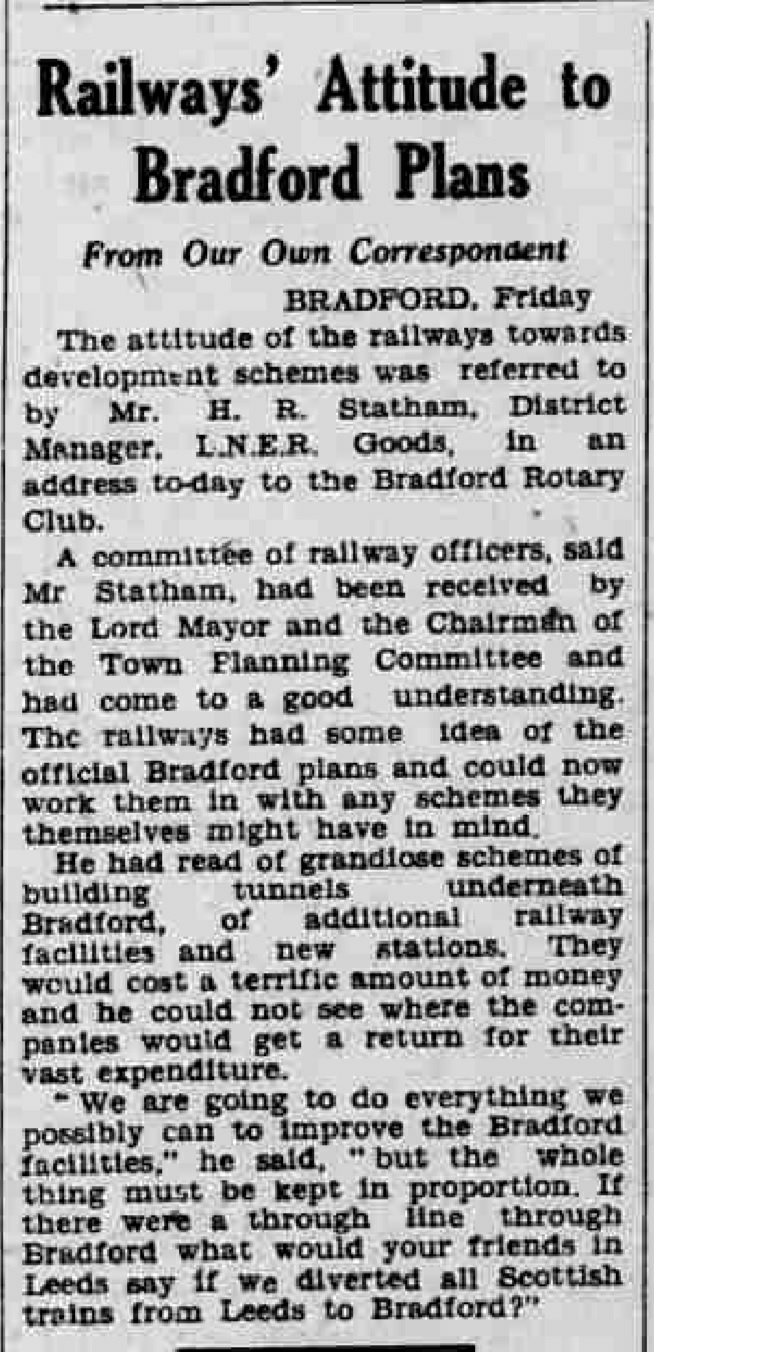
The 1947 scheme involved a tunnel from Birksland Street (LNER) to Manningham Station (LMS), the scrapping of Forster Square and the building of a new station near the Exchange. Once more it came to nothing and it was claimed that impending railway nationalisation represented a stumbling block to discussions. Another ongoing theme in the wider discussion about Bradford’s needs was the competing interests of Leeds and its own lobbying for preferential treatment in the allocation of funds.
There is no mention of joining the Exchange and Forster Square stations in either the Centenary History of Bradford published in 1947 (that gave coverage to Wardley’s plans for the redevelopment of Bradford) nor in the Bradford Development Plan that was approved by the Ministry of Housing & Local Government that was published in 1953. Instead the emphasis was upon developing the city’s road network, and in particular a new central radial road. The plan concluded that ‘the principal problem to be solved is the improvement of the city’s main terminal buildings and station amenities and the convenient linking of the principal goods depots to the new proposed road system and the proposed Ring Road in particular’. Whilst this likely reflected Wardley’s own bias towards private motor vehicle transport, it was probably also a pragmatic assessment that a through line was unlikely to be achieved. However it also reflected the fact that the existing Bradford rail network was not going to be able to serve new residential suburbs and hence the prioritisation of road networks that would also serve the needs of local industry through better access to goods depots.
Hence, despite the ambition of the Bradford Development Plan to modernise the urban landscape there was no consideration of how Bradford’s rail links could be transformed nor any evaluation of developing a light rail network within the district. In that era the railways of Bradford primarily served freight as opposed to passenger traffic and the intention was to develop public transport through the bus network and new bus stations. Any talk of a through rail line was then put to rest until around twenty years ago when the planned redevelopment of Broadway and demolition of buildings in Forster Square led to discussion about the feasibility of joining the city’s two stations. How seriously this was taken by local government is questionable, short of saying that also came to nothing.
Just over 70 years later we have speculation that Bradford could yet have a through line, championed by Transport for the North in January, 2018. Although no plans (and ominously no costings) have been released there appear to be two generic options. The first would be an upgraded station bypassing the city centre, presumably at Low Moor and the second would be a line through the centre of the city. Nonetheless, the city centre route would not involve a link between the Forster Square and Interchange stations and hence does not represent the long sought after north-south ‘through-line’. Instead it would be better described as bringing the east-west Lancashire & Yorkshire route northwards to run through the city centre.
An iconic city centre station could be built close to the site of the old Adolphus Street station near Wakefield Road – opened in 1854 but closed to passengers as long ago as 1867 and to freight in 1972 – but the option is likely to be prohibitively expensive and difficult to construct. The parkway alternative at Low Moor would be much cheaper and meet the declared aim of providing Bradford with a high speed connection albeit involving a shuttle into the centre. The Parkway choice however would be unlikely to achieve regeneration objectives for the centre of Bradford. We hold our breath.
The saga of a through line impacted on the urban development of Bradford and delayed its modernisation. Unlike most other large English towns and cities at the end of the nineteenth century, there remained considerable uncertainty in Bradford about the configuration of its railway connections. Elsewhere this had been resolved at least thirty years before. The uncertainty, in conjunction with depressed trading conditions and a collapse in land prices after 1874, impacted on property speculation in Bradford. This resulted in various sites remaining undeveloped or unoccupied in the midst of surrounding construction.
The railway companies were themselves big land-owners and in 1874 the Midland had committed to a programme of compulsory purchase to secure land for its own expansion – the origins of the Midland’s ownership of Valley Parade. For sports clubs this uncertainty created doubts about security of tenure – the case of Four Lane Ends being the prime example. Similarly, doubts remained in respect of the Valley Parade site until the Midland confirmed in 1907 that it would not be used for railway purposes. But where there was doubt there was also opportunity. In 1872 the newly formed Girlington Cricket Club took advantage of the vacant field at the bottom of Whetley Lane set aside for a possible station – later the home of Manningham CC between 1878 and 1895. Similarly, Manningham FC was another tenant of the Midland Railway, occupying the Valley Parade site which the company had previously intended for a warehouse in the 1870s. The land had remained undeveloped and the collapse of the Central Railway scheme in 1884 made railway development less likely; this meant that the site was vacant when Manningham FC needed to relocate from Carlisle Road in 1886.
When you consider how little has survived, the scope of railway speculation in Bradford in the second half of the nineteenth century is all the more astounding. The fact that Bradford has two stations, each of them on a siding does not do justice to the original intent to develop a cross-town, main line link. Difficulty was caused by the topography but competition between the railway companies proved to be a disadvantage in terms of the final outcome. The Victorian inheritance remained until the 1960s and it was the Beeching Reports of 1963 and 1965 that shaped the restructuring of Britain’s railways and the rationalisation of lines around Bradford. Similarly the Norman Chester Report of 1968 recommended merger of the two Bradford Football League clubs but in this case rationalisation came from the financial failure of Bradford (Park Avenue) AFC.

A Network Rail map (2018) would have us believe that Bradford had a cross-town line…
Despite the demand and need for a central station it never happened. Two stations. Two football clubs. By 1974 Bradford Exchange Station was being demolished, Park Avenue was abandoned and both Forster Square station and Valley Parade were derelict and forlorn. The symmetry is striking and had as much to do with the geography of Bradford as the competition between the respective organisations. Unfortunately, in both cases it left Bradford on a siding.
By John Dewhirst
Refer also:
The origins of Valley Parade and Midland Road
When Thomas the Tank Engine tried to cross Bradford and crashed down an embankment
From my book ROOM AT THE TOP, Bantamspast 2016 which also includes images / maps relating to the c19th railway network in Bradford and plans for its development.
If anyone wishes to reproduce this text the author expects due credit to be given for his research. Tweets: @jpdewhirst or @woolcityrivals
This feature on VINCIT explains the influence of Bradford’s railways in the nineteenth century on the development of sport in the town.
You can find links to features I have written about the history of Bradford sport as well as book reviews from the drop down menu above.
Post Script: It wasn’t just ambitious plans for a cross-town railway line in Bradford that never happened. This from 1960…

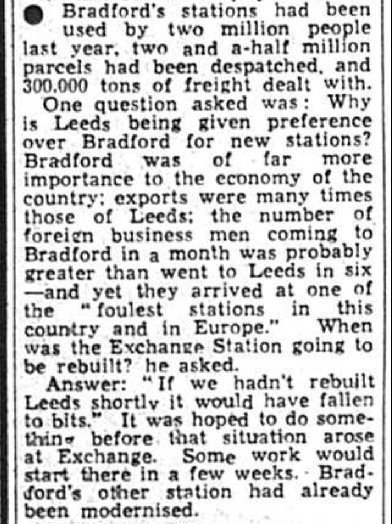
From the same year, complaints about under-investment in Bradford’s stations which remains a topical theme…
[1] In November 2021 it was announced that HM Govt had dismissed the proposals of Transport for the North in respect of a new Bradford station and a West / East mainline through connection. My observations about that decision.