The Sporting Heritage of Bradford

Talk at Bradford Local Studies Library: 19 May, 2018

During the second half of the nineteenth century Bradford established a proud reputation as a leading centre of sport and was known for the enthusiasm and prowess of its sports clubs.

However, after the end of World War One, Bradford became increasingly associated with sporting failure and ultimately, in 1985 with tragedy. The proud heritage of the nineteenth century tended to be overlooked and forgotten.

 The origins and early development of sport in Bradford has hitherto been neglected by local historians.

 In 2016 John Dewhirst published two books, ROOM AT THE TOP and LIFE AT THE TOP that narrate the history of Bradford sport from its beginnings through to becoming commercialised in the final quarter of the nineteenth century. His books explain how Bradford became a rugby centre and of how the intense rivalry of Manningham FC and Bradford FC dominated sporting passions, later extended into soccer through Bradford City AFC and Bradford Park Avenue AFC. He also offers an alternative explanation for the breakaway Northern Union in 1895.

 On Saturday 19th May he will be talking about his research findings and answering questions from people interested in Bradford’s sporting heritage at the Local Studies Library, Bradford 10:30am – 12pm.

For further details, and to book a place please contact Bradford Local Studies Library on 01274 433688 or local.studies@bradford.gov.uk

Local Studies Library, Margaret McMillan Tower (side entrance) , Princes Way BRADFORD  BD1 1NN

JD Sporting Heritage of Bradford 19-May-18

———————————————————————————————————————————–

If you are interested in Bradford sport history visit  VINCIT

Links to articles written by John Dewhirst on the history of football and the origins of sport in Bradford HERE

Musical chairs and Odsal ground-sharing

 To celebrate April Fools Day…

Rumours of new developments at Odsal: Superdome? Wembley of the North? An end to the Ice Age and Odsal micro-climate? Groundsharing with Bradford Park Avenue and rugby union?

With rumours that Bradford Park Avenue are looking to groundshare at Odsal next season, it represents another twist to the history of Bradford football.

Prior to 1907, rugby had been played at Park Avenue but with the Great Betrayal of that year and conversion to soccer, a new club – Bradford Northern RFC – was formed to allow Northern Union to be continued to be played in the city. That new club initially played at Greenfield, Dudley Hill before moving to Birch Lane in 1908 to play on the ground of the former Bowling Old Lane FC. In 1934 Bradford Northern moved to Odsal.

During the 1940s and 1950s there were various suggestions made that Odsal might be developed as a municipal stadium to accommodate a merged Bradford soccer club alongside Bradford Northern. Nevertheless (as will be told in my forthcoming book about the City / Avenue rivalry) at no stage did either Bradford City or Park Avenue have any plans to do so and it is a complete myth that before the last war the Park Avenue chairman Stanley Waddilove had formal proposals for soccer to be played at Odsal.

By the end of the 1960s Bradford Corporation had become impatient and frustrated with the expense and upkeep of Odsal such that after Bradford Park Avenue had failed to gain re-election to the Football League in 1970 the Corporation actively looked at alternative options. A number of schemes were proposed but when Stafford Heginbotham refused to countenance the possibility of Bradford City moving to Odsal or for that matter, to Park Avenue the pressure was put on the rugby club to move to Park Avenue. By 1975 however Park Avenue was already semi-derelict and it was reported that Bradford Northern could not afford the cost of upgrading the ground where its predecessor had played between 1880-1907. (NB The more plausible explanation for what happened will be revealed in my book.)

Bradford Northern and Bradford Bulls have both played games at Valley Parade but never at Park Avenue. Bradford City played at Odsal after the fire disaster but never staged a home game at Park Avenue. In 1907 the City members famously rejected the option of amalgamation and relocation to Park Avenue, a sentiment that dictated attitudes in the last century.

After vacating Park Avenue in 1973, the original Bradford Park Avenue AFC played a final season at Valley Parade. Now there is the possibility that they will become the first of the Bradford sides to have played on each of the three Bradford grounds – and Horsfall Stadium as well.

(In the nineteenth century, prior to the opening of Valley Parade in 1886 Manningham FC played a couple of home cup ties at Park Avenue in 1882. Later, Bradford FC staged a game at Valley Parade in February, 1888 when Park Avenue was unfit for play. Then in February, 1962 there was the isolated case of Bradford Park Avenue playing a friendly fixture with Swiss side FC Lugano at Valley Parade.)

For Bradford Bulls, a ground-sharing arrangement makes economic sense to derive better utilisation of Odsal. From the perspective of Bradford Park Avenue they desperately need to improve attendances if they are to fulfil a somewhat ambitious plan of returning to the Football League. Odsal may therefore help attract new spectators but even if average gates double to 700 they will hardly test the stadium’s capacity. Whether the Odsal pitch will prove more resilient than Horsfall and prevent as many games being postponed is anyone’s guess. (Another rumour hints at a synthetic pitch being installed and Odsal also staging professional rugby union …)

And so for the first time since 1973/74 comes the prospect of a ground-sharing arrangement in Bradford (City’s sojourn at Odsal being a distinctly temporary affair in 1986). I wouldn’t rule out the possibility that one day in the future Bradford City might be involved in some form of ground-share, maybe even at a new stadium. In the meantime it will be fascinating to watch developments at Odsal and all I can say is that I’m glad it’s not City who will be playing there.
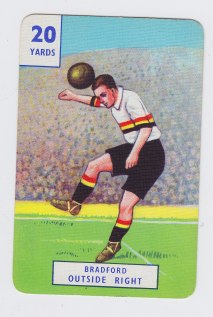
Pepys Its a goal game 1950

Given the common ancestry of Bradford Bulls (a name change from Bradford Northern in 1996) and Bradford Park Avenue it would be fitting for the latter to revive its traditional red, amber and black colours as first choice team strip in place of green and white. That however is another emotive debate!

John Dewhirst

POSTSCRIPT: Bradford Park Avenue remained at Horsfall Stadium during the 2018/19 season, presumably having been unable to agree terms with Bradford Bulls or maybe because they just couldn’t face going to Odsal!

Thanks for visiting my blog. Scroll down for details about my books in the BANTAMSPAST History Revisited series which tell the history of sport in Bradford – and in particular football. The books seek to explain why things happened as they did instead of simply recording what occurred and readers may be surprised at the extent to which they contradict many of the myths and superficial narratives that have circulated previously.

If you are interested in Bradford sport history visit VINCIT: http://www.bradfordsporthistory.wordpress.com

Links to other articles written by myself on the history of football and the origins of sport in Bradford HERE

On Saturday 19 May, 2018 I am giving a talk in the Bradford Local Studies Library on the origins of spectator sport in nineteenth century Bradford and the development of the city’s sporting culture and identity. This will cover principally cricket, rugby and football and include a Q&A session.

Further details tbc.

Tweets @jpdewhirst
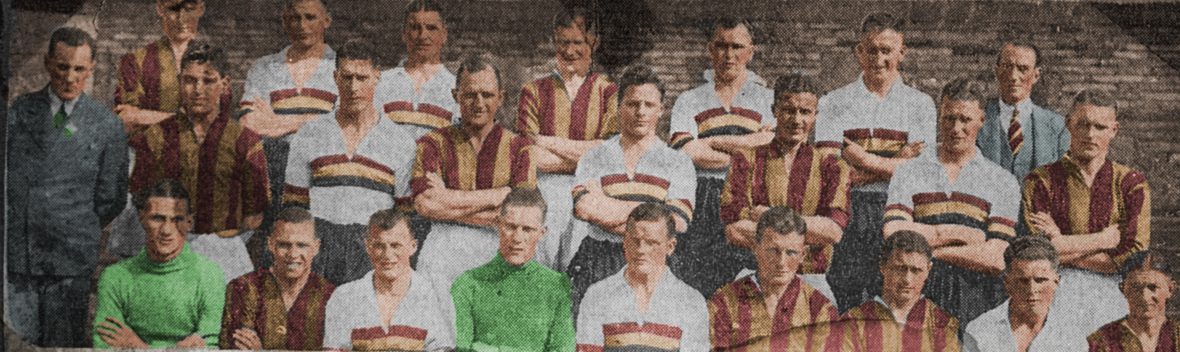
Bradford AFC, 1895-99

My feature published in the Bradford City AFC match day programme on 24 March, 2018 (vs Gillingham, League Division One).

In 1903, Manningham FC converted to association football because Northern Union competition was no longer viable and thus ended 23 years as a rugby club. A return to the (amateur) Rugby Union at Valley Parade was also considered but the case for soccer was too great. Bradford City AFC – the ‘AFC’ being a deliberate statement to avoid any ambiguity about the code of football – became the first in West Yorkshire to join the Football League. Within a few years it was joined by Leeds City (1905), Bradford Park Avenue (1908) and Huddersfield Town (1910). Later, in 1921 Halifax Town became a founder member of Division Three (North). It didn’t take long for association football to have become established in West Yorkshire, a scenario that had appeared highly unlikely only the previous decade.

The year 1895 is remembered for the split in English rugby and the launch of the Northern Union (forerunner of the Rugby League) that permitted the payment of so-called ‘broken time’ expenses to players. A related development was the launch of soccer clubs in Bradford, Halifax, Huddersfield and Leeds in 1895 followed by Dewsbury the year later, promoted by the respective rugby clubs in those towns. In Bradford however it was the Park Avenue club rather than Manningham FC who became involved, co-opting the Buckstone Park side based at Apperley Bridge to establish a soccer section (pictured above in 1895/96).

Manningham FC was a founder member of the West Yorkshire FA in 1896 yet never formed its own section. The explanation for this was probably a lack of suitable players to recruit combined with practical concerns about groundsharing. Nevertheless Valley Parade hosted a semi-final of the Leeds Hospital Cup in 1896 and the final of the West Yorkshire FA Cup in 1897 although the first ever soccer game at the ground is understood to have been a ladies match on 7 May, 1895.

In March, 1894 Bradford FC had played an exhibition rugby match at Goodison Park in Liverpool which had opened two years before and the visit opened the eyes of club officials to the commercial potential of soccer. The Park Avenue leadership had been proud of the club’s status as the richest rugby club in England and its acclaimed sports ground but the new home of Everton set a higher standard altogether.

Faced with the uncertainty of the Northern Union, association football was identified in 1895 as a better commercial proposition than professional rugby. It was therefore something of an insurance policy and once the new breakaway competition became established there was a marked drop in enthusiasm for soccer at Park Avenue. That said, few rugbyites had much interest in soccer and Bradford FC members lobbied the management committee to withdraw financial support.

The Bradford side existed for no more than four seasons and in 1899 was disbanded, ironically at the stage when schoolboy soccer was becoming increasingly popular in Bradford. The Leeds, Huddersfield and Halifax teams were also wound-up around this time. The Bradford FC soccer section was latterly based at Birch Lane, home of Old Bowling CC which had an adjacent football field (also used by Bradford Northern between 1908-34). Other than winning the Leeds Hospital Cup in 1896 it had an undistinguished record. Nevertheless the decision to disband came to be regretted by the club’s guarantor, Harry Briggs who later championed conversion to soccer and the abandoning of rugby at Park Avenue in 1907.

Former members of the Park Avenue soccer section proved influential in the development of the game at a local level in Bradford and the formation of the Bradford & District FA in 1899. In 1901 leading members of the B&DFA were instrumental in the launch of a team at Greenfield, Dudley Hill that was intended to be the de facto representative of Bradford and which was called ‘Bradford City’. They later came to see the potential of Manningham FC’s conversion and hence the Bradford City name was adopted at Valley Parade.

—————————————————————————————————————————-

—————————————————————————————————————————–

Thanks for visiting my blog. Apart from publishing my BCAFC programme articles I also upload occasional articles of historical interest. Scroll down for details about my books in the BANTAMSPAST History Revisited series which tell the history of sport in Bradford – and in particular football. The books seek to explain why things happened as they did instead of simply recording what occurred and readers may be surprised at the extent to which they contradict many of the myths and superficial narratives that have circulated previously.

Tweets @jpdewhirst

Links to other articles written by myself on the history of football and the origins of sport in Bradford HERE

On Saturday 19 May, 2018 I am giving a talk in the Bradford Local Studies Library on the origins of spectator sport in nineteenth century Bradford and the development of the city’s sporting culture and identity. This will cover principally cricket, rugby and football and include a Q&A session.

Further details tbc.

Bradford’s second FL club

My feature in the Bradford City matchday magazine on 14 March, 2018 (vs Wigan Athletic, League One)

In June, 1908 Bradford became home to two Football League clubs and City – the newly crowned champions of Division Two – were joined by Bradford Park Avenue.

The Bradford club had abandoned rugby at Park Avenue the previous year and been elected to the Southern League. At the end of February, 1908 it was announced that the club intended to resign its place in preference of an application to the Football League. It followed QPR and Tottenham Hotspur giving notice of their own resignation from the Southern League.

The Park Avenue leadership was concerned that if it did not make the move, its own ambitions for a place in the Football League could be thwarted. It came at a time when its finances were under pressure from falling gates and the expense of travel. It was not simply the cost of travelling to southern venues but the commitment to reimburse southern clubs coming to Bradford. What was an expensive pledge had been made by Bradford Park Avenue to secure a place in the Southern League after its original application to join the Football League was rejected in 1907.

The Southern League was a rival competition but there had been speculation about merger and becoming a feeder to the Football League which was predominantly northern in its composition. The concern in Bradford was that with the loss of Spurs, it would make the Southern League less attractive. Likewise, there was a fear that the pre-emptive move by the two London sides might lead to the door being closed to others seeking a switch in future years. (The Southern League was anxious to maintain its integrity to optimise negotiations with the Football League for merger.)

The leadership of the Southern responded to the actions of the three recalcitrant clubs by telling them they would not be readmitted to membership. Hence the notice of resignation by Bradford Park Avenue amounted to a high risk venture if it was not successful in getting a place in Division Two.

In 1907 there had been opposition among members of the Football League of there being two Bradford clubs. The Valley Parade leadership had also lobbied against Park Avenue’s membership, fearing the impact of direct competition. Notwithstanding, there were sympathies for Bradford Park Avenue who could boast financial security and a prestigious ground. Crucially with Bradford City anticipated to win promotion to Division One it was considered acceptable for Avenue to join Division Two. Indeed, Bradford was considered a hotbed of soccer enthusiasm in West Yorkshire.

Incredibly when the vote eventually took place, Bradford Park Avenue polled more than Spurs and became members of the Football League at the expense of Lincoln City. However, Tottenham secured a place when Stoke City dropped out of the Football League due to financial difficulty. QPR meanwhile withdrew its application and returned to the Southern League.

Six years later Bradford Park Avenue won promotion to Division One and in 1914/15 – as well the first two post-war seasons in 1919/20 and 1920/21 – Bradford had two first tier clubs.

  • Thanks for visiting my blog. Scroll down for details about my books in the BANTAMSPAST History Revisited series which tell the history of sport in Bradford – and in particular football. The books seek to explain why things happened as they did instead of simply recording what occurred and readers may be surprised at the extent to which they contradict many of the myths and superficial narratives that have circulated previously. You won’t get fancy art school graphics but you will find substance and historical accuracy in the content. Of course if you prefer an abundance of pictures accompanied by text written for a Year 5 schoolchild you’ll find them ball-achingly boring. Tweets @jpdewhirst

If you are interested in Bradford sport history visit VINCIT: http://www.bradfordsporthistory.wordpress.com 

Links to other articles written by myself on the history of football and the origins of sport in Bradford HERE

On Saturday 19 May, 2018 I am giving a talk in the Bradford Local Studies Library on the origins of spectator sport in nineteenth century Bradford and the development of the city’s sporting culture and identity. This will cover principally cricket, rugby and football and include a Q&A session.

Further details tbc.

Tweets @jpdewhirst

Pompey’s Chimes

My feature to be published in the Bradford City matchday programme vs Portsmouth, League One fixture 2017/18 (originally scheduled for 3rd March, 2018)

Nowadays we take it for granted that there is singing at football matches and whilst it tends to be associated with Liverpool in the 1960s, communal singing has in fact been a phenomenon at Valley Parade since the earliest years of Bradford City.

The practice was influenced in part by music halls where entertainers would invoke sporting rivalry as a means of engaging with audiences. In January, 1896 for example there is an account of a ‘Widow Twankey’ appearing in a pantomime in the claret and amber colours of Manningham FC (the rugby predecessor of Bradford City AFC). It was reported that it produced an effect similar to that produced by exhibiting a red rag to an infuriated bull. The audience, which evidently comprised a majority of Bradford FC supporters, only stopped booing when the performer re-appeared in red, amber and black.

On Boxing Day, 1903 the Bradford Daily Argus reported that ‘Bradford City is duly mentioned in the Theatre Royal panto. One of the comedians sings a jingle verse about the new club, and winds up with ‘McMillan and Graham, and all the boys will soon be at the top of the sheet.’ There is a chorus about City going in for the English Cup.’ In this way community singing was linked to football and it is quite possible that the same verse came to be sung at Valley Parade.

Earlier still, singing was actively encouraged. Writing in the Bradford Daily Telegraph in September, 1903, ‘Sportsman’ – a confessed rugbyite – remarked on a man with a cornet who led the ‘Pontoon Chorus’ at Blundell Park which was the Grimsby Town anthem. He declared ‘We should like to see such enthusiasm in connection with football in Bradford.’ The Grimsby supporters impressed the Bradfordians with their singing and in April, 1904 the Yorkshire Sports reported that the Valley Parade regulars were amused by the ‘Hello’ chorus sung by the Grimsby ‘Pontoon Choir’ during the return game. It explained that the origin of this had been the visit in 1901/02 for an FA Cup tie reply of Portsmouth supporters who sang the Cambridge chimes using the words ‘Hello, Hello’. The chorus was adopted in Cleethorpes and at the Boulevard (rugby) ground in Hull. The ‘Hello, Hello’ chorus was subsequently embraced at Valley Parade and became such a favourite that in 1946 it was even recorded on a 78rpm vinyl. It is a vivid illustration of how football singing was – and continues to be – spread by example and I recall that the same ‘Pompey Chimes’ inspired a City version shortly after we renewed fixtures with Portsmouth FC in 1977/78.

In April, 1905 2,000 City fans travelled to Blundell Park and the Bradford Daily Telegraph reported that ‘…a monotonous chant was kept up and when at last City did score the excitement found full vent. Bradfordians howled with delight. Trumpets, rattles and every other imaginable instrument of torture swelled in a Spanish fandango, and a crowd of spectators danced with glee upon the field.’

By 1905 there were numerous references to a musical hall song from the previous year having been adopted by supporters of a number of clubs. ‘Are we downhearted?’ was a song of cheery stoicism and became another Valley Parade anthem.

By John Dewhirst

  • Thanks for visiting my blog. Scroll down for details about my books in the BANTAMSPAST History Revisited series which tell the history of sport in Bradford – and in particular football. The books seek to explain why things happened as they did instead of simply recording what occurred – readers may be surprised at the extent to which they contradict many of the myths and superficial narratives that have circulated previously.  Tweets @jpdewhirst

Links to other articles written by myself on the history of football and the origins of sport in Bradford HERE

On Saturday 19 May, 2018 I am giving a talk in the Bradford Local Studies Library on the origins of spectator sport in nineteenth century Bradford and the development of the city’s sporting culture and identity. This will cover principally cricket, rugby and football and include a Q&A session.

Further details tbc.

Tweets @jpdewhirst
Features about the origins of sport in Bradford

Thanks for visiting my blog! [Home page] This post provides links to articles I have written about the origins of sport in Bradford, the development of commercialised sport in the nineteenth century and the early history of cricket, rugby and soccer in Bradford.

My background

I am a longstanding supporter of my local club, Bradford City and have an extensive collection of football memorabilia.

My interest in sports history has been shaped by a number of influences but principally stems from a fascination with the history of Bradford, its industrial and urban development as well as its social history. I have collected football artefacts as a means of connecting with the past and strongly believe that history – and indeed the history of sport – can be told through objects. Having studied economic history at university, and as an accountant specialising in undertaking business reviews and providing support to off-plan businesses, I also have a particular interest in the evolution of sport as an industry in itself.

These themes are evident in my most recent books which seek to examine the history of football clubs as commercial organisations, to understand how financial circumstances in the past dictated decision-making and outcomes. My books also feature a wealth of historic memorabilia illustrated in colour as a means of making relics accessible to a wider audience.

I was co-founder of The City Gent (Bradford City) fanzine in 1984. I have authored four books on the history of Bradford football and the origins of sport in the district and been involved in the production of five others. I am currently writing a history of the Bradford City / Park Avenue rivalry which will be the sixth volume in the BANTAMSPAST ‘History Revisited’ series. (NB Another title featuring sport in nineteenth century Bradford is also planned, details to be announced later.) You can find details of the books on this site from this link. Copies of A HISTORY OF BRADFORD CITY AFC IN OBJECTS, ROOM AT THE TOP and LIFE AT THE TOP are still available and can be purchased direct from the publisher, BANTAMSPAST, PO Box 307, SHIPLEY BD18 9BT price £20 each including postage (cheques payable to BANTAMSPAST).

I have contributed a series of articles to the Bradford City AFC programme during the 2017/18 season and these are published on this site. They feature varied themes from the origins of soccer in Bradford  / the Boar’s Head identity / the influence of the military on sport in Bradford / the origins of Valley Parade and its early development / the story behind how BCAFC became known as the Bantams and various topics relating to the history of both City and Bradford Park Avenue.

Also published on this site are a number of other varied articles, from the history of railways in Bradford to the story of Harry Garnett of Bradford FC (also a former RFU President).

I have written a number of articles about the origins of Bradford sport which have been published variously on the following websites:  PLAYING PASTS and VINCIT, an online journal of Bradford Sport History as well as The World Rugby Museum website

These, as well as planned future articles, are summarised below.


Published on PLAYING PASTS

The role of social networks on the early development of football 

The case of Bradford FC and the origins of football as a business

The origins of professional football in Bradford

Reconsidering 1895 – a Bradford perspective


Published on the World Rugby Museum website…

Bradford’s contribution to rugby history 


Published on VINCIT

The significance of sport in shaping a Bradford identity 

History of the Bradford Charity Cup

Compendium of Bradford sports club names  

The late development of soccer in Bradford 

What’s in a name? Semantics about Bradford City and Park Avenue  

John Nunn, Bradford physical aesthete

The story of the Belle Vue Hotel, a nineteenth century pub adopted as a sports headquarters in Bradford 

150th anniversary of football in Bradford, 1867-2017

The history of Bradford rugby and the case to reassess the split in English rugby in 1895  My findings from investigation of the origins and development of Bradford football provide sufficient evidence to challenge the orthodox view that the split in English rugby was driven by social class as opposed to the economics of sport.

Bradford’s rugby heritage  


Other articles are scheduled in coming months on the following subjects:

  • the origins and early history of cricket in Bradford;
  • the story of the long forgotten junior rugby clubs in late Victorian Bradford;
  • the origins of soccer in Bradford;
  • the history of sports journalism in Bradford;
  • the political history of Odsal Stadium; and
  • the influence of the railways on Bradford sport.


International Football History Conference, Manchester 2018

In June, 2018 I am presenting a joint paper with Professor Wray Vamplew at the City Football Academy, Manchester examining the transformation of sport from a recreational activity to an entertainment business, specifically with regards to the experience in Bradford and Glasgow. This will form the basis of two planned academic papers to be published later this year.

ROOM AT THE TOP and LIFE AT THE TOP provide a detailed account of how football – both rugby and soccer – became commercialised in Bradford and provide what may be the first business history of English rugby clubs.


Bradford Library – Presentation May 2018

On 19 May, 2018 I am giving a presentation at Bradford Library to talk about the origins of sport in Bradford, covering cricket, rugby and football and the early history of sport in the town. I will also be answering questions about my recent books.

JD Sporting Heritage of Bradford 19-May-18

Anyone wishing to contact me or collaborate can do so through a DM tweet, refer my account @jpdewhirst


50th Anniversary of a memorable defeat

My feature published in the Bradford City AFC v Bury programme on 10th February, 2018:

Younger supporters struggle to comprehend that until 1970 there were two Football League clubs in Bradford. As will be told in my forthcoming book Wool City Rivals, it defied financial gravity that Bradford could support both clubs for so long and there is little prospect of the phenomenon ever being repeated. The existence of two senior sides in Bradford undermined the finances of each and goes a long way to explain why neither City nor Bradford were particularly successful. (Older fans will remember that it was the Park Avenue club who were known as Bradford and the contemporary abbreviation of Bradford City to ‘Bradford’ is not one of historical validity.)

Although a reformed Bradford Park Avenue club was established in 1988 (and now plays at Horsfall), little remains of the original ground at Park Avenue as a reminder of its place in Bradford sports history. Opened in 1880, Park Avenue was intended as a multi-activity venue for cricket, athletics and football. The bottom third of the site staged rugby until the so-called ‘Great Betrayal’ in 1907 and thereafter soccer. After 1908 it hosted Football League fixtures (and from 1970, Northern Premier League games) but was abandoned in 1973 and then finally demolished in 1980.

Park Avenue was a popular venue and arguments persisted that it was the better soccer stadium in the city. Certainly it was a ground with character albeit one that was constrained in terms of its footprint which would have restricted options for modern redevelopment. Even in its prime, Park Avenue had a lower capacity than Valley Parade and the respective record attendances were 39,146 (1911) and 32,810 (1944).

The final demise of the Bradford (PA) club was pitiful and during its last three seasons in the Football League it managed no more than 15 wins. After finishing second from last in 1966/67 it was rock bottom of the fourth division between 1967/68 and 1969/70. The club relied upon the ‘Old Pals’ Act’ to be re-elected until eventually other clubs lost patience and in June, 1970 Bradford was replaced by Cambridge United.

Of those 15 League victories during the final three seasons in the Football League, only one was secured away from home and the last time that Bradford (PA) won away was on 10 February, 1968. However the 50th anniversary is unlikely to be celebrated at Valley Parade because against the run of form, Avenue defeated City 2-1. It proved to be the club’s last win of the season. City, who had been top of the division, dropped to third and in the end missed promotion by a single point.

The derby fixtures were keenly awaited by supporters of both sides and this particular game was attended by 11,513. By contrast the average crowd for City’s other home games in the fourth division in 1967/68 was only 7,152.

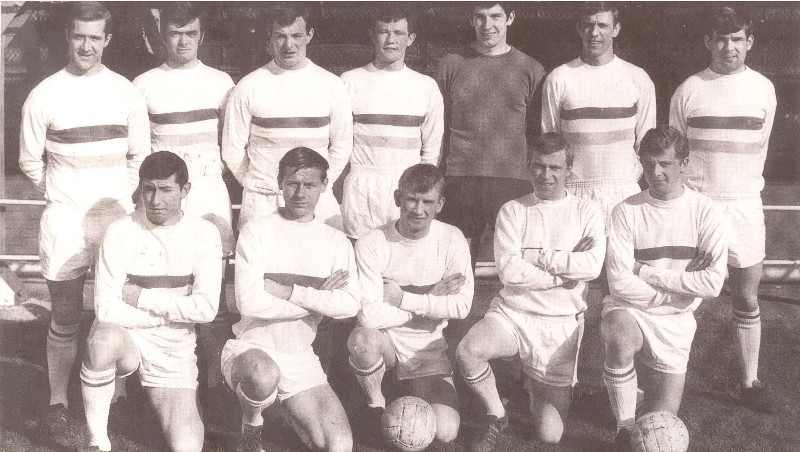
BPA 67-68

Pictured: Bradford (PA) AFC 1967/68 in the home kit of white shirts with single red and amber circlets.

Out of 52 contests in the Football League, City won 20 and Avenue 21. In November, 1968 the final derby at Valley Parade resulted in a 1-0 home win and the last ever derby at Park Avenue the following January was a 0-0 draw. The Bradford (PA) club was liquidated in 1974 after a final season ground-sharing at Valley Parade. Subsequent to its demise a good proportion of the remaining supporters opted to follow clubs other than Bradford City such was the ill-feeling.

To keep the memory of the City / Avenue rivalry alive my new book will feature surviving relics and artefacts of the two clubs and I appeal to anyone who has (pre 1970) memorabilia to help me make this a comprehensive record for posterity. It is not going to be an art school project and the book will be produced in the same style as the earlier title, A History of BCAFC in Objects.

—————————————————————————————-

Thanks for visiting my blog. Apart from publishing my BCAFC programme articles I also upload occasional articles of historical interest. Scroll down for details about my books in the BANTAMSPAST History Revisited series which tell the history of sport in Bradford – and in particular football. The books seek to explain why things happened as they did instead of simply recording what occurred and readers may be surprised at the extent to which they contradict many of the myths and superficial narratives that have circulated previously. You won’t get fancy art school graphics but you will find substance and historical accuracy in the content. Of course if you prefer an abundance of pictures accompanied by text written for a Year 5 schoolchild you’ll find them ball-achingly boring. Tweets @jpdewhirst
————————————————————————————–

Read more about the early history of Bradford soccer in my books ROOM AT THE TOP and LIFE AT THE TOP

If you are interested in Bradford sport history visit VINCIT: https://www.bradfordsporthistory.com

On Saturday 19 May, 2018 I am giving a talk in the Bradford Local Studies Library on the origins of spectator sport in nineteenth century Bradford and the development of the city’s sporting culture and identity. This will cover principally cricket, rugby and football and include a Q&A session.

Further details tbc.

Tweets @jpdewhirst
Memories of 1977/78

My feature in the Bradford City programme published on 27 January, 2018:

Forty years ago Bradford City were in the midst of a struggle against relegation. Promoted the previous season after going unbeaten at home during 1976/77, there had been big hopes that the club could consolidate at a higher level.

A number of changes were introduced including a fairly radical new programme design that incorporated action photos for the first time (albeit in black and white). The home strip was manufactured by Litesome in Keighley but the cost of the new modern style was the replacement of amber by canary yellow. There was also a radical new away strip – a claret shirt with a yellow V, white shorts and claret socks. It turned out to be one of the least worn kits and could not have been used more than a handful of times. (For 1978/79 Litesome was replaced by Admiral and so it disappeared altogether.)

City struggled in Division Three and strengthening of the squad during February, 1978 came too late. The new record signings Mick Wood and David McNiven were popular but insufficient to make the necessary turnaround. It proved to be a disappointing campaign and the club finished 22nd to make a swift return to the basement.

It was nonetheless a memorable season and there could not have been a more remarkable game at Valley Parade than that against Wrexham on Boxing Day in 1977 when City scored two goals in the last minute to secure victory against the leaders and eventual champions. The first of those was recorded as an own goal and the second was credited to Don Hutchins but it was the City winger who made both. Having dominated the match, the Welshmen had been ahead 1-0 thanks to a 46th minute goal from Dixie McNeal but it proved insufficient and Wrexham suffered their first defeat in 18 matches.

The abandoned fixture at Plymouth was mentioned in a previous feature. Others that come to mind were games at Deepdale and Hillsborough where there were large followings from Bradford. Unfortunately both ended in defeat but at the time it made a refreshing change for the team to be supported away by good numbers.

At Valley Parade the biggest crowd was 12,825 for the Sheffield Wednesday match in October, 1977 which was well above the average 5,103 gate for league games. The lowest attendance was 3,203 against Lincoln City in December, 1977. In the FA Cup, City were defeated in the first round by Crewe Alexandra at Valley Parade in front of a crowd of 5,068.

The 1977/78 season was the first for Wimbledon FC in the Football League having been elected in place of Workington. Wimbledon struggled to attract crowds to its Plough Lane ground and in 1979 the club was even reported to have considered a move to Milton Keynes. In fact Wimbledon FC only played 14 seasons in the Merton Borough of London as a Football League club. It then spent 12 seasons in a ground-sharing arrangement at Selhurst Park between 1991-2003 before relocating to Milton Keynes, reincarnated as the MK Dons.

Thanks for visiting my blog. Apart from publishing my BCAFC programme articles I also upload occasional articles of historical interest. Scroll down for details about my books in the BANTAMSPAST History Revisited series which tell the history of sport in Bradford – and in particular football. The books seek to explain why things happened as they did instead of simply recording what occurred and readers may be surprised at the extent to which they contradict many of the myths and superficial narratives that have circulated previously. You won’t get fancy art school graphics but you will find substance and historical accuracy in the content. Of course if you prefer an abundance of pictures accompanied by text written for a Year 5 schoolchild you’ll find them ball-achingly boring.  Tweets @jpdewhirst

Laughing altogether: the new Super L666ds badge

scum

There’s nothing better than a Super Leeds Chuckle, the equivalent of the ‘Leeds Salute’ enjoyed by those of us who enjoy a good laugh at the latest exploits of that team east of Pudsey.

For a club that has been adventurous in the design of football crests, their new Mussolini / Gaviscon inspired badge is a classic deserving to be remembered. The designer responsible should be congratulated. No longer will Super Leeds appropriate the Yorkshire rose and at last they have a stylish badge that truly epitomises the passion (sic) of their fans.

Leeds United claim that the design has benefited from the feedback of 10,000 of their supporters. And I believe them because the new badge likely appeals to the neanderthal element in their support. It blows away any pretence of a family friendly club and instead celebrates the borish morons who have defined the reputation of Super L666ds. It is a badge that will remind people of exactly what kind of supporters Leeds United attract – the ones we remember setting fire to a chip van at Odsal and lobbing seats on the pitch at Valley Parade.

The biggest laugh may yet be to come. Don’t rule out the possibility that the Elland Road executives have ordered new shirts and merchandise bearing the design. The release of the new badge in January hints that the timetable was based on production schedules in China and the likelihood that a button has already been pressed. Pity the L666ds luvvies who are upset, it might just be too late for the decision to be reversed.

The development of commercialised spectator sport in c19th: the example of Bradford and Glasgow

I am co-presenting with the celebrated sports historian, Wray Vamplew at the 2018 International Football History Conference in Manchester.

Our subject is the commercialisation of sport in the nineteenth century with a focus on what happened in Bradford and Glasgow. Both cities experienced a dramatic economic transformation in the second half of the century that impacted on all aspects of life including sport. The developments in the two cities were remarkably similar notwithstanding differences of geography, history, industrial activity and the dominant football code.

The event features a good number of speakers with a broad range of subject content. Further details can be found at: https://www.eventbrite.co.uk/e/international-football-history-conference-7-8-june-2018-tickets-42168351675

I am co-authoring a publication with Wray on the subject later this year and details will be posted on this blog.