The origins of The City Gent magazine

Next month marks the 35th anniversary of the launch of The City Gent, now in its 221st issue. Anniversaries invariably bring with them a combination of self-congratulation and retrospection but often the memories are incomplete. As co-founder, intimately involved with the project from its conception in 1983 until 1988 (when I handed over to Mick Dickinson as editor) this is my version of the origins and early development of The City Gent, distinct from the imagined history told in a recent podcast.

IMG_0044.jpg

The timing of the launch of The City Gent coincided with Brian Fox, Jon Burgess and myself returning to Bradford from university in 1984. We had talked about producing a Bradford City-centric publication the previous year and what finally brought the project to fruition was the fact that Brian was keen to establish credentials to secure a job as a journalist. He was the creative writer and I was the organiser who managed the printing and the logistics. Jon was the third member of the original team, a former fellow pupil at Bradford Grammar School who lived close to Brian in Thornton. However, he moved away to Peterborough shortly after the launch of The City Gent and so was not as actively involved. John Watmough later managed sales of The City Gent and took responsibility for subscriptions.

All three of us collected football programmes and were acutely aware of the poor standard of the City programmes as well as familiar with what good looked like. If we had been given the chance, I think we’d have jumped at producing the programme and you will find quite a lot of mention about club programmes in early issues of The City Gent. We were all members of City Travel Club ’73 (Bradford) and travelled to most away games. At a CTC meeting John Watmough had shown us a copy of Terrace Talk, a publication produced by supporters at York City (first published in November, 1981) and we had also become aware of Wanderers Worldwide, a similar publication from Bolton (first published in 1983). However, it was the Bantams Review publication sold in the club shop during the 1983/84 season and which ran to three issues that was the real inspiration for The City Gent.
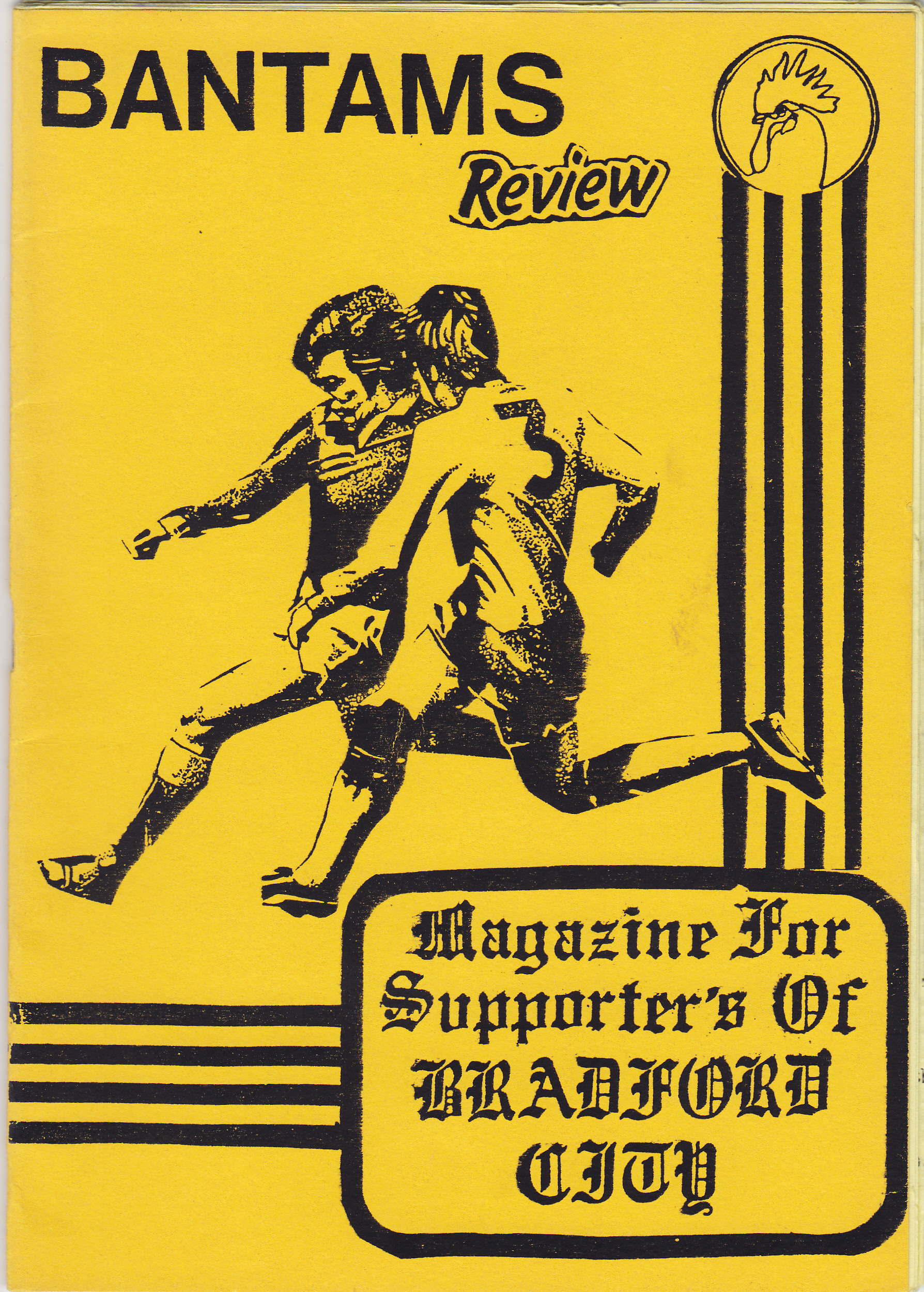
Mar-84 B Rvw.jpg

Bantams Review was published by Raymond Maul, a local programme dealer and its pages devoted extensive coverage to City collectables. The standard of the editorial was poor and we knew that we couldn’t do any worse. More to the point, the existence of Bantams Review demonstrated that it was feasible to self-publish and it gave us the self-confidence to go ahead with our own project. The choice of title was instinctive: we all had fond memories of the City programme cover from 1966-74 and wanted a return of the character – and striped shirts – to Valley Parade. (The background to the City Gent character is told here.)

Our objective was to provide news and comment about Bradford City at a time when there were few other sources. We also saw The City Gent as a means to foster positive impressions about the club. Brian, Jon and I had all just finished at university where we’d seen ourselves as ambassadors of Bradford City among our peer groups and had countered the usual prejudices about Bradford.

As regards the influence of punk fanzines I can categorically state that this was not a factor, despite being fond of new wave and punk music (and a keen Stranglers fan to this day). Although I was familiar with self-published music fan sheets, I found a lot of them pseudo-intellectual and arty. If I had to cite an influence it would have been involvement with a college magazine whilst at Oxford and it wasn’t until around 1986 that I had even heard of ‘fanzines’. From the start we described The City Gent as an independent supporters’ magazine and it was essentially a publication that focused to a large extent on the affairs of CTC’73.

(It has tended to be overlooked that a number of early independent supporters’ publications were similarly connected with supporters’ clubs, for example Red & White of Middlesbrough FC / Boro Supporters Club in 1979/80  or even The Kick Off produced at Park Avenue between 1946-47 – refer link below.)

There was never any thought given to the sort of abstract titles that later became commonplace among fanzines elsewhere. From the outset we were practical and focused on financial viability. For instance, the choice of title was considered suitable to appeal to a wide audience and yellow covers were adopted so that the magazine could be seen on the terraces and sellers made visible. The editorial style was also deliberately responsible and whilst we didn’t shy from controversial comment, we sought to be balanced and fair in what we wrote. For the record, the Soviet style iconography adopted by The City Gent is not to be confused with ideological leanings. It was entirely tongue in cheek, inspired by my own travels behind the Berlin Wall as a student.

Initially The City Gent was published as the magazine of CTC but it was later made stand alone to avoid the impression of being too narrow based or cliquey. Nonetheless, strong links with CTC continued and its away trips were given coverage in The City Gent. The CTC had been established in 1973 in response to the parent club declining to arrange coaches to away games and was fiercely protective of its independence. In 1984 for example the members rejected overtures from Bradford City AFC (encouraged by the police) for away travel to once more be co-ordinated by the football club and it is fair to say that The City Gent shared the same independent mindset.

In the late 1980s the emergence of football fanzines – publications produced independently by supporters and on a non-commercial basis – was an unprecedented phenomenon in British football and it didn’t take long before academics began offering profound explanations about what had given the impulse to their emergence. Inevitably it all started to become contorted as a major sociological affair, frankly unrecognisable to what I remember having occurred. It seems that people are still fond of attributing deep and meaningful explanations for what, as far as we were concerned was virtually an impromptu and spontaneous initiative.

As one of the first and now the longest surviving fanzine at any club in Great Britain, The City Gent has been held up as an example of one of the pioneering publications at the vanguard of the so called fanzine movement that had emerged by 1987. I won’t deny that The City Gent was considered influential in those formative years – I was told as much by supporters of other clubs during my time as editor – but we never considered that we were riding a wave of fashion as a generic football fanzine. My explanation for how the phenomenon came about is that supporters at different clubs wanted to emulate what was happening elsewhere, including imitation of what had been achieved at Bradford. It was a basic competitive impulse that harnessed the passion of supporters for their club and seeing that it could be done elsewhere provided the inspiration. (NB It’s hardly different nowadays with regards to the phenomenon of internet blogs.)
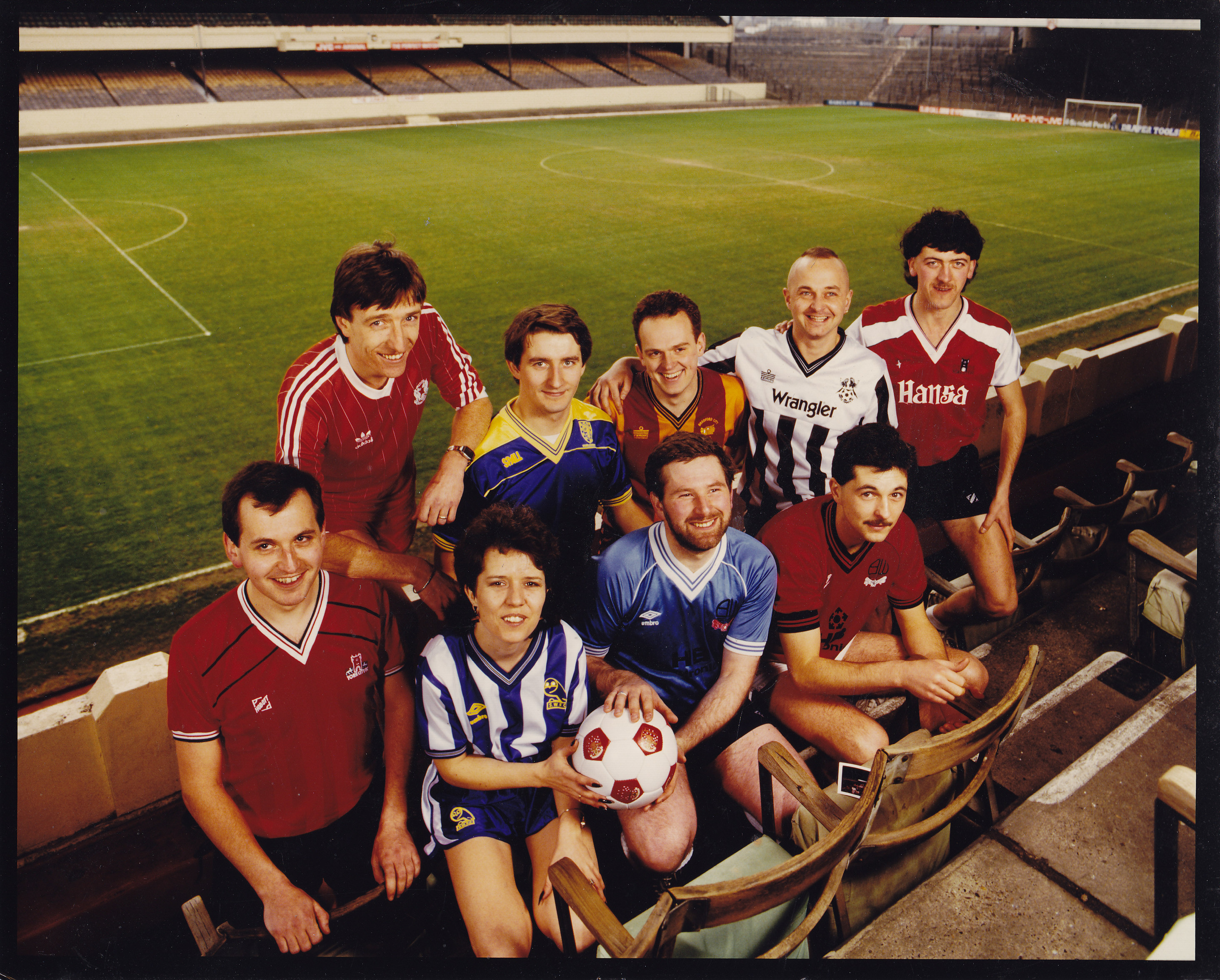
highbury 1986.jpg

Pictured: Observer magazine feature on football fanzines at Highbury in 1986

For sure The City Gent became extensively networked with fanzines around the country and it brought us in touch with people with similar ideas and attitudes. We were open in sharing our publishing experience, but I don’t believe we ever saw ourselves as part of a movement as much. We remained polite but in private you could not ignore a massive gulf in standards between fanzines (and more than a few of them were poor).

We always identified first and foremost as a Bradford publication and indeed, The City Gent was essentially about a Bradford identity with its own curry guide. As far as we were concerned The City Gent was a partisan publication with an agenda driven by pride and loyalty to the city. There were other unique circumstances and it is surely no coincidence that The City Gent came of age in the aftermath of the Valley Parade fire disaster at the end of our first season. The best way to describe the publication at that time was as the flag bearer of a revivalist spirit at Valley Parade, what I later described as ‘Bantam Progressivism’.

IMG_0045.jpg

Any doubts that we had shared about the launch of an independent supporters’ publication were soon dispelled and The City Gent was more successful than we ever imagined. By the end of the 1984/85 season we had a print run of 1,800 for example. Whilst all of this was very satisfying it felt as though we had created a monster that increasingly demanded more of our time.

Had the fire not occurred there is a good chance that The City Gent might have been a short-term phenomenon and set aside. However, the aftermath of the disaster provided a purpose to maintain the commitment to continue publishing. Brian’s parents had been badly injured in the fire and we both recognised that we had a part to play in the club’s recovery by continuing to produce The City Gent. Hence if The City Gent had originally been an opportunist venture, by the beginning of its second season it was positioned to play a part in the revival of Bradford City.

By 1986 our circulation averaged around one in six of those watching Bradford City – probably one of the highest readership ratios in the country – and evidence that The City Gent had popular appeal across a broad range of supporters. By virtue of the circulation we were taken seriously and respected by those in charge at Valley Parade. It would be wrong to say that we were part of the establishment but we definitely had a foot in the door because Stafford Heginbotham knew that we could not be ignored or ostracised. All of this was achieved because we didn’t set out to be anti-establishment per se and we were responsible as well as considered in our editorials.

cg10.jpg

The City Gent has had seven editors since 1984. Each of us has shaped the publication in our own vision but it is wrong to say that we have necessarily shared the same outlook or emphasis. To retrospectively project a later vision to ‘explain’ the origins and early development of The City Gent constitutes a remarkable leap of the imagination, one that is entirely at odds with what I remember from back then.

When it comes to people attempting to contextualise The City Gent in broad brush strokes alongside punk fanzines or underground anti-establishment samizdats I just roll my eyes. It is what I describe as sloppy, pretentious history telling for anyone to paint such a picture. In the desperate search for complex, profound explanations to somehow intellectualise and romanticise what happened 35 years ago, the more mundane yet fundamental elements of the story have been overlooked.

We never produced a manifesto but had we done so, the objectives of The City Gent would have been defined roughly as follows:

  • To provide a positive impression of the city of Bradford, its football club and its supporters.
  • To provide a link with the club for exiled Bradfordians and a contact for supporters of other clubs.
  • To encourage constructive debate about the club and its reconstruction.
  • To provide quality reading about the club and its history.

It was as simple as that. The success of the publication came from two basic ingredients: (i) a refusal to compromise on standards; and (ii) hard graft.

The development of The City Gent benefited enormously from securing a cheap printer. From the second issue until the end of the 1984/85 season we used the services of a couple who happened to have a printing press in their basement in Saltaire. It was an unconventional arrangement and on occasions the print quality and rejects left something to be desired. Crucially however it allowed the size and circulation of The City Gent to be expanded without impact on cover price. From the second season we opted for a high street printer which made life much less fraught.

By 1988 I was close to burnout from the effort and handed across to Mick Dickinson as editor. I could no longer afford the time commitment and felt that I had taken The City Gent as far as I could and that it needed new energy and direction. The circumstances of the nearly season (1987/88) were demoralising and hadn’t exactly boosted my enthusiasm to continue. I was also fed up of the petty politics at Valley Parade which had impacted on enjoyment of the football. However, by that stage it was also becoming apparent that the publication was at a watershed.

This slideshow requires JavaScript.

During the first couple of seasons The City Gent had been produced through a combination of ‘typewriter and letraset’. In around 1986 I had invested in a Canon Typestar which was an electric typewriter that printed on thermal paper. The disadvantage was that if the paper output was left in the sun for too long the content on the page would disappear. On the other hand, the technological advance was that the machine had a memory that allowed you to correct anything that had been mistyped on the preceding couple of lines. The savings in Tippex were immediate but it remained a laborious task to type up articles and letters for publication. The following year I invested in an Amstrad home computer and whilst this was primitive by today’s standards it nevertheless represented another leap in technology and getting things done. It also opened the door to new opportunities.
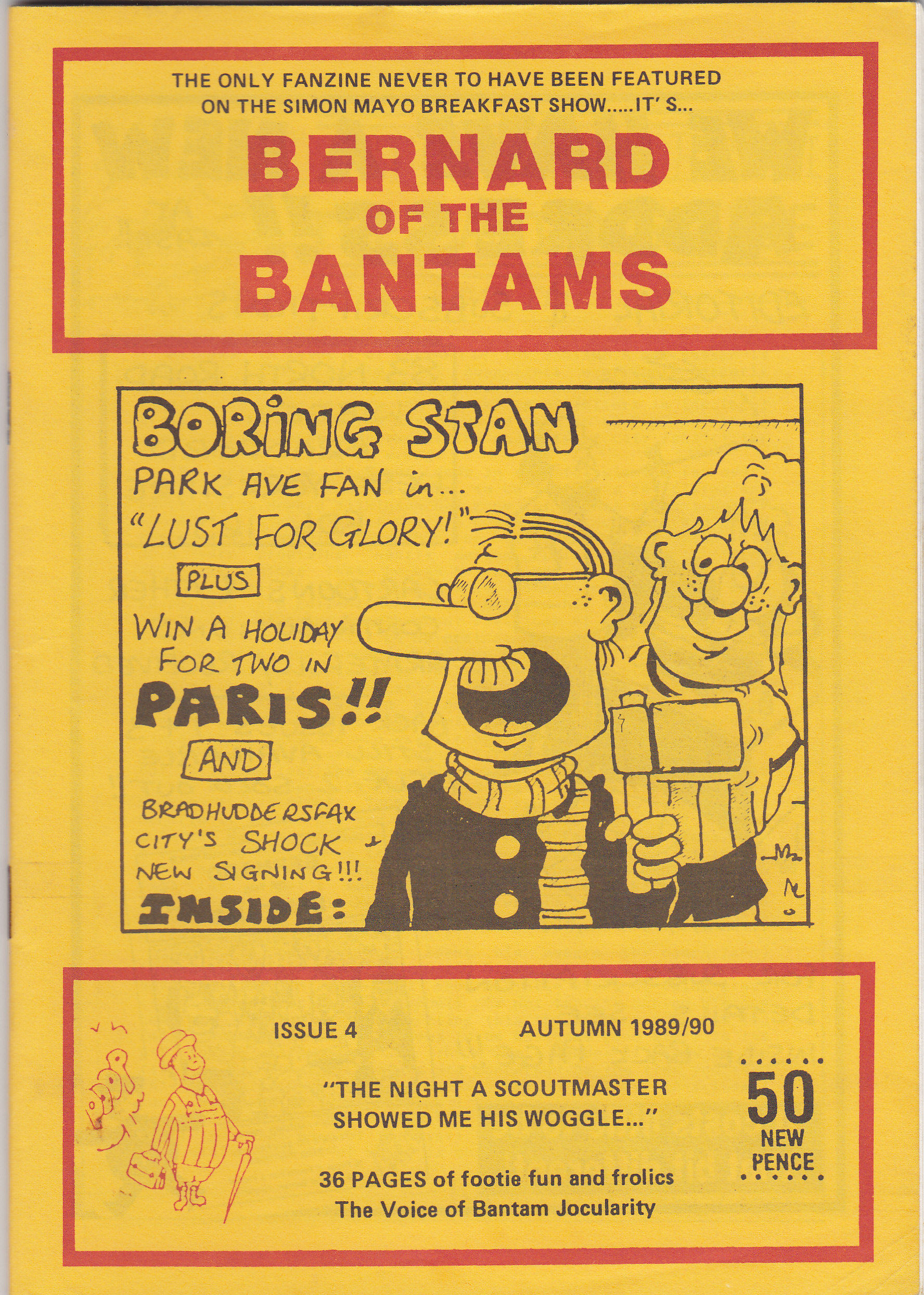
BOTB Sep-89.jpg

Around that time I recall having had conversations with someone who had suggested that a Bradford listings publication could be spun out of The City Gent. In 1986 and 1987 there had already been diversification to publish a range of publications such as the six issue comic series Bernard of the Bantams; an away travel guide; a handbook to promote the relaunch of Bradford Park Avenue; a blank tribute to L666ds United; and even a one-off tongue in cheek fanzine, ‘Und Nun Voll Dampf’ based around the East German side, Lokomotove Leipzig. The concept of a listings magazine was a step too far but I can’t deny that it would have been an interesting project. (NB Even now I think there would be mileage in The City Gent linking with the likes of the Bradford Review to embrace its design and distribution.)

UND NUN VOLL DAMPF Cover

Technology had become a decisive factor in the production of supporter publications by the end of the 1980s. When I retired as editor there was already a growing divergence between a number of titles becoming commercialised and those continuing on a more traditional, amateur basis. By then the fanzine boom was probably past its peak and it seemed that many had become identikit / formulaic with little originality or distinctiveness.

CG back to VP

Looking back, I am proud of what was achieved and the way in which The City Gent helped champion interest in the history of Bradford City (which also led to my own book writing). I believe that we played a big part in bringing supporters together and encouraging a sense of pride. However, what gave me the greatest pleasure was to contribute towards the revival spirit at Valley Parade after the fire. I make no excuses that we were deliberate in fostering and channelling a spirit of positive thinking about how the club could be rebuilt after 1985, including a successful campaign to return to Valley Parade.

The critical success factor of The City Gent was that it did not become overly dependent upon a small number of contributors and this allowed standards and variety of content to be maintained. Likewise, its survival has been due to a succession of people willing to assume responsibility for its production. However, The City Gent benefited enormously from the fact that it never had any serious competition and as a consequence, there was never a fragmentation of effort in Bradford among rival titles. The advantage undoubtedly accrued from the rapid growth of The City Gent in its early existence that gave it a monopoly position at Valley Parade (at least in printed format) it has never lost.

It seems a long time since The City Gent first went on sale at Valley Parade and much has changed since then. However, the emotional commitment of people to their favourite football club remains undiminished. To re-read the pages of The City Gent from those early years is a reminder that the basic experience of supporting a club is much the same and that people do not change, whether directors, supporters or players. The City Gent provides a valuable historical record of life at Valley Parade and yet for all the change so much remains the same in BD8.

Other Bradford football fanzines

The first football supporters magazine in Bradford

Thanks for visiting my blog. The drop down menu above provides links to my features in the BCAFC programme, book reviews and content about the history of Bradford football.

Details of my books in the Bantamspast History Revisited series

Tweets: @jpdewhirst
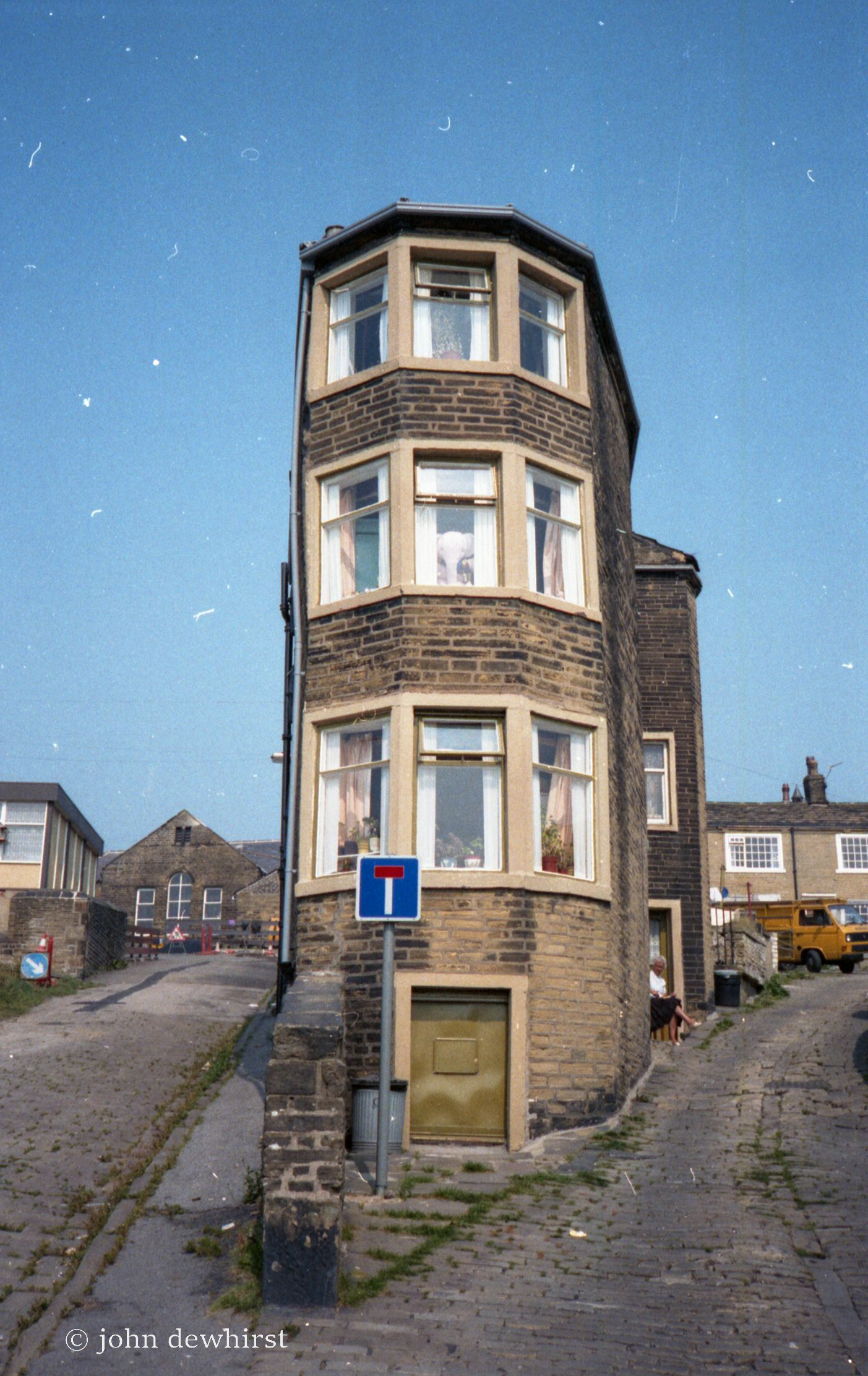
 

72-74 Market Street in Thornton, Bradford was the birthplace of the Brontes. Nearby Coffin End in Havelock Square, Thornton was the birthplace of The City Gent. Pictured here c1985.
Brian Fox with issue #1 of The City Gent

Port Vale, 22nd October 2019

PROGRAMMES OF OLD

Published in the Bradford City AFC match day programme for the above fixture

Port Vale and Bradford City have met on 100 previous occasions in the Football League going back to the first fixture between the clubs in October, 1903 – only the sixth game of City’s debut season in the competition. Between then and the most recent game in February, 2017 there have been 42 wins for the Bantams and 29 for the Valiants.

Of our rivals this season, Port Vale is the club that Bradford City has played the most – Oldham Athletic follow close behind with 99 League games to date – and this season will bring the degree of familiarity level with that of Stockport County with whom they were 102 meetings between 1903-2011.

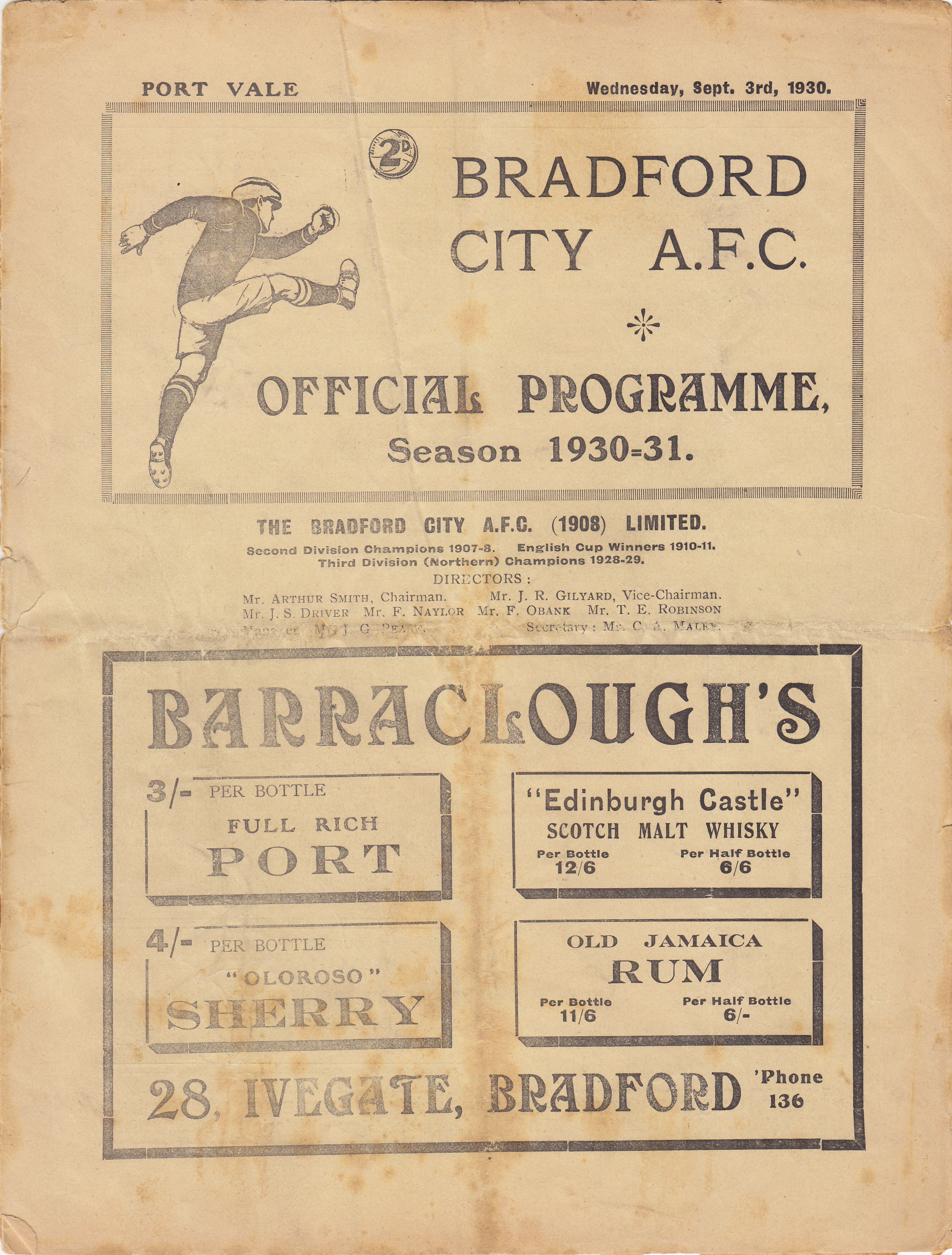
port vale 03-sep-30.jpg

There have been five meetings in the FA Cup albeit with only two wins for City. Forty years ago it seemed that the two clubs could not avoid each other and we were drawn together on three occasions in five seasons between 1978/79 and 1982/83.

October seems to have been a good month for contests with Port Vale. On the first day of that month in 1932 Bradford City secured the club’s highest victory against today’s visitors, a 7-0 win at Valley Parade. This was followed by a 5-0 triumph on 23rd October, 1937.

More recently came a 4-0 win on 29th September, 1998 which was memorable for the brace of goals scored by Lee Mills against his old club. The victory was the third in succession for Bradford City and by the end of that year the club was well placed among the promotion contenders in what was to be a memorable season. What seems remarkable is that the crowd for the game with Port Vale was ‘only’ 13,245, a measure of the extent to which discounted tickets have sustained attendances at Valley Parade.

Scan_20190703 (3).jpgThe programme for that fixture is featured on this page. In contrast to those produced at Valley Parade in earlier years, that for the 1998/99 season marked a distinct improvement in standard. In fact it has only been in the last twenty years that the match day publication of either club could reasonably be described as a ‘match day magazine’.

Until the 1970s there had been little change in the content of either the Bradford City or Port Vale programmes which were equally traditional in their design. The other featured programmes on this page are from September, 1930; December, 1952; and October, 1979. With the exception of a glossy cover on the latter there was little to distinguish them and when compared to the quality of today’s publication they are distinctly minimalist. The irony of course is that despite the leap forward in standard, fewer people nowadays buy a match day programme.

You can find other features about the history of Bradford City AFC on this blog as well as links to other content that I have published previously. The menu provides links to archive images featuring historic photographs of Valley Parade as well as old programmes.

Details of my books.

Tweets: @jpdewhirst

Crawley Town, 19th October 2019

PROGRAMMES OF OLD

Published in the Bradford City AFC match day programme for the above fixture

The first fixture between Bradford City and Crawley Town was in September, 2011 at Crawley and the return was in March, 2012 at Valley Parade. City lost both of those games, the only previous occasion we have competed together at this level in Division Two. The latter game is sadly remembered for the wrong reasons.

We renewed acquaintances in League One in October, 2013 at Crawley and the home side won that game to achieve a 100% record against us. Since then there have been three further games – all of which have been won by Bradford City – and the last meeting was in March, 2015 at Valley Parade.

Despite having only joined the Football League as recently as 2011, Crawley Town have a long history having originally been formed in 1896 as Crawley FC (with the club’s name changed to Crawley Town in 1958). Nevertheless, for most of their existence they have operated as an amateur and semi-professional side. The club’s meteoric rise has been principally in the last ten years and undoubtedly the milestone in the club’s modern history was its rescue from financial difficulty and mismanagement in 2006.

This slideshow requires JavaScript.


You can find other features about the history of Bradford City AFC on this blog as well as links to other content that I have published previously. The menu provides links to archive images featuring historic photographs of Valley Parade as well as old programmes.

Details of my books.

Tweets: @jpdewhirst

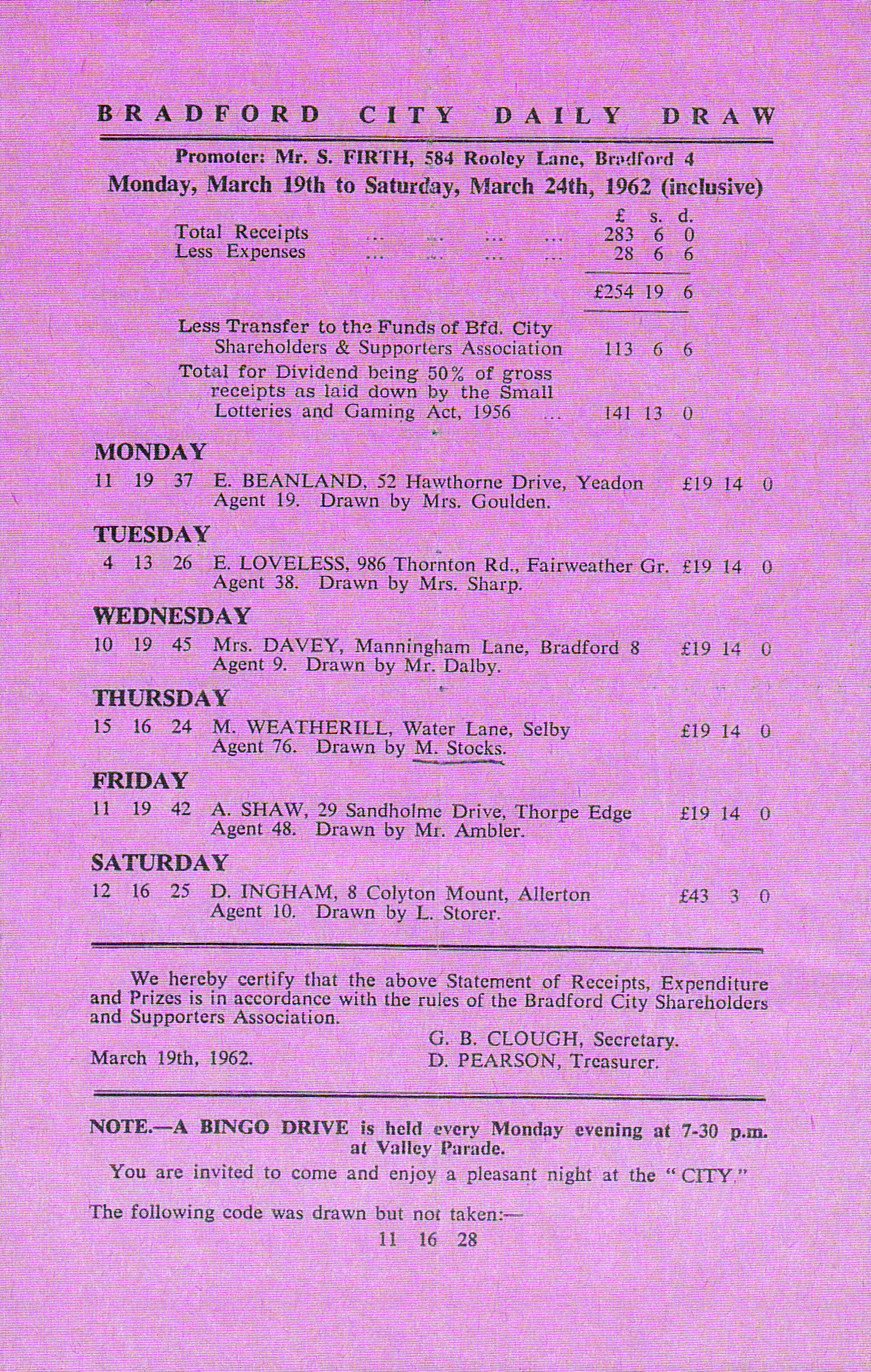
The Bradford City Lottery

During the summer Bradford City AFC announced its plans to begin a new lottery fund-raising scheme at Valley Parade, following in the footsteps of a successful initiative launched just over 40 years ago…

Nowadays we take it for granted that off-field revenue is an integral part of financing the affairs of Bradford City and it is quite sobering just how unsophisticated were the forms of fund raising not that long ago. Historically the only commercial activity beyond basic advertising was based around selling lottery or bingo tickets to spectators – the equivalent of today’s ‘Shirt off your back’ promotion.

bcssa draw 1962.jpg

In 1957 came a radical innovation at Valley Parade with the introduction of a weekly pool draw that existed in various manifestations for the next twenty years but it was the arrival of Stafford Heginbotham at Valley Parade in 1966 who introduced radical changes. Whereas previously the supporters’ club (the Bradford City Shareholders’ and Supporters’ Association) had organised such ad hoc raffle ticket draws, it was Heginbotham who first introduced a new pools lottery scheme.

IMG_0133.jpg

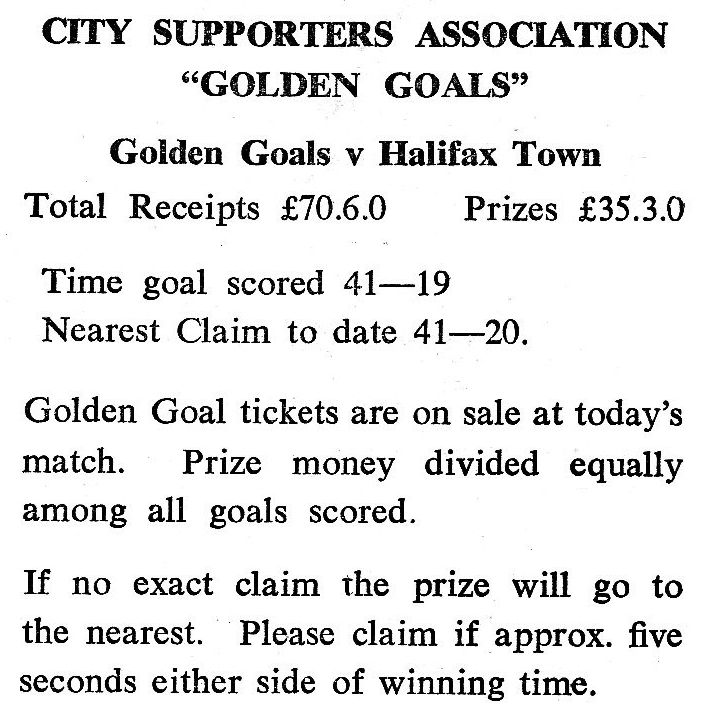
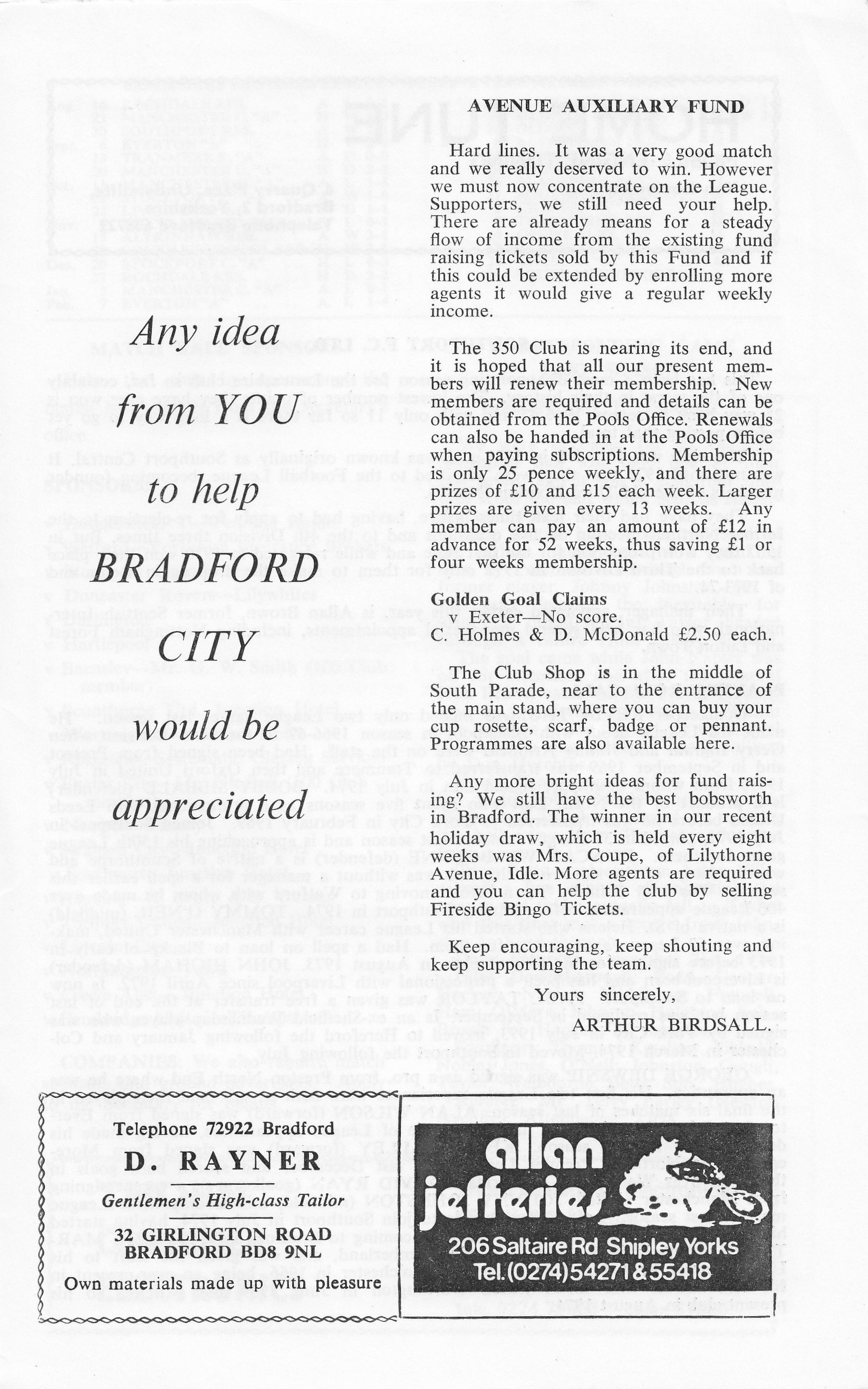
In 1966/67 the Golden Goal pools competition was introduced at Valley Parade. After 1974 this was promoted by the Avenue Auxiliary Fund and managed by the late George Sutcliffe. The AAF was originally a branch of the BPA Supporters’ Club which assisted BCAFC (or as it was put, ‘for association football in Bradford’) until the launch of the new lottery in 1978. The support of the AAF was not insignificant and in 1975/76 it contributed £8,027 (which compared to advertising receipts in the same year of only £5,977 and programme sales of £3,122). From 1968/69 to 1975/76 golden goal times were printed in the programme to encourage sales. In 1974/75 the Bradford City Development Society was established as another vehicle to promote sales of pools tickets.

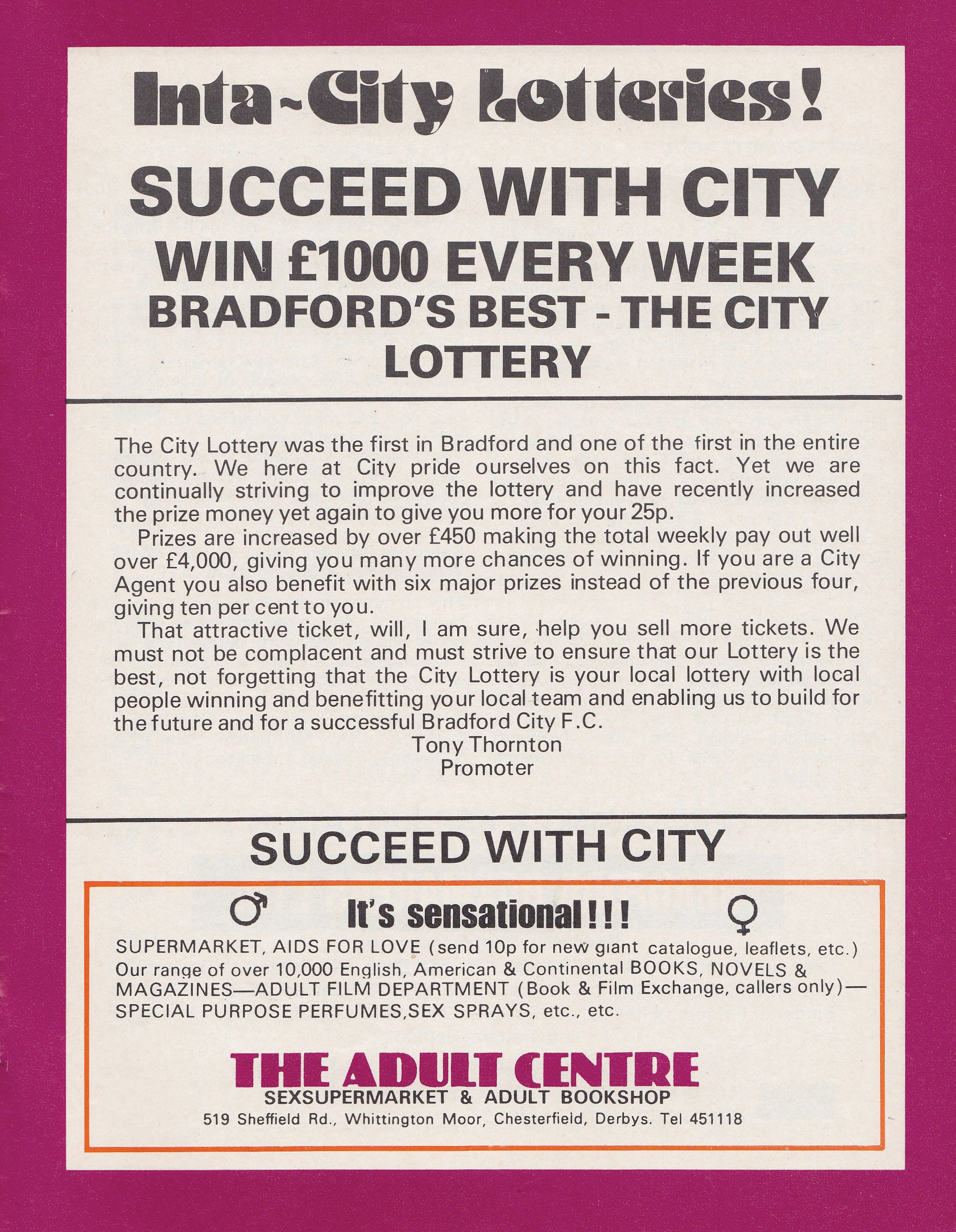
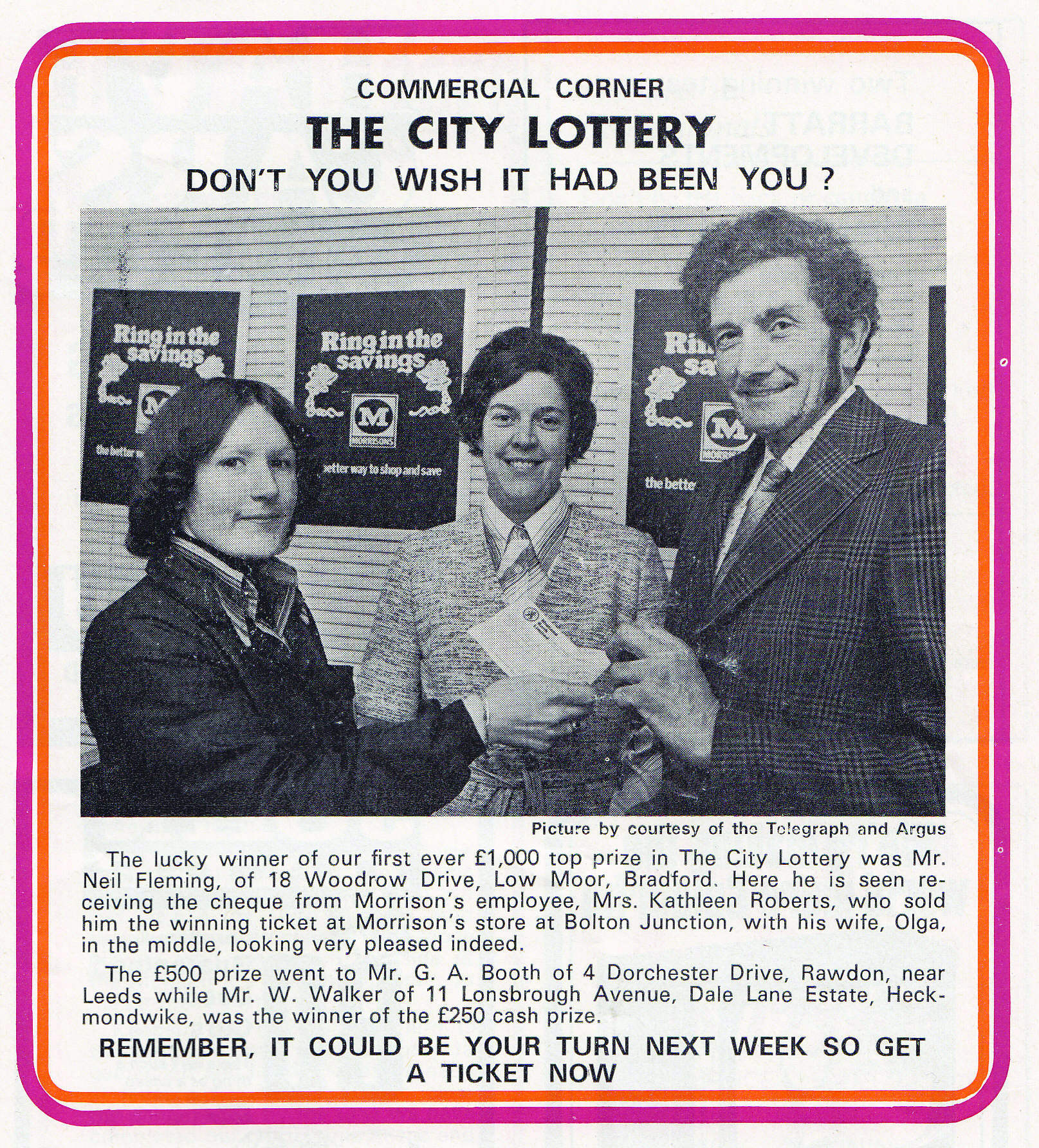
The Lotteries & Amusements Act of 1976 introduced new legislation to regulate the operation of lotteries which raised maximum prizes and encouraged the development of lottery schemes. A consequence of this was that football clubs launched their own lotteries as a means of fund-raising. Bradford City launched its lottery in January, 1978 with tickets sold from retail outlets across the district. By March, 1978 it was reported that forty thousand tickets were being sold weekly at 25p each. This was no mean feat and it was achieved by recruiting a dedicated team initially under the leadership of Roger Fielding and then Tony Thornton who joined as Lottery & Promotions Manager in 1977. Mike Ryan later joined the team as Commercial Manager from Millwall in August, 1978 and alongside Tony Thornton masterminded the development of the new lottery.

This became a major income stream for the club which benefited from a lack of effective local or national competition in the first few years. Crucially it was successful in that people would buy the tickets irrespective of whether they were supporters and the Bradford City lottery benefited from the catchment of the Bradford district. The original City Lottery was so successful that a second, the Bradford Lottery was launched in March, 1978. At the time it was suggested that Bradford City displayed more competence at running a lottery business than its core activity.

lottery jan-1978.jpg

Almost overnight the club’s finances were transformed and the success of the lottery funded an unprecedented spree of player transfers during the second half of the ill-fated 1977/78 season and the 1978 close season. It also funded the repurchase of the Valley Parade freehold from Bradford Council in May, 1979 (it had been sold to the former Bradford Corporation in 1970 in part to generate funds for new players). By 1979/80 lottery income amounted to £206,237 and exceeded gate revenues. Lottery funds were necessary to plug losses during the disappointing 1980/81 campaign when a promotion challenge never materialised and attendances plummeted. There was further spending to secure the services of Roy McFarland as manager in 1981 and then Trevor Cherry and Terry Yorath the following year.

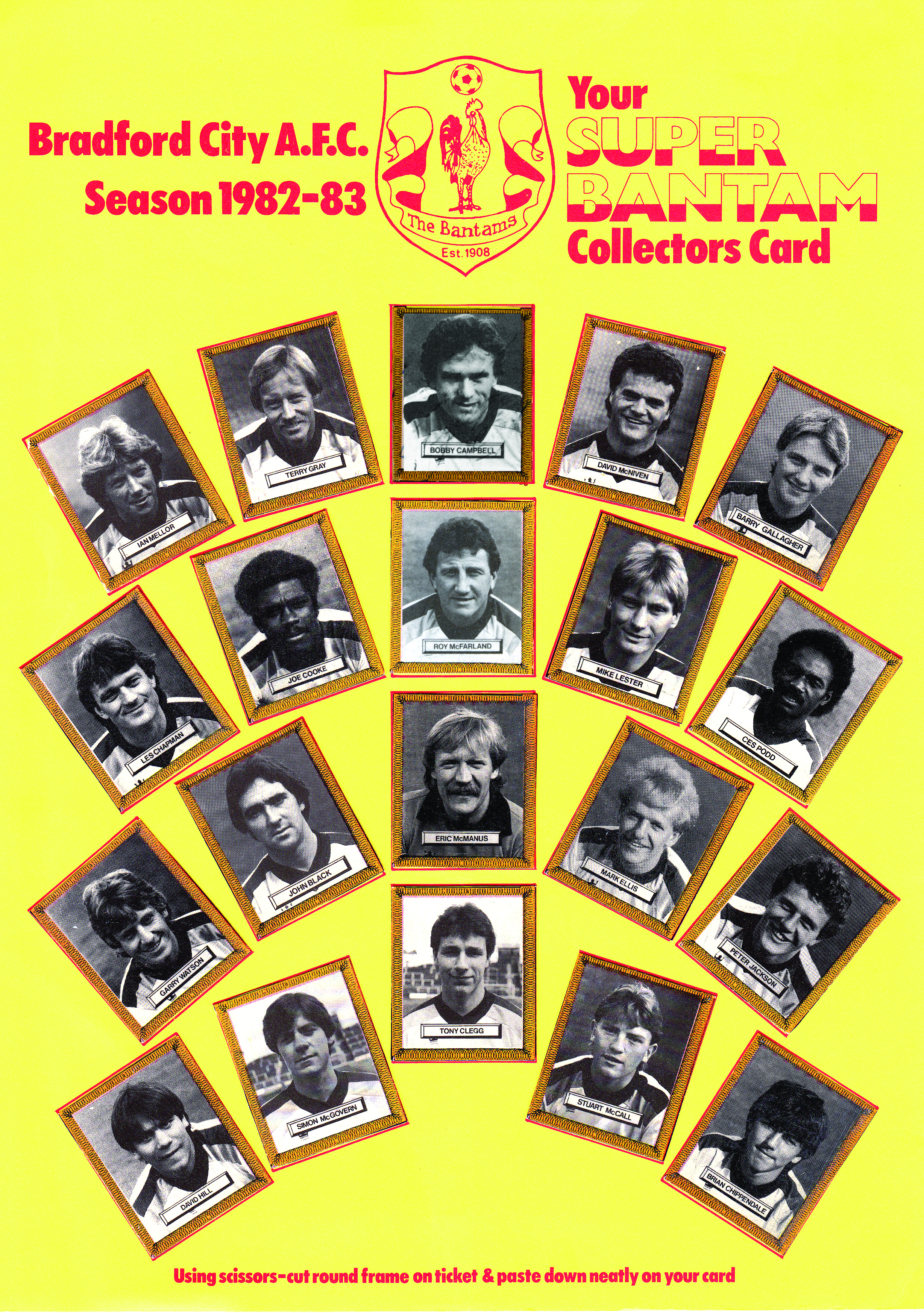
Older supporters will recall the lottery scratch cards promoted in 1982 that encouraged the collection of player portraits featuring the first team squad. Bobby Campbell was the hard-to-find card.

This slideshow requires JavaScript.

Eventually the lottery advantage was lost as competition emerged. By 1981/82 lottery income was less than half that in 1979/80 whilst player wages were nearly 20% higher (and three times higher what they had been in 1976/77) which eventually led to the 1983 insolvency. Despite new monies being made available through lottery proceeds, little was invested in the renewal of Valley Parade. This was the immediate background to the 1985 fire disaster and in that context the verdict on Bob Martin’s reign is all the more damning. The irony is that the club behaved in the manner of a lucky lottery ticket winner going on a profligate spree to spend, spend, spend until there was nothing left.

lottery player cards 1982.jpg

Match-day lucky draw tickets such as the ‘Shirt off your Back’ draw and previously the 50:50 matchday raffle have continued at Valley Parade, albeit are far less significant from a fund-raising point of view than the former lottery tickets. Furthermore, many of these have been organised by volunteers such as former club stalwarts Alan and Gladys Hannah from the 1960s through to the 1990s, or supporter groups including the Shipley Bantams and the Bradford City Supporters’ Trust.

This slideshow requires JavaScript.

Taken from my book A HISTORY OF BCAFC IN OBJECTS, Volume One of the BANTAMSPAST History Revisited series published in 2014 – further details of the HISTORY REVISITED series of books

Thanks for visiting my blog!

The above menu provides links to other features that I have written about the history of Bradford sport as well as articles published in the BCAFC programme and book reviews.

Updates are tweeted @jpdewhirst and I can be contacted by email at johnpdewhirst at geeeeeeeeemail dotttt commmmmm.

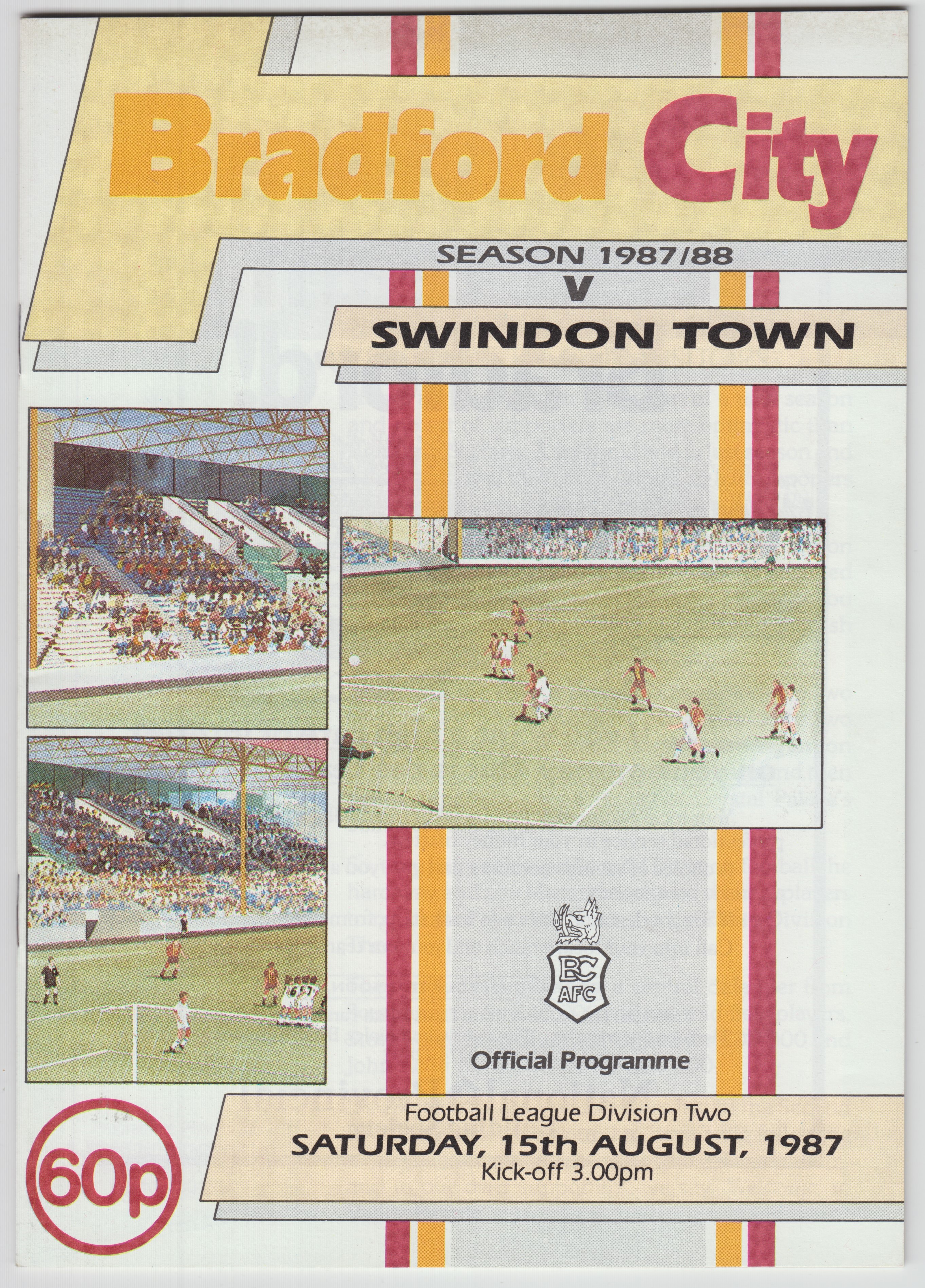
Swindon Town: 5th October, 2019

PROGRAMMES OF OLD

Published in the Bradford City AFC match day programme for the above fixture

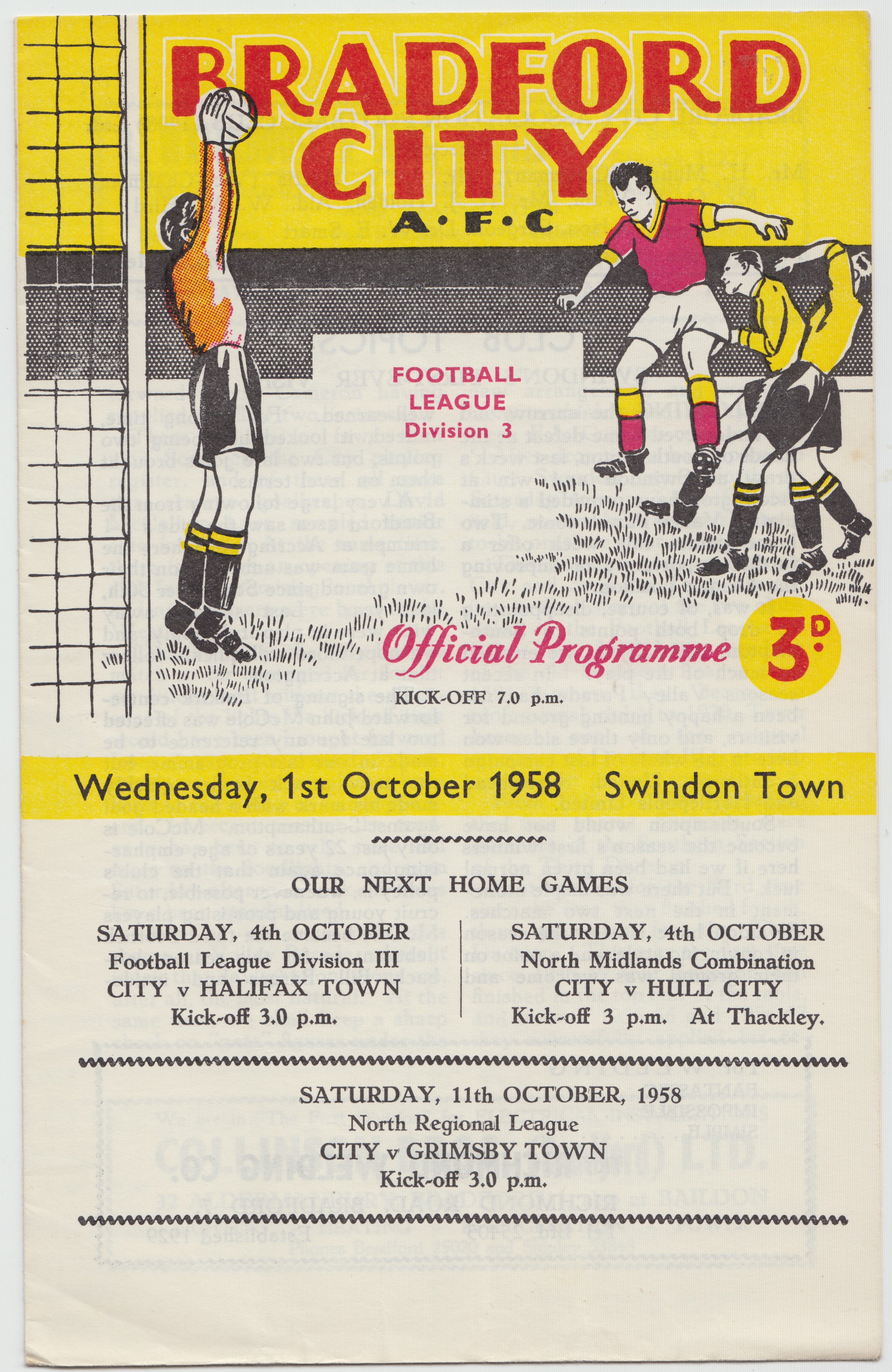
Bradford City and Swindon Town first met in the Football League during the 1958/59 season as members of the newly formed Division Three having been in the regionalised northern and southern third divisions respectively. The first fixture was on 24th September, 1958 at Swindon and ended in a 2-2 draw and the return was a week later in Bradford on 1st October, 1958 which ended as a 1-2 defeat for the hosts. Notable is that the crowd 61 years ago at Valley Parade was 8,279.

5859 H.jpg

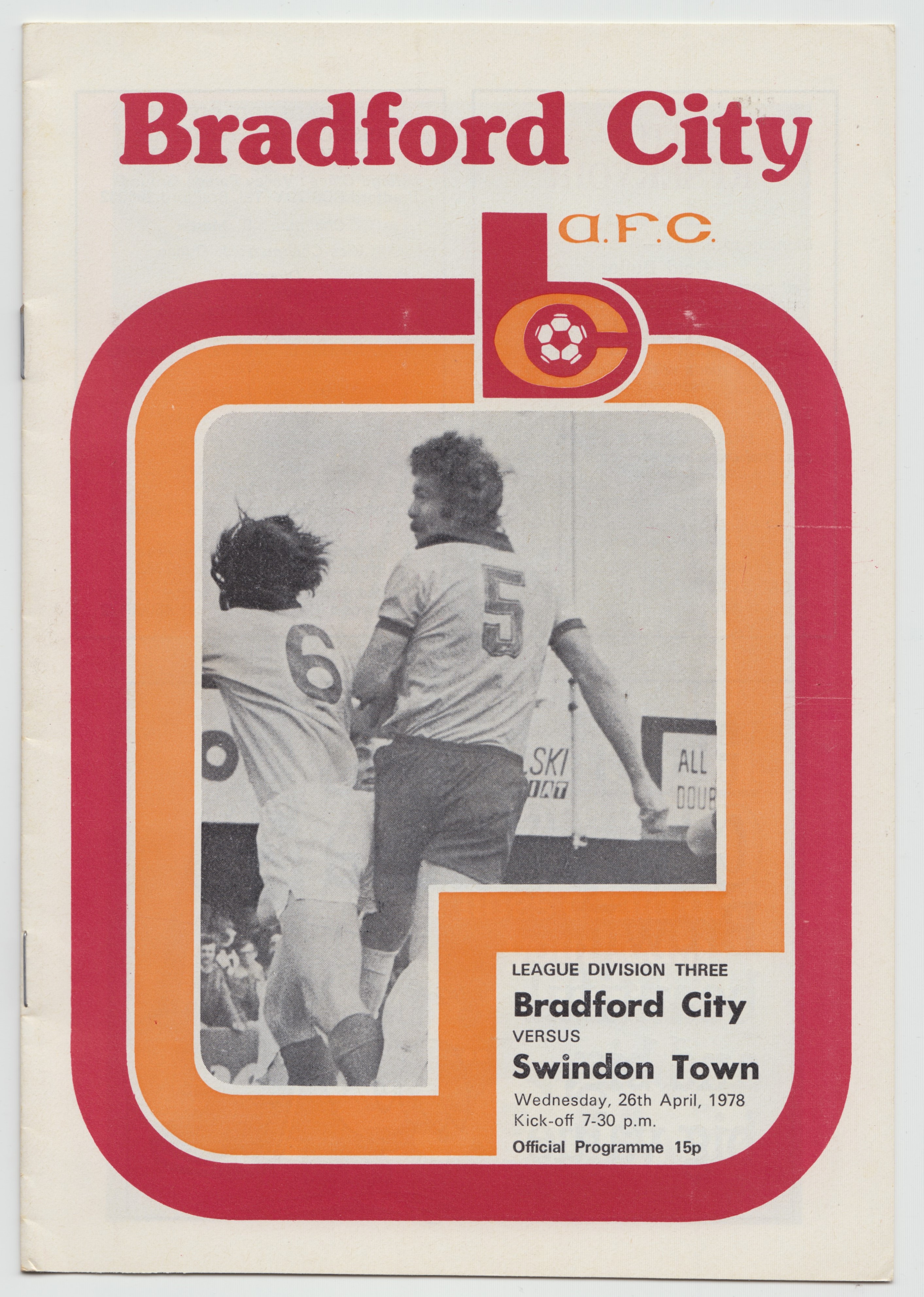
This is now the 19th season that the two clubs have been in the same division, most of which have been since 1987/88 which was our ‘nearly season’ in the second tier when we narrowly missed promotion. In fact, prior to then our League meetings were few and far between, limited to three seasons in Division Three between 1958-61 and then a solitary season, 1977/78. In 1968/69 the clubs met in the Second Round of the League Cup with Swindon progressing in a replay after a 2-2 draw at Valley Parade and the Robins subsequently defeated Arsenal in the final. The Swindon goalkeeper that season was Peter Downsborough who later became a big hero for City. Sadly Peter died only last week and will be fondly remembered by supporters of both City and Swindon Town- a brief tribute to him on this blog through this link.

7778 SPARE.jpg

I travelled to Swindon for our game in January, 1988 which was abandoned midway as a result of fog. The game was replayed ten weeks later at the end of March, 1988 which was yet another 2-2 draw between the sides. It came at a time when the team was struggling to get results, not helped by injuries and it was the loss of form that proved costly for our promotion ambitions.

Of our meetings, only once before have we competed together in the fourth tier, that being in 2011/12 when both meetings were goalless. In aggregate, of our 38 games in the Football League there have been 11 draws and 11 victories for the Bantams. The last time Swindon Town came to Valley Parade was in March, 2017 when our 2-1 win put us on track to finish in the League One play-offs which now seems a long time ago.

8788.jpg

You can find other features about the history of Bradford City AFC on this blog as well as links to other content that I have published previously. The menu provides links to archive images featuring historic photographs of Valley Parade as well as old programmes.

Tweets: @jpdewhirst

John Dewhirst

Peter Downsborough RIP

1977 Downsborough

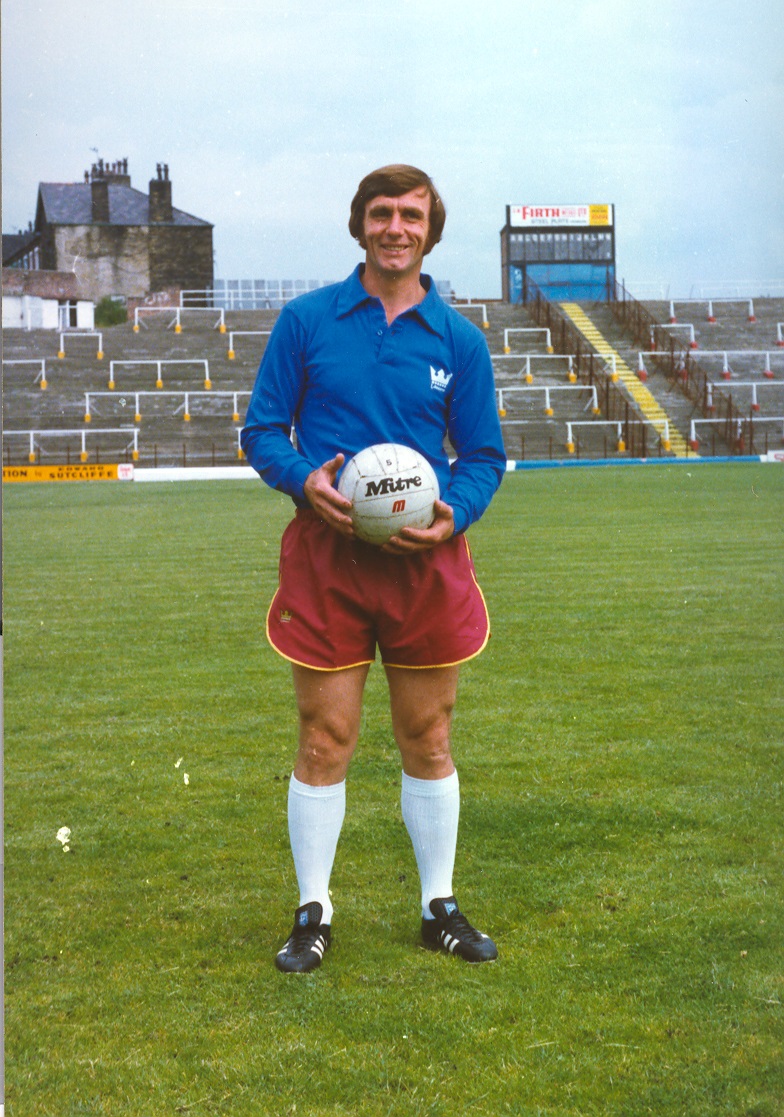
I was saddened to hear of the death of former Bradford City goalkeeper Peter Downsborough last week who was a stalwart of the team in the mid/late 1970s. He represented his home town club, Halifax Town before joining Swindon Town where he earned fame as a member of that club’s Football League Cup winning side in 1969.

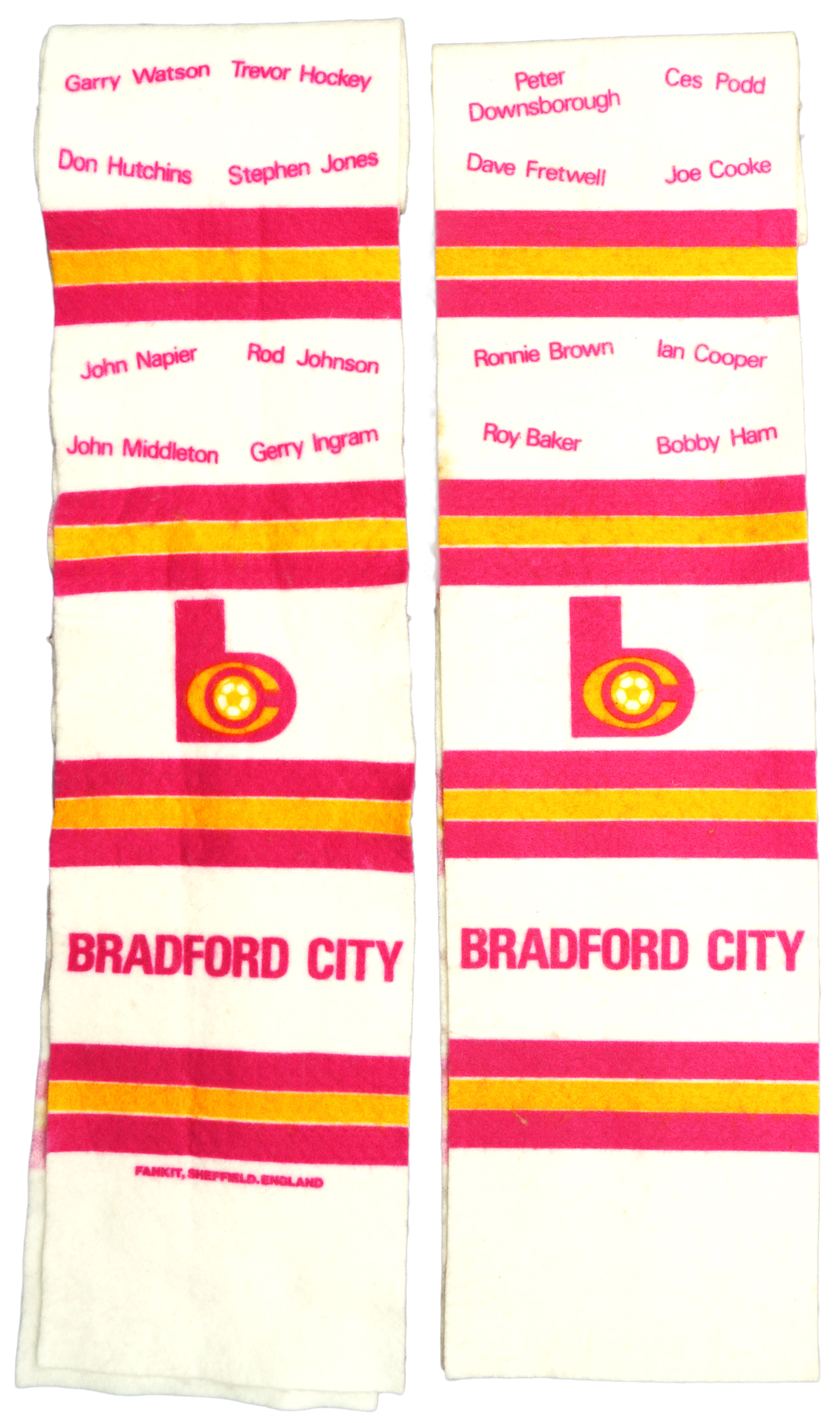
DSC04564.jpgHe made his debut for City in December, 1973 having signed on a free transfer from Swindon, returning home to his Halifax roots. (Photo below shows him in the City team in the second half of the 1973/74 season.) Aged 30 it was arguable that he was in the twilight of his career yet during the next six seasons he was virtually ever present, making 225 appearances for the Paraders before eventually retiring through injury. The scarf is from his first full season at the club in 1974/75.
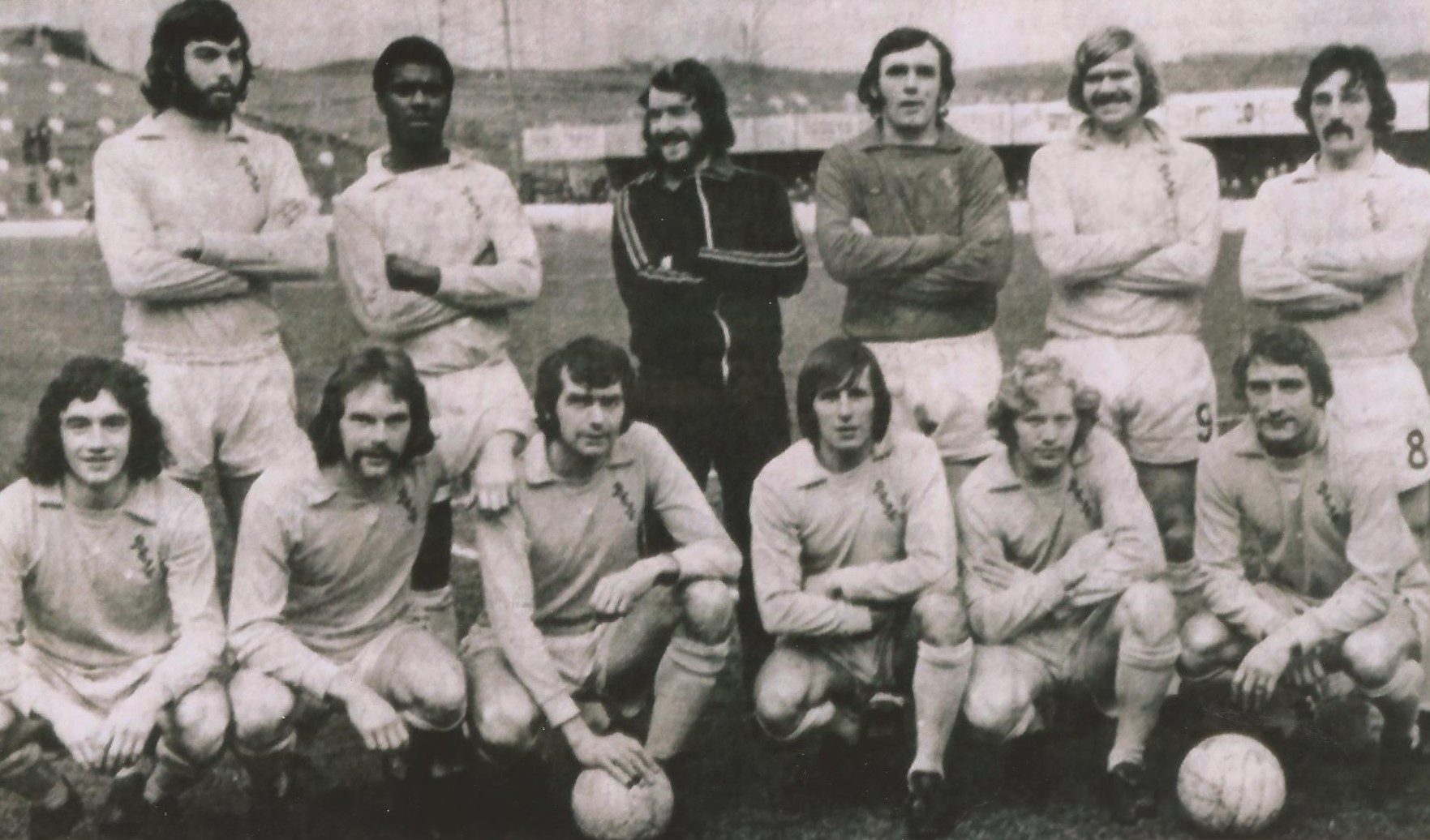
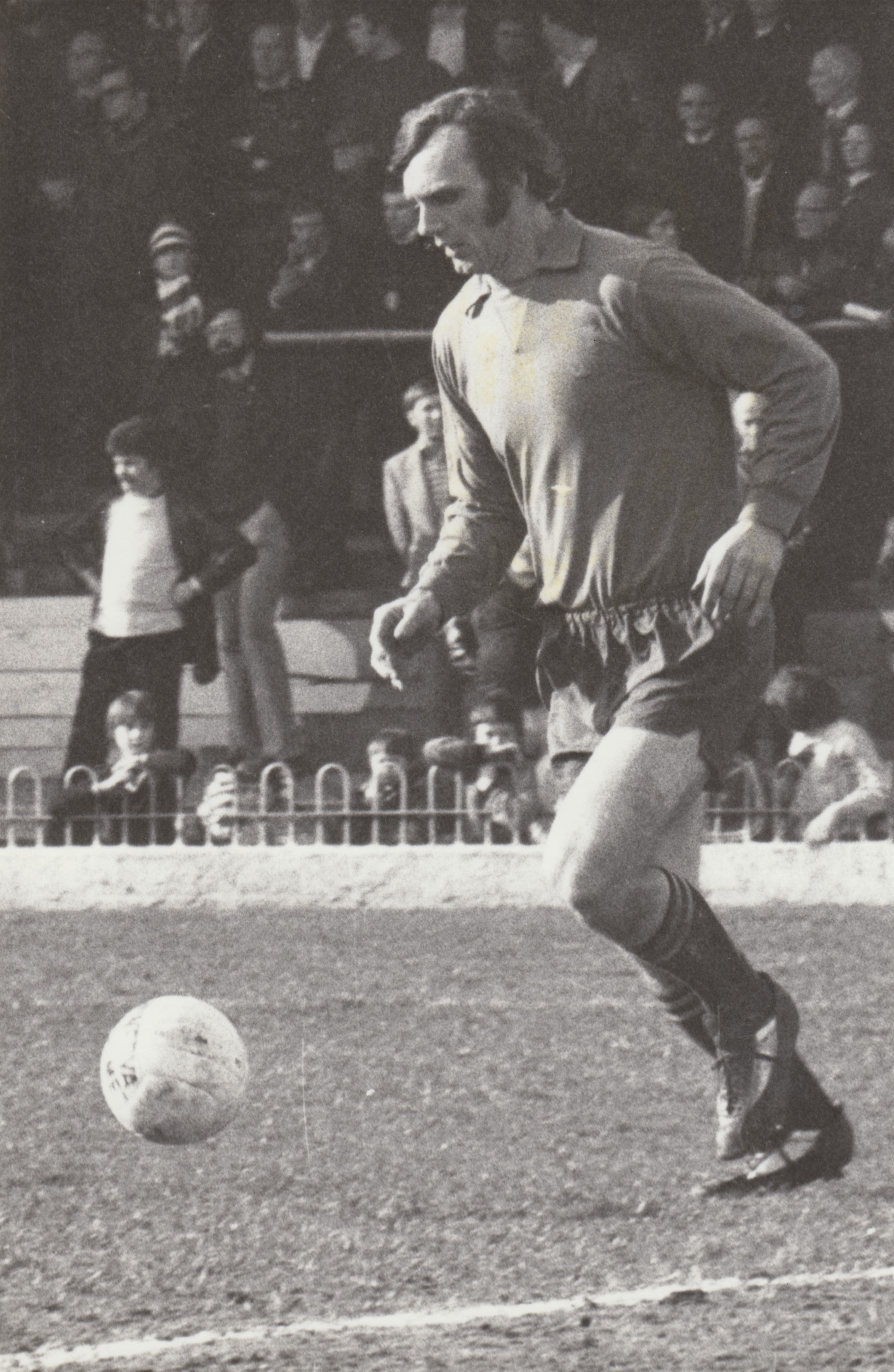
He was a popular team member with supporters and considered both reliable and consistent. At a time when the club had a relatively low turnover of players he was a mainstay of the team along with the likes of Ian Cooper, Joe Cooke and Ces Podd. An abiding memory of Peter Downsborough was that he was always cheerful and relaxed, clearly enjoying the opportunity to be a professional player.

His experience proved invaluable at Valley Parade and he deserves considerable credit for the team’s FA Cup run in 1975/76, not least for his role helping the club achieve a giant-killing at Norwich and preventing the Canaries from scoring an equaliser in a memorable 2-1 victory. In 1976/77 he was a member of the promotion winning side and was considered something of a talisman with his ability to save penalties. Downsborough’s technique was to step to one side of the goal inviting the penalty taker to aim towards the wider gap.

1973-74.jpg

Arguably he compensated for shortcomings in the side but could not prevent relegation from the third tier in 1977/78. One of the highlights of that season was an away win a Swindon where Downsborough defied the home strikeforce to secure the points in an emotional return to the County Ground.

Eventually he lost his place to Steve Smith and retired at the end of the 1978/79 season although remained as cover during the 1979/80 season when the club narrowly missed out on promotion. His testimonial in May, 1980 was against Huddersfield Town who were (successful) promotion rivals that year. Sadly he could not participate in the game because of injury.

I met Peter Downsborough in Halifax in around 1987 where he was working as a handiman. Having been a childhood hero I was completely in awe of him. I disovered him to be an incredibly modest and warm individual, keen to talk about his time at Valley Parade and share what were obviously fond memories. I shook his hand and was taken aback at the size, maybe another reason for his prowess as a keeper.

John Dewhirst

Tweets: @jpdewhirst

Tribute in the Bradford Telegraph & Argus published 30th September, 2019

Peter Downsborough.jpg

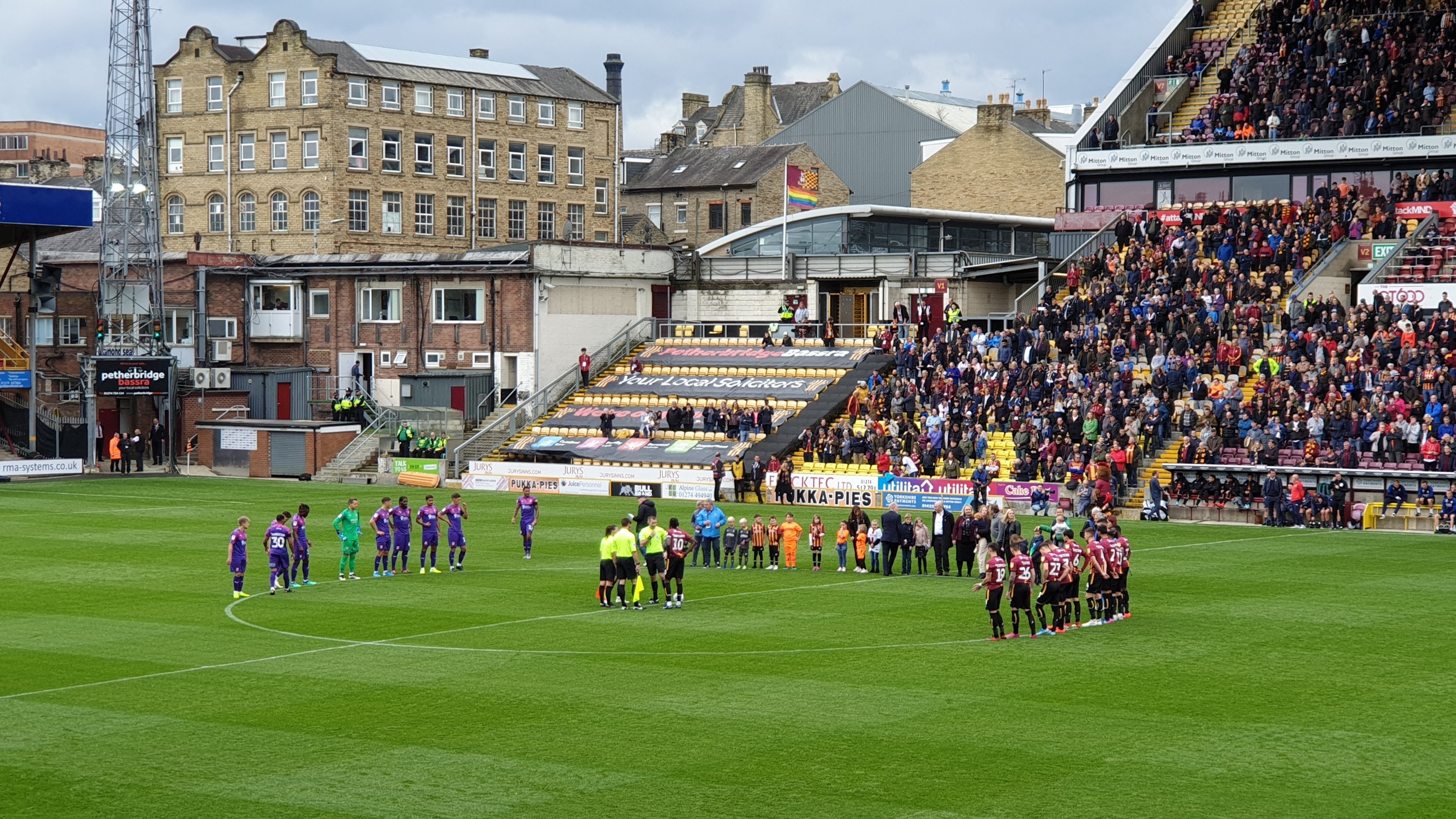
Tribute pre kick off, Bradford City v Swindon Town on 5th October, 2019

The early development of Valley Parade, 1886-1908

A number of people have asked for details about the historic development of Valley Parade and this feature provides some background as well as links to other online references. You can find historic photographs of Valley Parade from this link and others will be uploaded in the future. The following is intended principally to provide some context to the footprint of the ground and its evolution.
The origins of Valley Parade is told in my book Room at the Top (volume #3 in the BANTAMSPAST History Revisited series) which includes previously unpublished material and details of the ground in its early existence discovered during the course of my research.

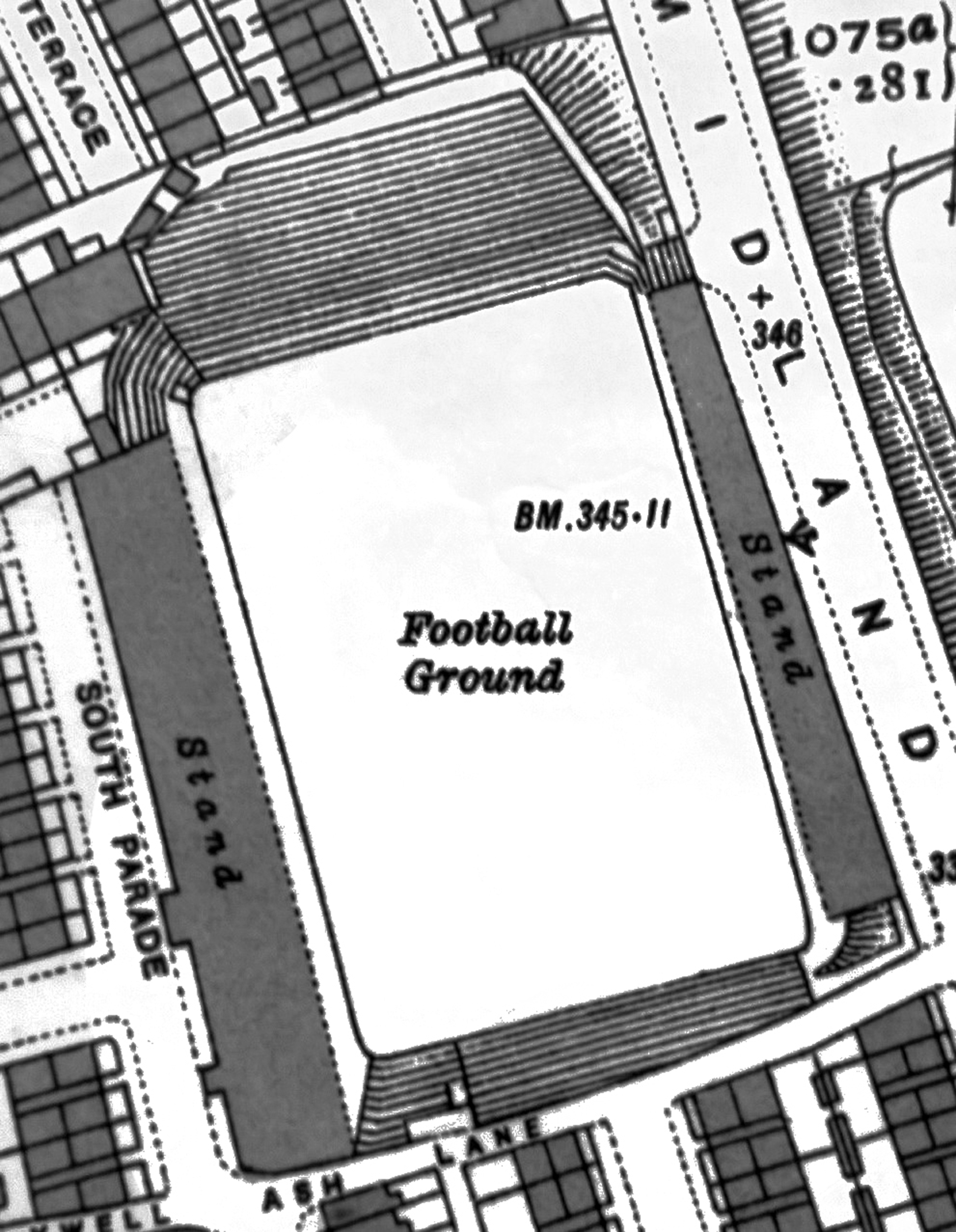
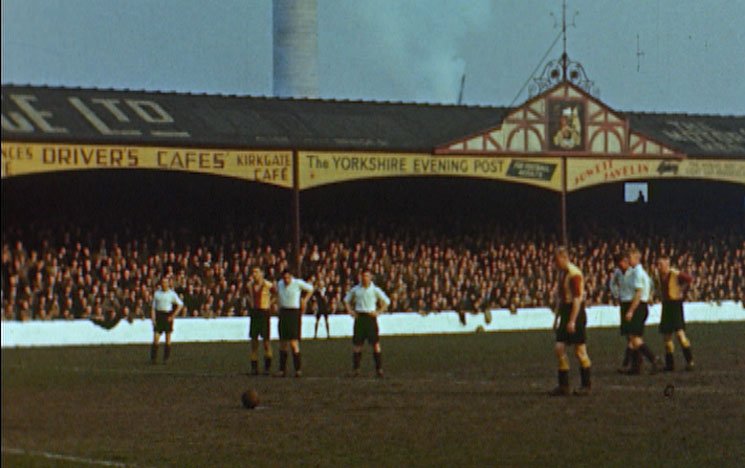
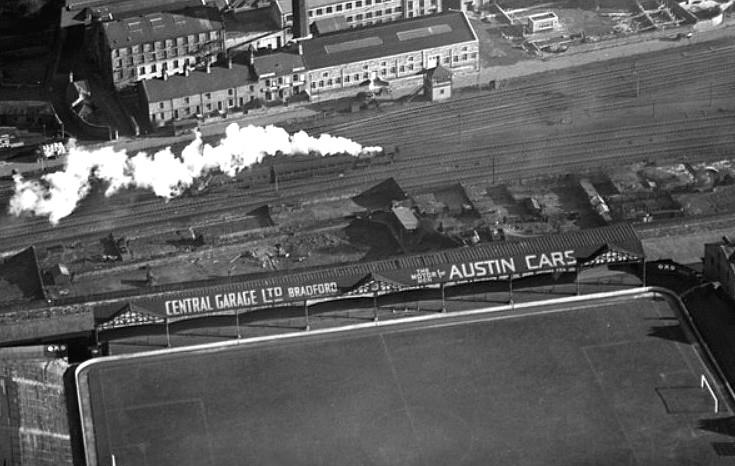
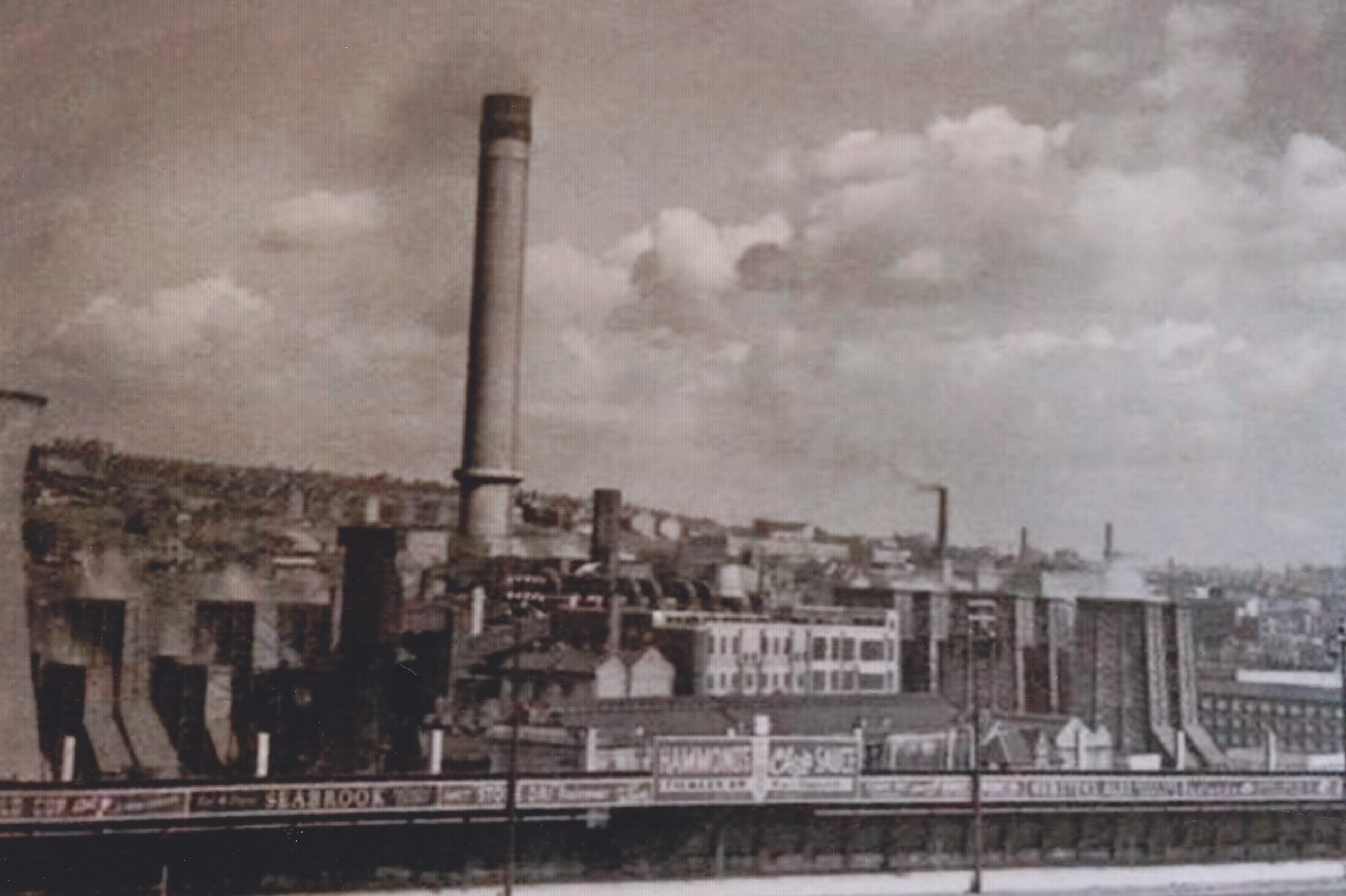
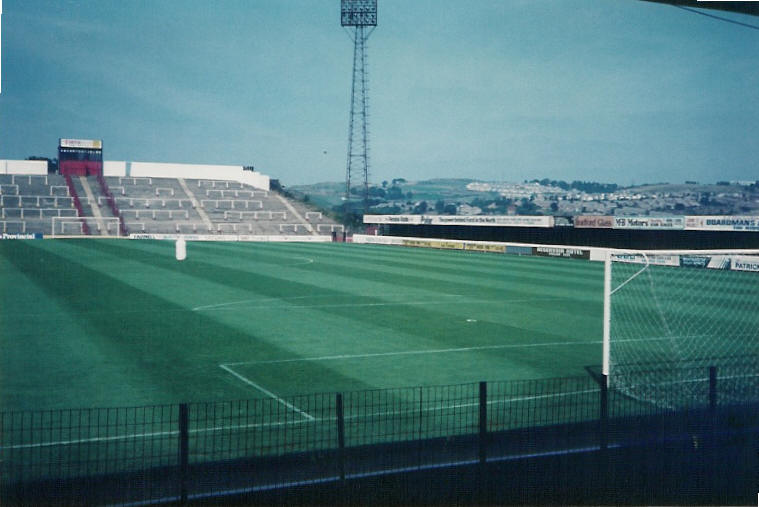
The Valley Parade that existed in 1985 was generally recognisable from the stadium that had been developed in 1908. Between 1903 (when Bradford City AFC was elected to the Football League) and 1908 Valley Parade was transformed through a series of projects that were relatively ingenious in terms of developing a ground capable of hosting Division One football within the physical constraints that existed. The story of that development is best told through comparison of historic maps which also demonstrate the extent to which the housing in the immediate surroundings of Valley Parade has disappeared.

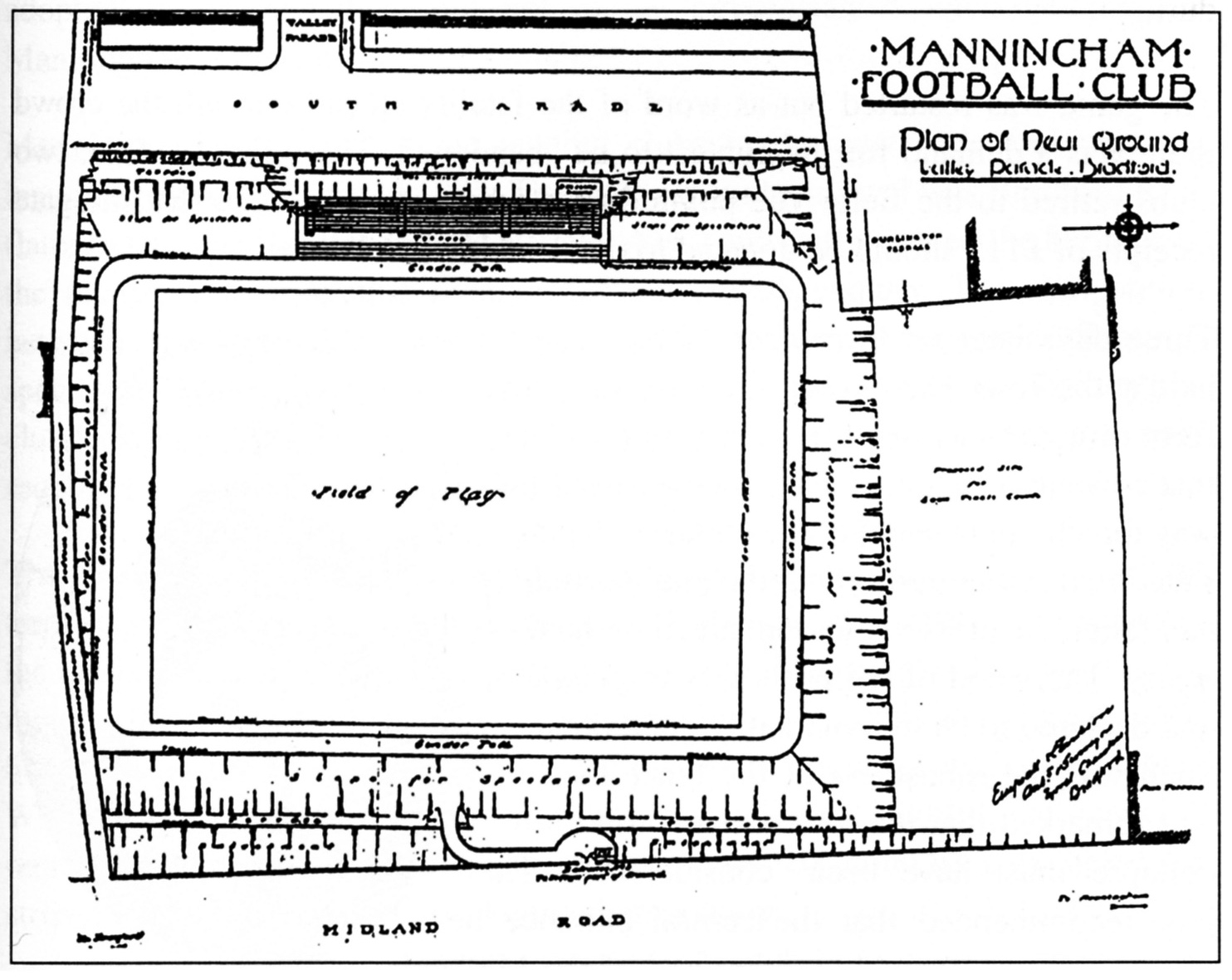
Architect's plan for the development of Valley Parade.

We start with the plan (above) for the original development of Valley Parade in 1886 by Manningham FC. The story of the origins of the ground is told here.

The early history of Valley Parade continued to be closely linked to that of Bradford’s railways. The background to the latter and the story of the saga for a cross-town rail link in Bradford can be found from this link.

VP 1900

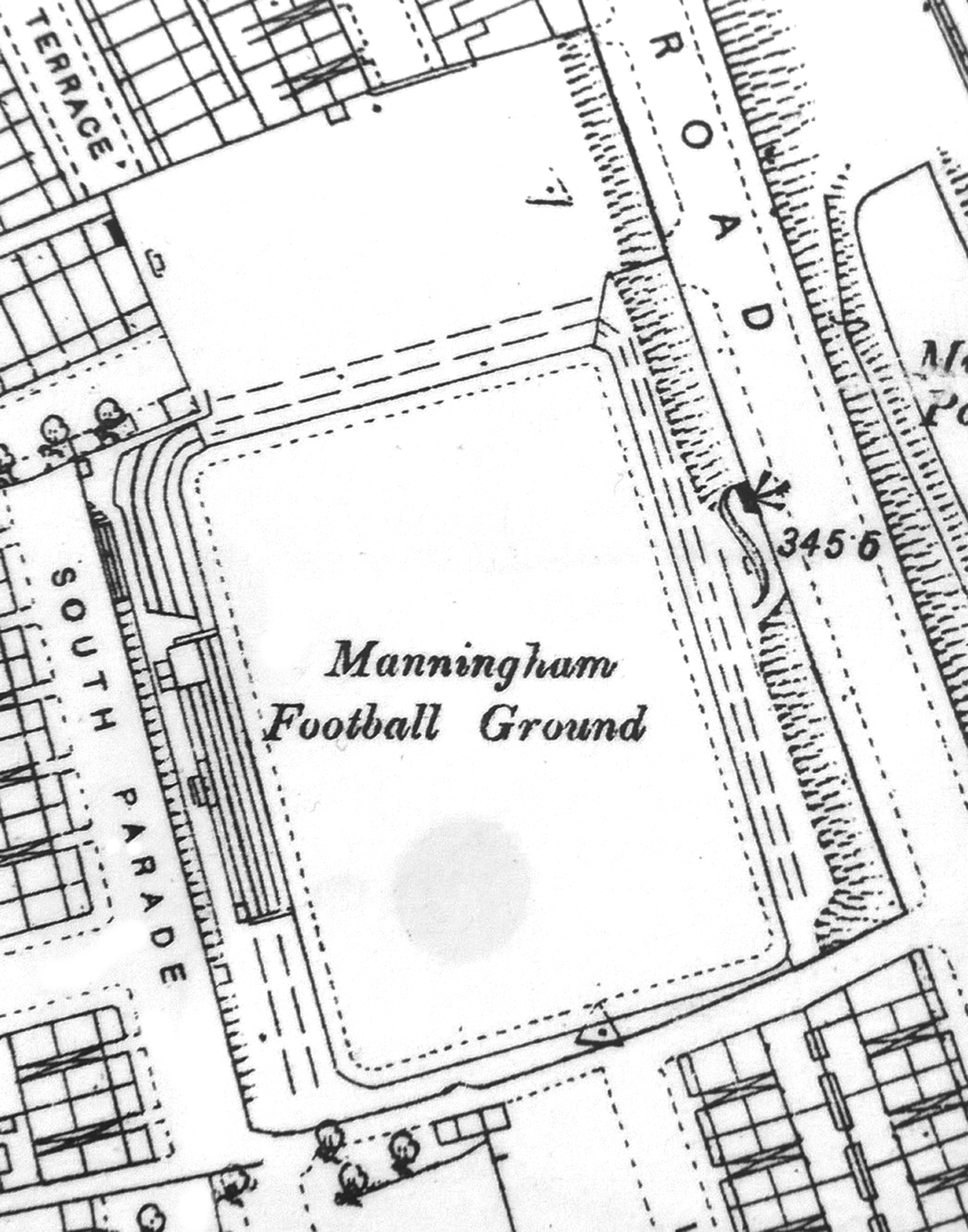
This map shows Valley Parade in 1900 with its uncovered grandstand (better described as a viewing platform).

The original grandstand dated from 1885 and was transferred from Manningham FC’s Carlisle Road ground to Valley Parade in 1886 – an open viewing platform that was reassembled at the new ground. By 1897 the timbers had rotted and it was condemned as unsafe by Bradford Corporation who bought the timbers which were used for the civic bonfire to celebrate Queen Victoria’s Diamond Jubilee (60 years as monarch, 1837-97).

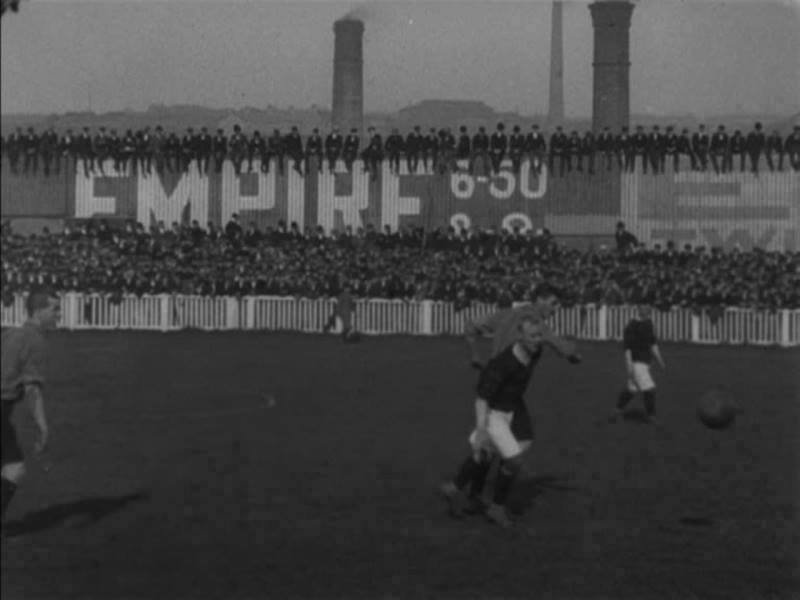
During the 1897 close season new terracing was developed on the South Parade side of the ground comprising 25 steps which it was claimed could accommodate 10,000 people. In the centre section a new uncovered ‘grandstand’ was erected as shown in this map and which can be seen in the archive footage of Bradford City AFC’s first ever game in September, 1903: refer BFI Mitchell & Kenyon archive.

Manningham FC had originally intended to develop a ‘pavilion’ on the site – by which was meant a covered stand, the term ‘grandstand’ being used by Victorians to describe a basic viewing platform. Other plans for dressing rooms were also deferred until funds would allow and in the meantime the club resorted to use of the Belle Vue Hotel. (The story of the Belle Vue is told on VINCIT)

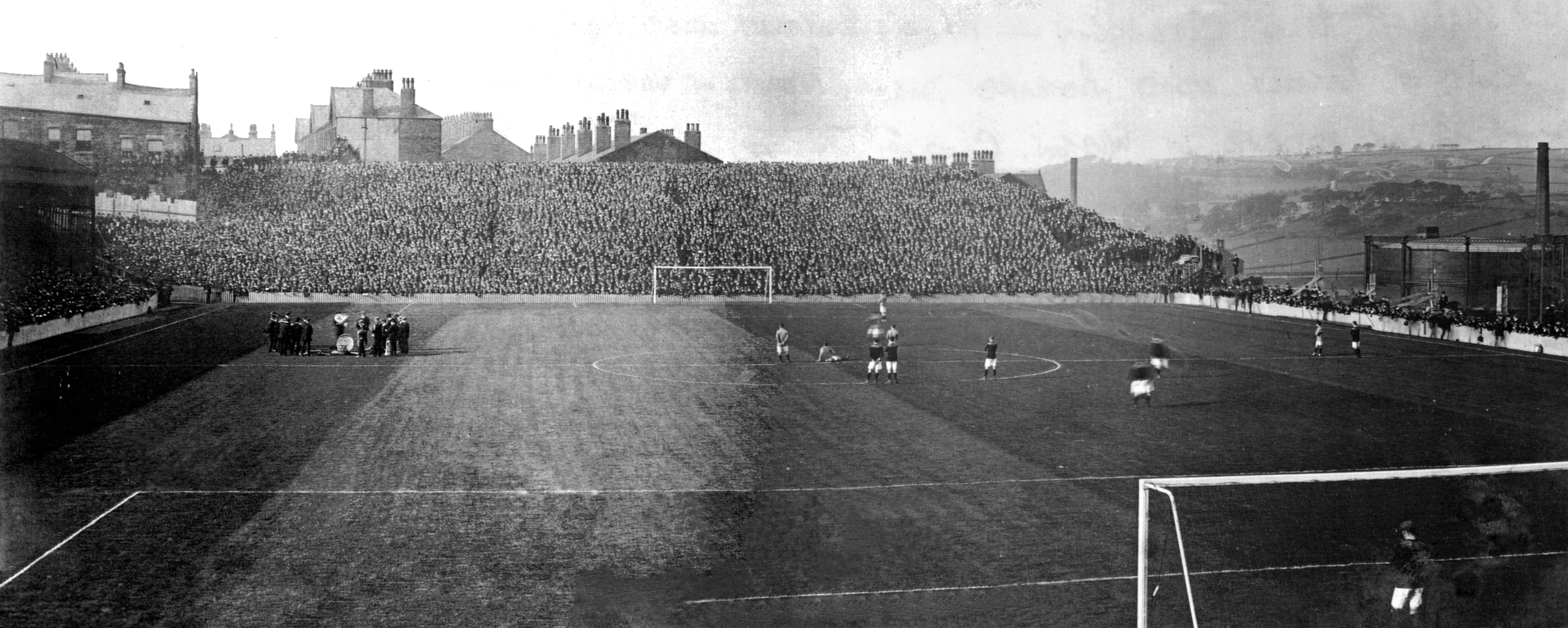
Until 1908 there was little depth to the Bradford end whilst at the opposite end of the ground the terracing was limited to probably no more than 20 steps. At the top of those was a flat area which can also be seen in the 1886 plans. The Midland Road side was similarly cramped with a pathway to the road.

The photo below is of the Midland Road side from 1903. It was then bordered by a 20ft advertisement hoarding on which people can be seen sitting on the occasion of the first ever FL game at the ground.

The northern part of South Parade is now covered by the main stand at Valley Parade, extended in 2000. The reason why the stand does not extend the length of the field is that otherwise it would block the thoroughfare between Valley Parade (ie the road up the hillside) and Holywell Ash Lane at the back of the Bradford end.

vp1906 (2)
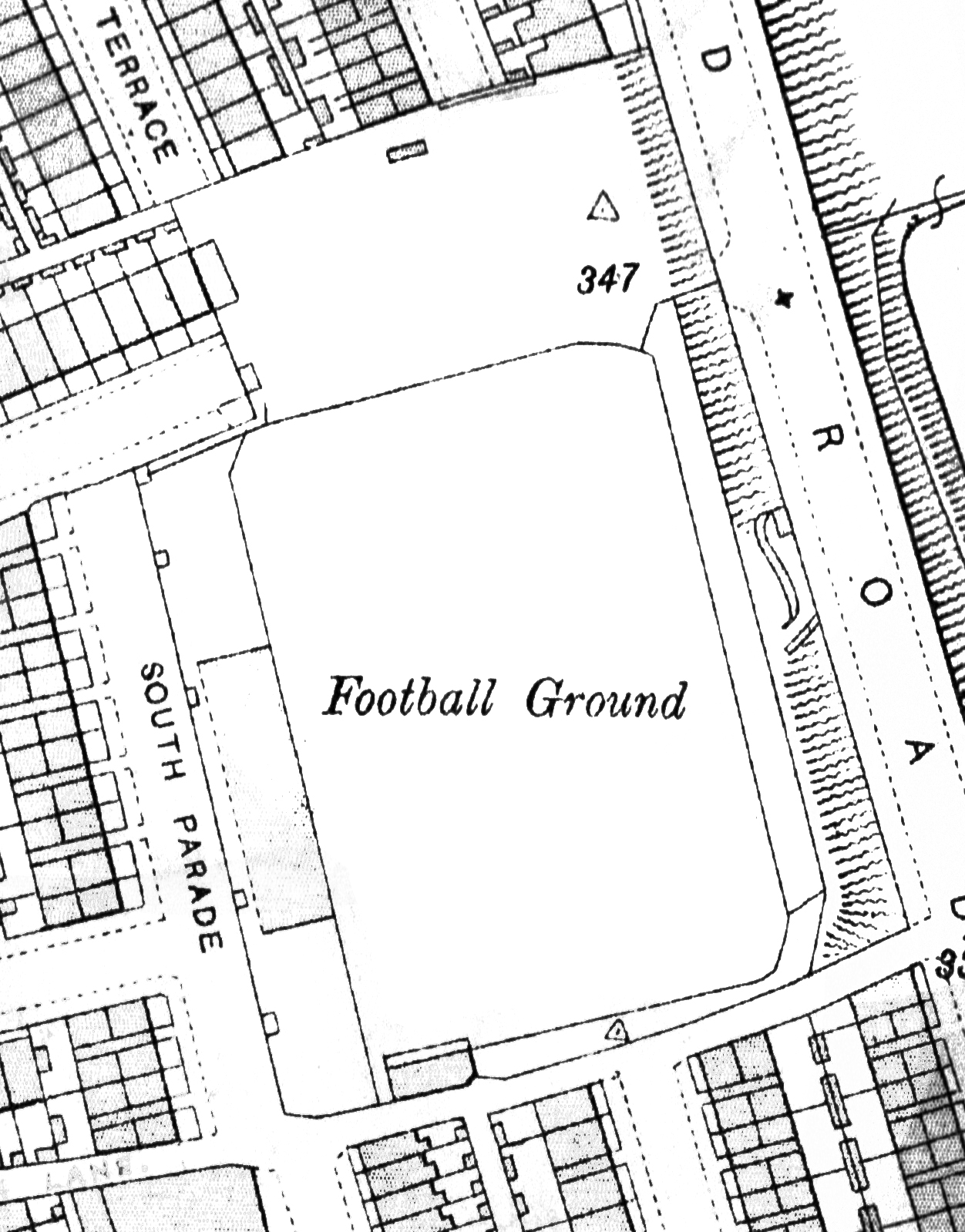
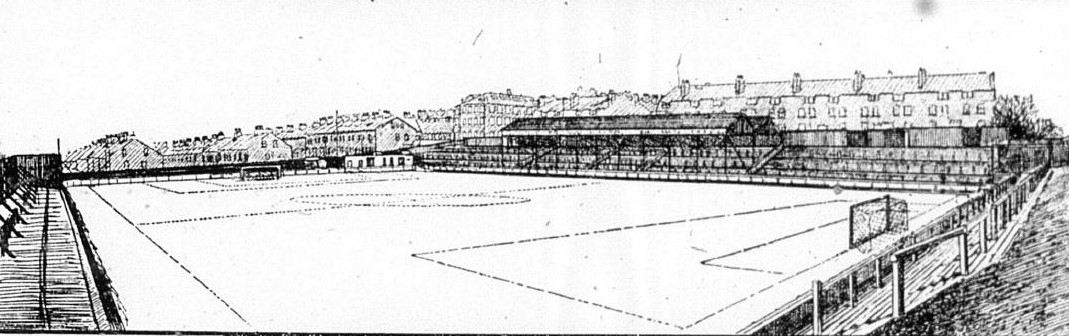
This map published in 1906 shows the dressing rooms constructed in 1903 in the south west corner of the ground on the Bradford end adjoining the pitch. The illustration below is also from 1906.

Valley Parade 1906.jpg
The grandstand was by this stage covered (completed January, 1904). In the north west corner a retaining wall from Burlington Terrace bounded the ground. At the corner of the playing field this would have been at least 20 feet high.

VP 1908

The above shows Valley Parade in 1908 by which stage the Bradford end had been extended and the pitch moved towards the Manningham end by re-developing the north-west corner of the ground. This was achieved through the demolition of the Burlington Terrace retaining wall and the creation of (curved) terraces. A tunnel connected the pitch with the cellar of the bottom property in Burlington Terrace that was used for offices and dressing rooms.

The extension of the Manningham end terraces was commenced in the close season of 1906 and finally completed the following February. This was banked to create the kop, originally known as Nunn’s Kop (link here to background about John Nunn who masterminded the development of the ground) and latterly as the Spion Kop.

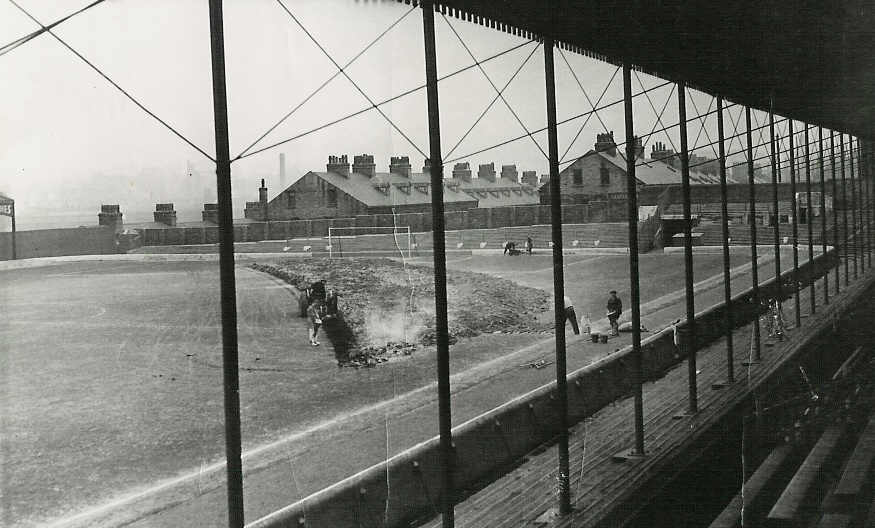
The main stand was extended the full length of South Parade in 1907 and was covered. (You can find background here about the construction of the old main stand.) This structure was the one that burned down in 1985. (Photos below taken by myself in August, 1983.)

This view of Valley Parade in 1951 was much the same as it had been in 1908.

1951 VPde stand and Bfd End

The risk of fire at Valley Parade was clearly discounted when the main stand was erected. Or rather, the implicit assumption was that any risk of fire could be managed. It was not as if grandstand fires were unheard of – my own research has identified at least nine cases of fire between 1900 and the construction of the main stand at Valley Parade: Liversedge (1900); Darlington (1901); Swinton (1901); Hearts (1903); Celtic (1904); Nottingham Forest (1904); Falkirk (1907); Penarth, Cardiff (1907); Burton United (1907). Wood was used in the construction of stands at other grounds and the potential risk of fire was accepted as an occupational hazard – at Park Avenue, in September, 1897 a fire in the grandstand had been reported incidental to the account of the game itself. No-one could have imagined the probability of a fatal disaster. But what tended to encourage complacency was not just that there had been no fire-related deaths; incidences of fire had tended to be when grounds were unoccupied and therefore the risk was associated with sinister reasons rather than as an issue of crowd safety.

The irony is that even when completed in 1907, the structure was always considered to be of a temporary nature and its design was deliberately basic to allow for the possibility of it being transported to another ground given that the club had concerns over security of its tenure at Valley Parade. (The concept of a portable structure was consistent with the practice in 1886 when Manningham FC’s wooden grandstand had been transported from Carlisle Road to Valley Parade.) In 1912 and again in 1919 the club looked at the possibility of constructing a permanent cantilever stand on the South Parade side (to replace the temporary structure) but financial constraints prevented this coming to fruition.

Throughout its existence Valley Parade had always drawn unfavourable comparison with Park Avenue, considered the more prestigious of the two grounds. In contrast Valley Parade was considered far more basic, utilitarian and undeveloped. The early reputation of the ground was also damaged by the tragic death in 1888 of a spectator on the Midland Road side when a boy had been crushed with the collapse of a boundary fence. The boy had been sat pitch side and the fence had collapsed on top of him with the weight of the crowd.

The Bradford Observer of 26 December, 1888 reported that ‘an accident of a shocking and unprecedented nature in this district happened on the ground of the Manningham Football Club, Valley Parade yesterday. Painful to a degree in itself, the occurrence was rendered all the more distressing by reason of the presence of, it is calculated, about 10,000 people.’ The matter of fact editorial referred to his instantaneous death. (Further detail provided in my book Room at the Top).

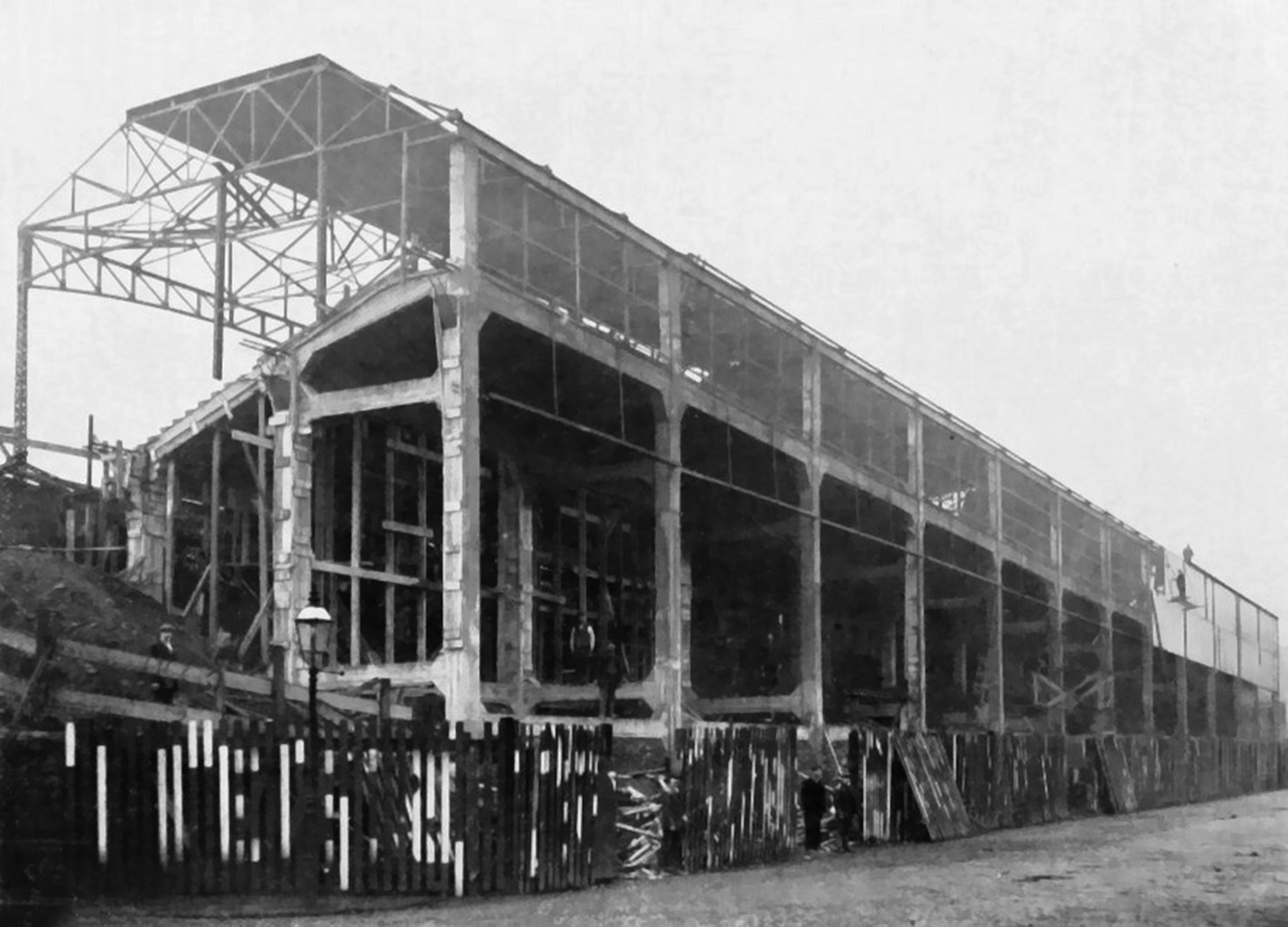
The ‘low-side’ – the Midland Road side – remained undeveloped but in 1906 a single bench was constructed that ran along its full length to provide seating. Football architect Archibald Leitch was commissioned to build a new stand in the close season of 1908 and the photo below shows the part completed stand at the time of Bradford City’s first home fixture in Division One against Manchester City in September, 1908.

City v Man City Sep-08

Leitch’s Midland Road stand was constructed with ferro-concrete (at the time an innovative approach) and opened on Christmas Day, 1908. In 1907 Leitch had designed the new stand at Park Avenue that faced both the football and cricket pitches, another innovative structure that provided a solution to constraints of space.

1908 Mid rd stand

The stand featured an impressive central gable, originally adorned with the coat of arms. The image below is from 1949 which illustrates the gable and the ornate steel work that provided a distinct character. Because of its elevated position it was vulnerable to gale damage and to an extent this was remedied by later including ventilation gaps in the rear structure, evident in the photo.

Originally it was intended that the Midland Road stand should be all-seater but it was decided to make this standing in order to optimise capacity. It held roughly 8,000 and addressed the need for covered accommodation, a critical investment to ensure that gates were not adversely impacted by bad weather.

Midland Road stand 1940

In 1907 there had been discussion about constructing cantilever stands on each side of the ground. Presumably Archibald Leitch did not entertain this concept on the Midland Road side on the basis that it would have been an expensive proposition. However the idea of a cantilever stand on the South Parade side was revived just before the outbreak of World War One. Whilst this was considered as a means to further increase seating capacity, lack of finance meant that it was never progressed and by 1922 the project was finally dismissed as unaffordable. Hence the temporary Main Stand that had been extended in 1907 became permanent by default and remained in place until the fire of 1985.

After the Bolton tragedy in 1946, the stand was condemned on account of safety concerns relating to steep exit stairways to the road below. In 1948 the club was ordered to reduce its capacity and to restrict access to the rear which was sectioned off. (Refer to this link for further detail / images of the circumstances in 1948/49.)

VP 1957

The 1908 footprint of the ground remained unchanged until redevelopment in 1986. In the meantime the principal alterations were: (i) the demolition of the Midland Road stand (begun in 1949 and completed in 1952) and its replacement with a series of modest covers – photograph above shows the cover erected in 1954; (ii) the construction of the current office block and dressing rooms in the south west corner in 1961 (that involved demolition of part of the stand to accommodate); (iii) the subsequent demolition of the Burlington Terrace properties that had served as club offices and changing rooms; and (iv) the covering of the Bradford end in 1961.

Compare the photo below of the Kop from August, 1983 with that 75 years before (as above). The principal changes in that period had been the addition of segregation fences and a scoreboard.

1983 VP v Sheff Utd G

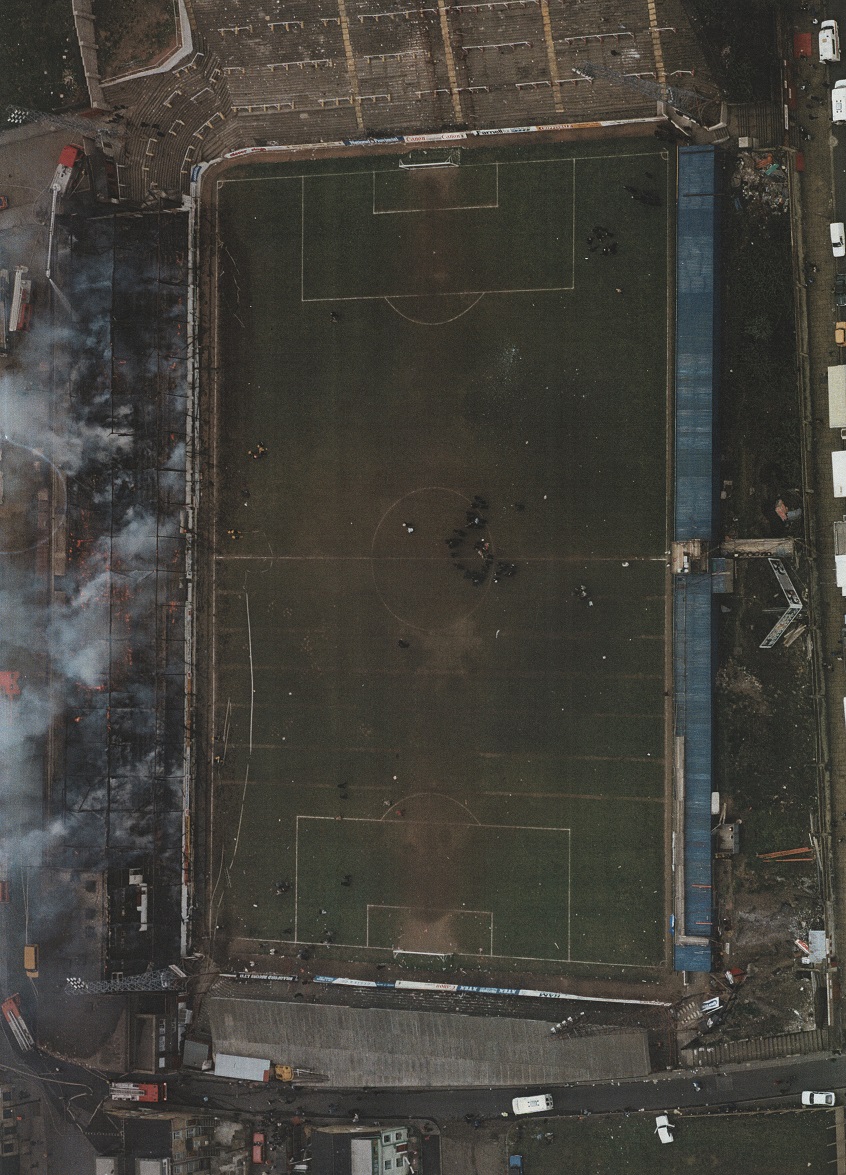
The photograph below was taken on 11th May, 1985 in the aftermath of the fire (rotated to provide comparison with the maps).

VP 11-may-85 X

The stand that caught fire was the same structure as that erected in 1907 which was always intended to be of a temporary and portable nature, a subtle but crucial point previously overlooked in earlier accounts of the history of Valley Parade. Even at the time of its construction it had always been intended that the stand would be replaced.

The then Midland Road cover (at the time of the disaster) was relatively narrow and until 1985 the remains of the ferro-concrete foundations of the former Archibald Leitch designed stand from 1908 could still be seen at the rear. (Refer to photos from this link.)

Links to other archive photos of Valley Parade

Valley Parade: Then and Now

========================================

The story of the origins of Valley Parade and its early development as a Football League ground is told in my books ROOM AT THE TOP and LIFE AT THE TOP published as part of the BANTAMSPAST HISTORY REVISITED series. These include previously overlooked yet crucial details about the development of the ground that were not included in earlier publications about its history. If anyone has any specific questions about the historic development of Valley Parade, by all means contact me by email as below. I am also keen to be put in touch with people with archive images of the ground for future publication in a book.

The above menu provides links to other features that I have written about the history of Bradford sport as well as articles published in the BCAFC programme and book reviews.

Thanks for visiting my blog. Updates are tweeted @jpdewhirst and I can be contacted by email at johnpdewhirst at geeeeeeeeemail dotttt commmmmm.

Carlisle United: 21st September, 2019

PROGRAMMES OF OLD

Published in the Bradford City AFC match day programme for the above fixture

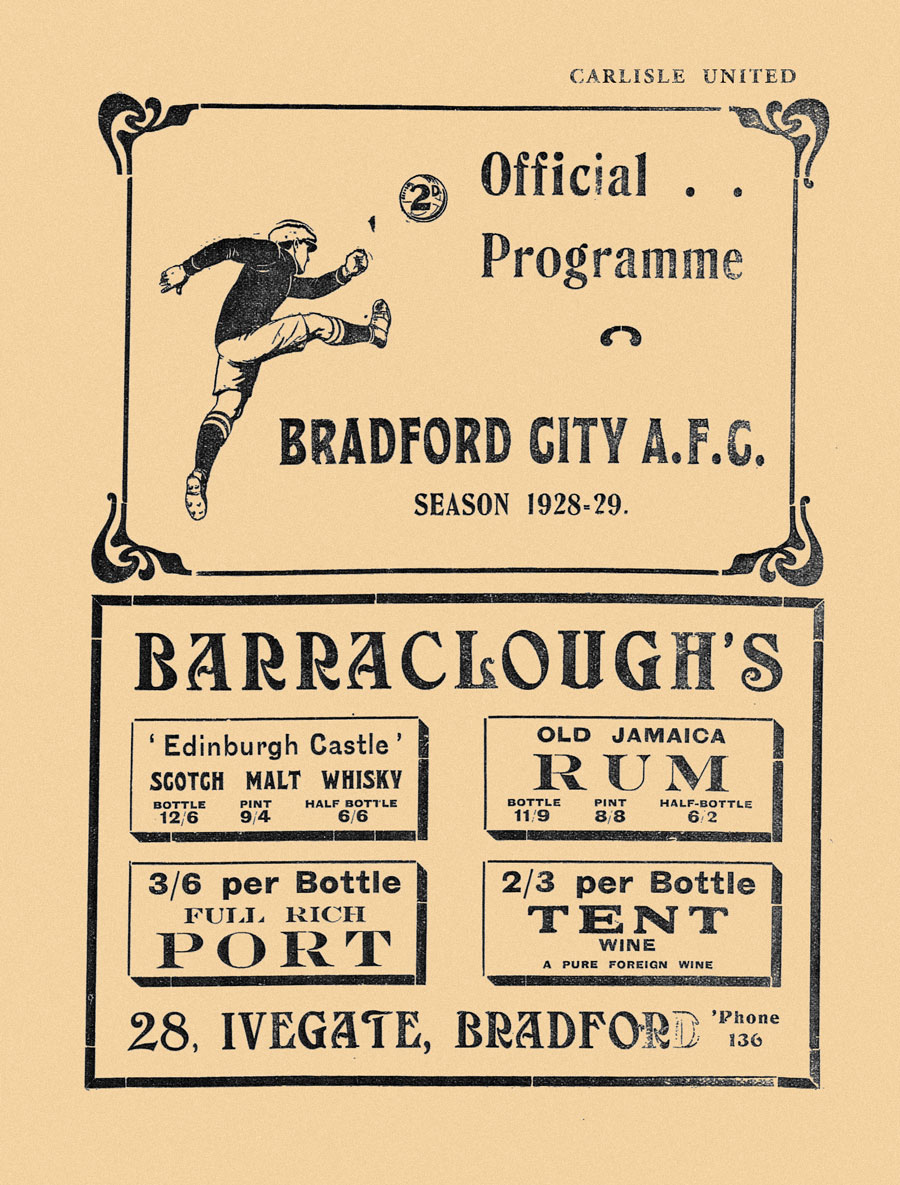
The first game between Bradford City and Carlisle United at a senior level was in August, 1928 on the opening game of the season. Carlisle had been elected to the Football League only months before, replacing Durham City and thus the game with Bradford City was the club’s first in the competition.

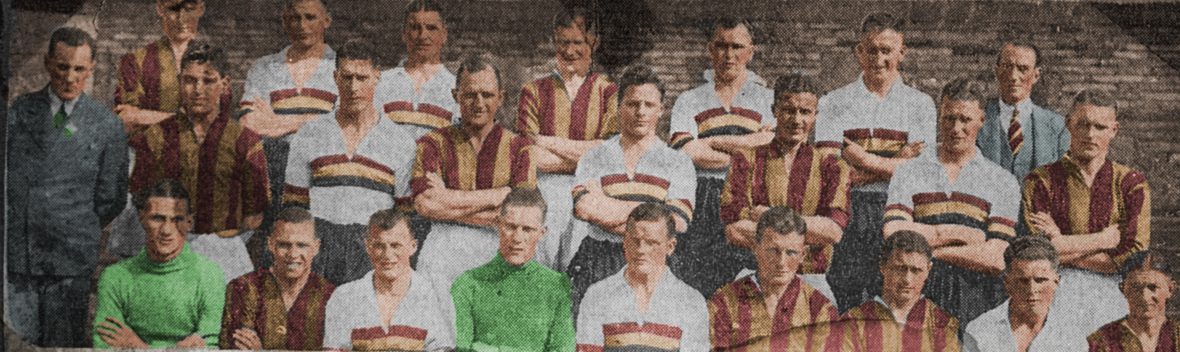
carlisle-28-29.jpgCity had been relegated to Division Three (North) in 1927 and newspaper reports attest to the fact that club officials had been generally unimpressed with the standard of facilities at other clubs in comparison to what they had been used to. On the other hand the visitors from Bradford had nothing but praise for Brunton Park and were said to have been most impressed with the hospitality and the state of the pitch. The return game was at Valley Parade (pictured) the following month which the Paraders won, 4-2 in what was to be an historic championship winning season.
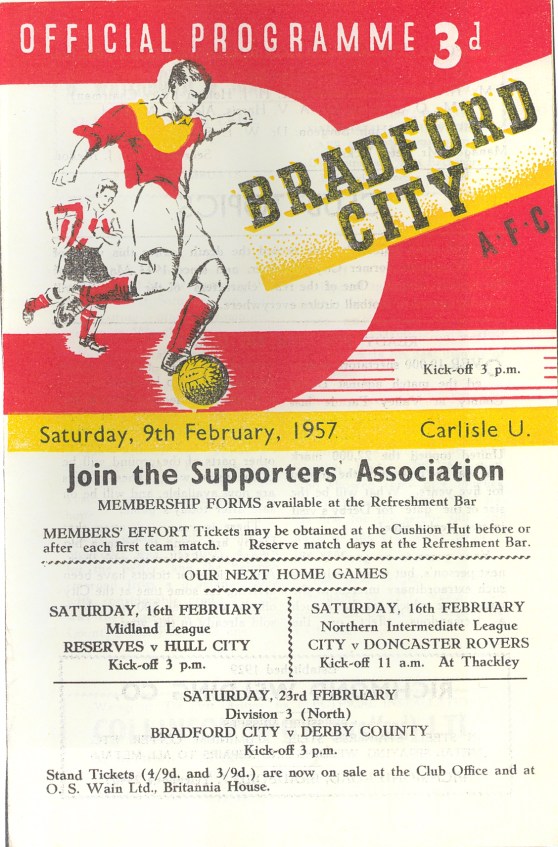
Bradford City were relegated back to Division Three (North) in 1937 and played Carlisle United in each of the subsequent 14 peacetime seasons before the structure was replaced by the national third and fourth divisions in 1958. The programme featured is that from September, 1957 which was won by the hosts, 3-2 and the cover featured the yoke style shirt worn in the FA Cup final of 1911 which had been revived in 1949 (and in the opinion of the writer is long overdue another revival).1957 0902 Carlisle H prog.jpg

Scan_20190702 (20).jpgIn August, 1985 Brunton Park staged another opening game involving Bradford City, a game memorable for the fact that it was the first after the Valley Parade fire disaster the previous May. Our 2-1 victory felt like a cathartic moment after the experience of the preceding months and I will never forget the atmosphere on the away terrace in the sun that afternoon. The fixture has remained a favourite away destination, not least by train from Shipley and via Settle.
We have played Carlisle United in the Football League at every level other than the first tier although this is only the third season in which we have met in the fourth division (and to date, Carlisle United have never beaten Bradford City at this level). Older supporters will remember Carlisle United’s brief stay in Division One in 1974/75, all the more memorable for the club winning its first three fixtures to briefly top the Football League. Among the players in the Carlisle team that season was Les O’Neill who had been signed from Bradford City in 1972 and let’s just say that it was pretty rare for former City players to play at that level in those times!

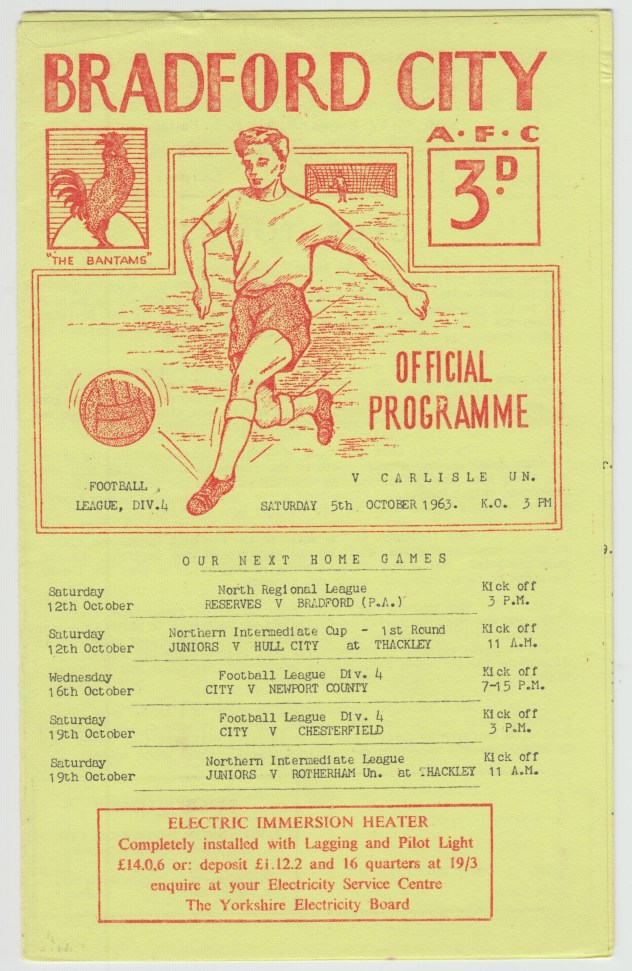
The programme from 1963/64 (below) is a reminder of the times when finances were so stretched that as an economy, Bradford City AFC resorted to printing its own programme internally and dispensing with staples. The standard of the paper was poor and inevitably few survive in decent condition.

Scan_20190702 (22).jpg

You can find other features about the history of Bradford City AFC on this blog as well as links to other content that I have published previously. The menu provides links to archive images featuring historic photographs of Valley Parade as well as old programmes.

Details of my books.

Tweets: @jpdewhirst

John Dewhirst

Having been involved in the production and publication of ten books about Bradford football I am keen to help anyone who seeks to self-publish their own efforts and particularly a story that deserves to be told and by someone who knows his subject. The book worth looking out for is that by Jeremy Charnock who narrates the story of the sad demise of Bradford Park Avenue at the end of the 1960s. Details of how to order as below.

BPA Book

New book about Bradford Park Avenue

This season marks the 50th anniversary of when Bradford lost its second Football League club. After an ignominious decline, Avenue unceremoniously lost their place to Cambridge United in 1970. The collapse of the club was unprecedented although the demise of Bradford City in 2018 demonstrated just how a club can be overcome by crisis and decline.

A new book by a former supporter of the old club is being published at the end of this month. The book is being self-published and given the effort invested by the author it deserves success. It is  story that needs to be told and has been long overdue. Full details of how to order as below:

BPA Book

Something completely different…

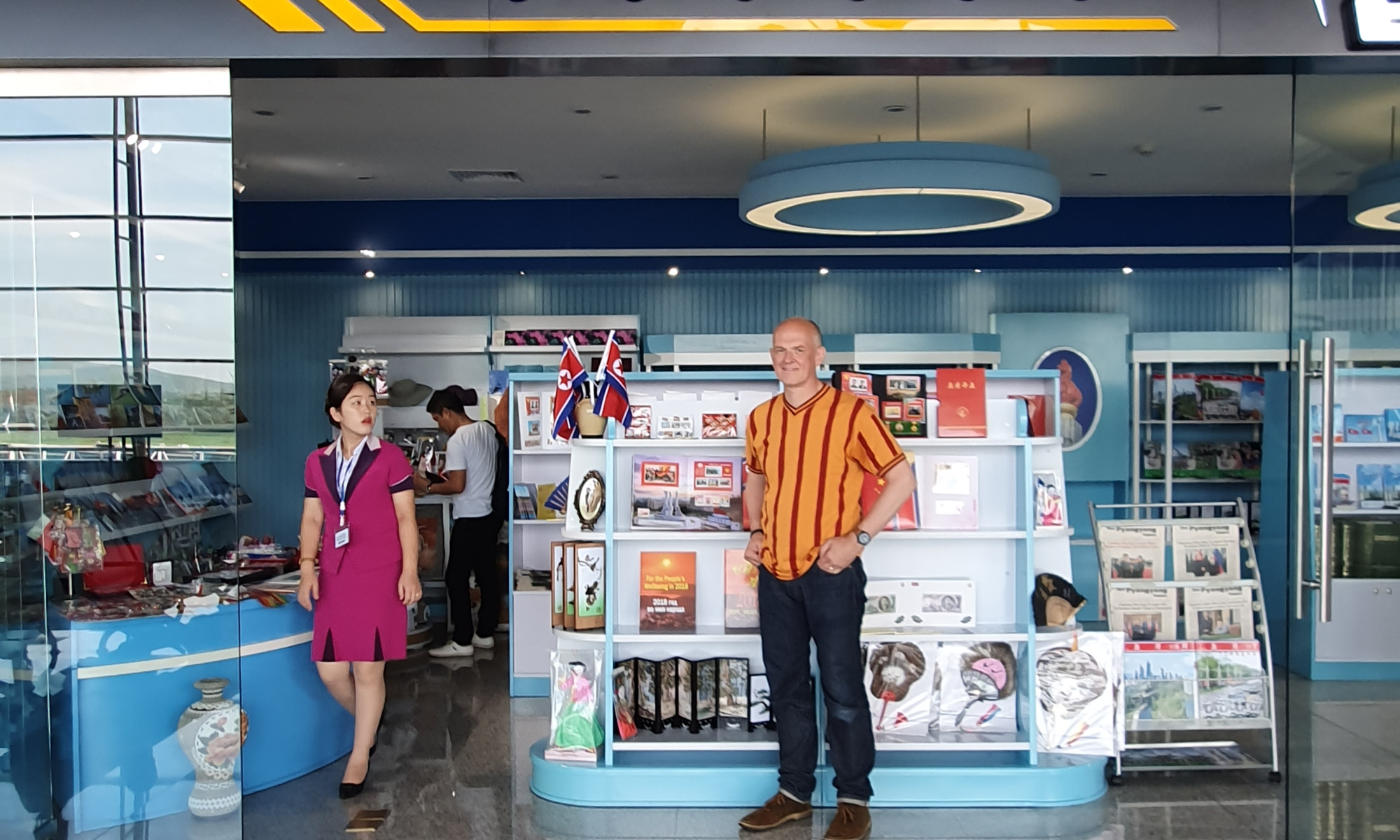
During the summer of 2019 I travelled to North Korea having previously visited in 2005. Photographs of my trip have been uploaded to a separate blog DPRK IN THE VIEWFINDER and photos are also being tweeted from @EscapetoNorthK1

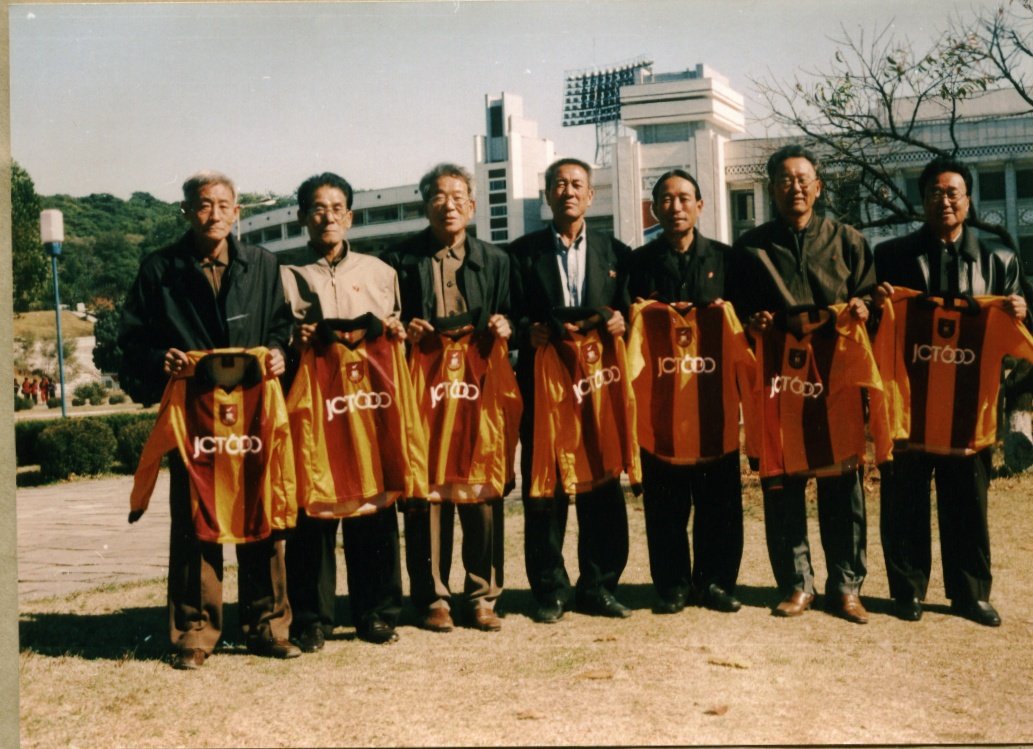
Back in 2005 I distributed Bradford City shirts to a youth team in Pyongyang having presented them initially to surviving members of the North Korean 1966 World Cup team (as below).

ED2JNy5W4AACXpB

North Korea is a fascinating place although I won’t make excuses for its regime. Many of the stereotypes in the western press are wide of the mark and as a destination it is certainly thought provoking, not to mention a photographer’s paradise.

I hope you visit the blog!

20190807_110216.jpg