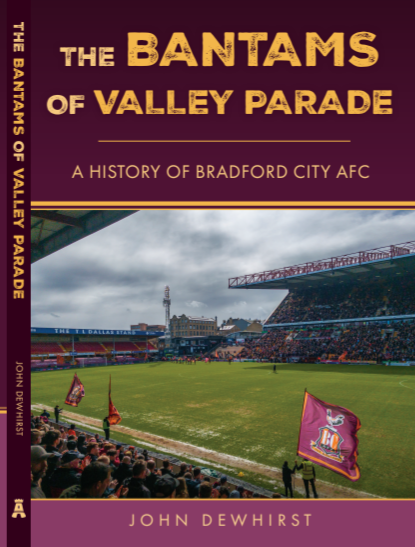

My new book THE BANTAMS OF VALLEY PARADE – A HISTORY OF BRADFORD CITY AFC – goes on sale on 15th September and will be available in Waterstones as well as Amazon. Copies can also be purchased through BANTAMSPAST. The cover price is £16.99 which is relatively cheap by modern standards. There has been an encouraging response to early production copies and I am hopeful that it will be well-received.
I was approached by Amberley Publishing last year about producing a history of BCAFC and whilst I had reservations about their more formulaic / template approach, they offered two major advantages which were appealing to me. The first was to make the book accessible to a wider number of people through their distribution channels and secondly, to be more affordable with a competitive selling price compared to what could be achieved through self-publishing as a BANTAMSPAST publication. Besides it saved me the effort of managing the process and allowed me to concentrate on the writing. For the avoidance of doubt this project has not been with financial gain in mind and is entirely a labour of love.
There hasn’t been a full history of Bradford City published since David Markham’s centenary book which was released twenty years ago and a lot has happened since. In fact the current moment feels like a turning point in the club’s history. I would imagine that in future decades supporters will look back on this era as more eventful and momentous than many prior periods that we could mention.
It is relevant to consider the historical context of where we are now. Last season for example was the first that the club has come close to successive promotions and average attendances were the highest since 1921/22. After so long, it genuinely feels as though we can be optimistic for the future and that the general direction of travel is upwards even if the club doesn’t necessarily improve on last season’s 4th place in 2026/27. It is also a time of significant anniversaries – 40 years since the rebuilding of Valley Parade, 30 years since the first visit to Wembley, 25 years since relegation from the Premier League and of course, 10 years since Stefan Rupp took ownership of the club. It feels timely to look back on the history of BCAFC and hence I encouraged Amberley to bring forward publication of the book rather than wait until 2027 as we had originally agreed.
The Richmond era was undoubtedly an aberration in the club’s modern history, a period of unprecedented success but also one that ended in calamitous failure. With the passage of time there has been a selective and nostalgic memory of reaching the Premier League which is hardly surprising given the achievement. What happened between 1994-99 in particular has become something of a benchmark to judge what has happened since as the measure of ambition. On the other hand, the extent of the financial crash that followed in the wake of relegation from the Premier League has tended to be forgotten despite its far-reaching implications.
The bumper crowds attending matches at Valley Parade nowadays is the product of innovative and affordable pricing policies by the club which has secured new supporters, many of whom are too young to have recollection of what happened when Geoffrey Richmond was in control. For many the impression is of him having been some sort of white knight. Cutting through the rose-tinted statements, Richmond cannot be exonerated and it is more relevant to see him as the predator who saw opportunity in Bradford in 1994 much as a vulture might identify his prey. For all the good memories of that time, it is the cold assessment of Richmond that cannot be ignored and needs to be highlighted. The memory of Richmond is also good reason to be wary about the future ownership of the club.
It has taken BCAFC a long time to get back on its feet, not least impacted by the Rahic affair that represented both a unique and unforgiveable episode of internal collapse at Valley Parade. Historically, the record of corporate governance at Valley Parade has been poor. Like Richmond before him, Rahic brought considerable damage to the club.
The fundamental question asked by most is why Bradford City AFC has never sustained success and why the club has languished for so long in the lower divisions. Poor governance has been a factor in this but there have been other structural factors impacting on the club’s fate. Going back to the club’s formation in 1903 it was undoubtedly disadvantaged by its rugby origins and its relatively late conversion to association football. Hence my book begins by examining the background to Manningham FC at Valley Parade in the nineteenth century.
There has been a remarkable recurrence of the same themes through the club’s history that have reflected the handicaps it has faced – low capitalisation (ie financial backing); competition from Bradford Park Avenue / Northern-Bulls; and the expense of a stadium on a hillside. Neither should we under-estimate the impact of two wars which compounded financial difficulties and undermined the club’s financial reserves (or rather exposed the lack of) with far-reaching impact. All of this has been compounded by the high turnover of managers at Valley Parade and failure to invest in infrastructure – recurring issues in the club’s modern history that fostered a short-termist approach to decision-making. In just about every decade through to 2018 there were financial crises at Bradford City and corresponding instability, preventing any momentum to consolidate earlier success. An alternative title for the book would be ‘Why has BCAFC consistently under-performed for so long‘… ‘and why things might now be different‘.
Bradford City AFC has never had a Jack Walker (Blackburn) or Jack Hayward (Wolves) figure who invested their millions into their local club. Historically the ambition of the club was limited by monies that its directors could afford or were willing to inject and neither was BCAFC or Bradford football an attractive investment proposition. When Richmond bought the club in 1994 he introduced a dramatic change in how the club was run but it proved wholly unsustainable and destroyed value.
For all the criticism of Stefan Rupp, since 2016 he has injected more money in the club than all other directors / owners at Valley Parade put together. Love him or loathe him, he is the nearest that Bradford City has ever had to a benign owner. At a time when football supporters across the country look nervously at the corporate ownership of their own clubs – the examples of Leicester and Sheffield Wednesday being obvious cases in point and consider also the recent experiences at Reading or Blackpool – the way that a club is owned and managed is as significant as player selection.
As I narrate in the book, the club suffered recurring financial crises in every decade through to 2018, in fact it was with a frequency of roughly every five years or so. Since 2018 we have had more financial stability than has ever been the case previously. We haven’t seen Rupp injecting millions indiscriminately but we have seen the evolution of a well-run and stable football club. In the last couple of years we have seen the fruits and the return of a feelgood factor to Valley Parade. Recovery was kick-started by Mark Hughes in 2022 but the subsequent impact of Graham Alexander has been transformative.
My belief is that we could be at a key moment in the club’s history. It doesn’t guarantee success but the foundations are much stronger than ever before and more likely to drive sustainable progress. Consider also the relative position of the club. Many – if not most – clubs in the Championship and in League One are significantly loss-making and weighed down by debt. Even allowing for football economics, surely clubs cannot defy financial gravity indefinitely? Bradford City AFC does not own its freehold and has a limited asset base but the fact that the club is debt-free puts it in a stronger position. Is it any coincidence that three headline signings this summer have been from clubs facing financial pressures (ie Barnsley, Burton and Leicester) which represents a major transformation in the club’s bargaining power and prospects.
I am keen to encourage wider interest and awareness in the club’s history. To know the club’s past is to know the future and hence why I believed it important to make this book as accessible and affordable to as many people as possible.
The reader will discover a lot of previously overlooked and forgotten detail about the club’s history that I have uncovered during the course of research in the last ten years or so. Quite a lot of what you find online or has been claimed about the history of BCAFC is inaccurate, what can politely be described as representing a wishful or imagined interpretation of events and indeed that was my motivation for launching the BANTAMS HISTORY REVISITED series of books in 2014.
THE BANTAMS OF VALLEY PARADE includes personal memories from key moments supporting the club, in particular the earlier era of ‘Bantam Progressivism‘ in the 1980s when I was actively involved in the launch and production of The City Gent when that publication carried influence at Valley Parade. I also wanted to put on record what happened in 2002-04 and 2018 when I had involvement with the club in a professional, work capacity.
REVIEWS OF BANTAMS OF VALLEY PARADE FROM THE LINKS BELOW:
Width of a Post website
I am hoping to arrange a number of talks in the next few months about the club’s history which follows the success of that at the Bradford Literature Festival. I hope that these will also allow for discussion and debate of the historic record. Updates will be posted on this blog and through Twitter @jpdewhirst.
The first of these is next month. My talk ‘The Origins of Football Culture in Bradford‘ at the Mechanics Institute, Bradford on 20th September 2026 can be booked here. Capacity is limited so early booking is recommended to secure attendance.
In the meantime I hope that the book is well received and if you don’t want to buy it, THE BANTAMS OF VALLEY PARADE – A HISTORY OF BRADFORD CITY AFC will be available in local libraries.