Athletics at Valley Parade

The following is my column that was published in the Bradford City programme (v Bristol Rovers) on 2nd September, 2017

Valley Parade has been the home of Bradford City ever since the club was formed in 1903. Prior to that it had been used for rugby by Manningham FC, staging Rugby Union between 1886 and 1895 and then Northern Union (RL) between 1895 and 1903. Additionally, it has been adopted by Bradford Northern and then Bradford Bulls for Rugby League fixtures. Accordingly, what is unique about the ground is that it has staged all three of the principal codes of football. During the last century Valley Parade hosted gymnastics and boxing on various occasions but what has been overlooked is that when Valley Parade was constructed it was designated as both a football ground and an athletics arena.

Manningham FC had been forced to relocate from Carlisle Road on account of the construction of a school and Valley Parade was selected by virtue of the absence of other options. The site required considerable work to create a suitable venue on a hillside but its central location was considered an advantage. The venture represented a major undertaking for the club and the use of the ground for athletics was therefore seen as a means to make the investment pay its way. As a result, a three yards wide cinder track was thus included around the pitch perimeter for running competition.

When plans for the new ground had been announced in May, 1886 local cyclists had lobbied for a cycling track to be incorporated at Valley Parade. The lack of a cycling track was keenly felt in Bradford and enthusiasts were forced to resort to cycling in public parks which was regarded as an anti-social nuisance. Poor road surfaces and adverse gradients left few other options. The cyclists had wanted a wooden track to be laid down. Other than the prohibitive cost the other factor dictating against it was that it would have been unsuitable for running whereas a cinder track could at least be used by cyclists and runners. Although the cyclists were disappointed and forced to look elsewhere, cycling events were nonetheless staged at Valley Parade during athletics festivals.

Athletic festivals took place at Valley Parade on an annual basis between 1887 and 1896. The illustration dates from August, 1887 when Airedale Harriers organised the first such festival at Valley Parade with events including a two mile bicycle handicap. On this occasion however the crowd was said to have been disappointing despite decent weather. A marquee was erected on the platform which then existed above the Manningham end terrace before the Kop was extended in 1906. Manningham FC and later Bradford City AFC maintained close relations with Airedale Harriers of whom Tony Fattorini was a joint member and those links encouraged the adoption of athletic training for football purposes. Prior to 1903 the Harriers also provided pre-match entertainment with races at Valley Parade.

The end of athletic festivals came with the launch of the Northern Union in 1895 and the reluctance of amateur athletes to be associated with events staged by professional clubs for fear of being banned from amateur competition. Changing fashions and the evolution of athletics towards codified events demanding dedicated venues were other factors. Furthermore, the final event at Valley Parade in 1896 had been loss-making.
Remembering Jimmy Speirs

The following was published in the Bradford City match day programme on 19 August, 2017:

JimmySpeirs.jpg

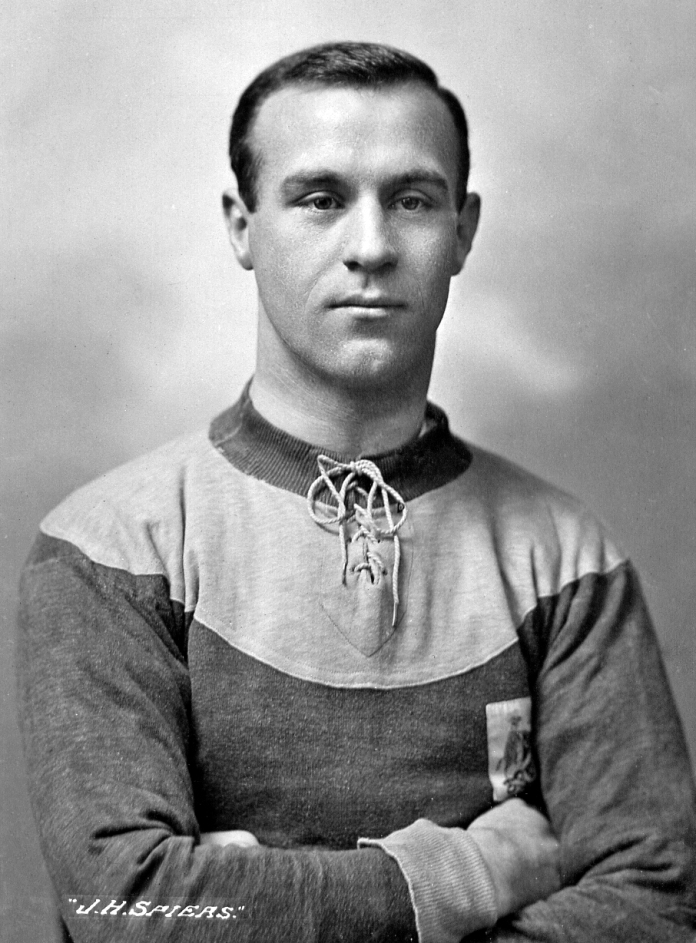
Tomorrow marks the centenary of the death of Jimmy Hamilton Speirs, team captain and scorer of the winning goal when City defeated Newcastle United in the FA Cup Final replay at Old Trafford on 26 April, 1911. After the game he was cheered by 100,000 exultant Bradfordians in the city centre and yet six years later he faced death in a muddy shell-hole at the age of only 31, killed at Passchendale on 10th August, 1917.

Jimmy Speirs had formerly played for Rangers and Clyde before joining Bradford City in 1909. Whilst at Rangers he had been capped once for Scotland. In total he made 96 first team League and Cup appearances for City, scoring 33 goals before being sold to Leeds City on 27 December, 1912. At the time of his transfer he was the leading scorer at Valley Parade but faced with a collapse in form during the preceding two months, Peter O’Rourke needed funds to finance team strengthening. It proved impossible to refuse the £1,400 fee offered by Leeds City for the inside left which was a record transaction for both clubs. However it is questionable whether Bradford City ever recovered prior to the suspension of League football in 1915 from the loss of their talisman.

On their part, Leeds were prepared to pay a premium such that Jimmy Speirs would be registered in time to play in the FA Cup but it is notable that the player himself was reported to receive between £200-300 which would have provided financial security for his family. Indeed Speirs was known to be financially astute and it was said that in 1909 he had made a small fortune from trading rubber shares. We will never know whether he was unsettled at Valley Parade in 1912 and possibly tempted away by Leeds manager, Herbert Chapman.

Whilst Jimmy Speirs is remembered for his place in the history of the club, he could be defined by so much more. Not only was he an inspirational leader on the football pitch he was a popular NCO on the battlefield who led by example, awarded the Military Medal in May, 1917. He was also a family man with two young children. The loss of such a remarkable individual is the ultimate illustration of the futility of war. He is buried at Dochy Wood Cemetery in New Flanders and his grave is regularly attended by football supporters and family members.

In making the ultimate sacrifice, Speirs was one of 245,000 British soldiers killed at Passchendaele and an estimated 744,000 in the conflict as a whole. A total of four serving and six former Bradford City players were killed in action during the Great War and Bob Torrance was another member of the 1911 FA Cup winning team to be killed (April, 1918). Subsequent to the war Jimmy Speirs and others with a Valley Parade connection were remembered first and foremost as fallen soldiers among comrades in arms. So many men had been killed that there was a reluctance to differentiate former professional football players as deserving of unique attention and I believe that Jimmy, known as a team player would have concurred with this treatment.

Accordingly a memorial to the war dead of Bradford City was not erected at Valley Parade until 2015 (funded by a badge sale organised by Bantamspast) and prior generations tended to remember Jimmy Speirs as one of countless others who never returned. By contrast the distinct commemoration of footballers killed in action has been a more modern phenomenon.

I encourage readers to visit www.jimmy-speirs.co.uk to learn more about Jimmy.

John Dewhirst

The origins of Valley Parade and Midland Road

The following was published in the Bradford City match day programme on 8 August, 2017

Judged from its width alone, Midland Road conveys the status of a primary highway and yet it doesn’t go anywhere. Could the Victorians have really designed it solely for modern day street parking and to provide entertainment for future generations of traffic wardens? Surely there cannot be another road of its ilk in Bradford.

The original intention was for a road to Shipley from the Midland Station (what became Forster Square station, as renamed in 1924). The route can be detected from an aerial view on Google maps and you can’t help but think that it would have been a better option compared to either Manningham Lane or Canal Road. Indeed, our predecessors thought likewise. In particular, Valley Road was a cause of frustration for the Midland Railway as it was unable to accommodate the increase in traffic to its busy goods yard.

Passenger and goods traffic to and from Bradford was booming so the Midland looked to expand its warehouse and goods depot as well as increase capacity through additional sidings. The plans for the new ‘twenty yard’ road – a benchmark for primary highways of the era – fulfilled a couple of other objectives for the Midland by improving access to a new station at Frizinghall (opened 1875) and by encouraging the development of housing along the corridor.

The scale of development and the extent of the financial investment should not be underestimated but it was unfortunate that it coincided with a downturn in the property market in 1873. The reason why the Midland Road never extended to Shipley is understood to have been because property owners refused the sale of their land en route. In the depressed conditions, the Midland decided to terminate negotiations as well as the road project because a loss of appetite for property speculation in the town undermined the viability of the scheme. The Midland had other construction programmes at the time and was also digesting the cost of the Settle to Carlisle railway (which did not open to passenger traffic until April, 1876) and the construction of St. Pancras station in London. Hence it decided to conserve funds for use elsewhere. Thus Midland Road became something of a white elephant.

The Valley Parade site was originally intended to be a consignment warehouse by the Midland Railway who bought the land in anticipation of development in 1872. The railway company had intended to construct a bridge from the bottom of Cornwall Road to the railway yard in the valley below. A warehouse at Valley Parade would then have provided goods storage to and from the sidings.

Subsequent to the same property crash of 1873 the Valley Parade warehouse development did not proceed and the site remained in an undeveloped state with stone extracted for building and the area used to deposit a combination of building spoil and household waste. Although it would have been rough land there is reason to believe that it was adopted for stabling and in May, 1886 it was even reported to have staged a circus.

The following link narrates the early development of Valley Parade after 1886 and incorporates material that had been overlooked until the publication of my book ROOM AT THE TOP (Bantamspast, 2016).

John Dewhirst

*** The history of Valley Parade continued to be closely linked to that of Bradford’s railways. The story of the saga for a cross-town rail link in Bradford can be found from this link.

Construction of the Main Stand at Valley Parade, 1907

The following was published in the Bradford City AFC match day programme vs Blackpool, 5th August 2017…

In August, 1907 Valley Parade was in the midst of redevelopment with the extension of the main stand on South Parade that dated from 1904. The stand which burned down in May, 1985 was essentially the structure that was completed in 1907 and in this photograph taken at the beginning of the season the construction work can be seen underway.

teamgroup1907-08 - Copy

Facilities at Valley Parade were basic and subsequent to being elected to the Football League in 1903, limited resources had existed for Bradford City to invest in ground improvements. However the lack of security of tenure was an issue that deterred major investment and in 1907 the criteria was that any new stand should be of a transferable nature as a contingency measure in case the club was forced to relocate. Whilst it might seem incredible to us, the idea of a portable stand was not a new idea because the Manningham FC members were already familiar with moving a stand to a new ground (as had been the case in 1886 when the uncovered grandstand – what would better be described as a viewing platform – had been relocated to Valley Parade from Carlisle Road).

The risk of fire was clearly discounted when the main stand was erected. Or rather, the implicit assumption was that any risk of fire could be managed. It was not as if grandstand fires were unheard of, but what tended to encourage complacency was that incidences of fire had tended to be when grounds were unoccupied and therefore the risk was associated with sinister reasons rather than as an issue of crowd safety.

The stand was completed in time for the fixture with West Bromwich Albion in November, 1907 and thus provided a quick solution to the need for additional covered accommodation. It was claimed that it had a capacity of 12,000 of which 5,000 seated but the minimal facilities and lack of dressing rooms hardly made it worthy of being described as a grandstand. Even by contemporary standards in 1907 it would have been considered basic and the predominant use of wood was a cheaper (and transportable) option compared to concrete. The irony is that it was considered a temporary structure, constructed as cheaply and quickly as possible with the intention of eventual replacement by a cantilever stand.

In February, 1907 work on the new Kop had been completed, christened Nunn’s Kop after the name of the director responsible. A new stand on the Midland Road was constructed the following year.

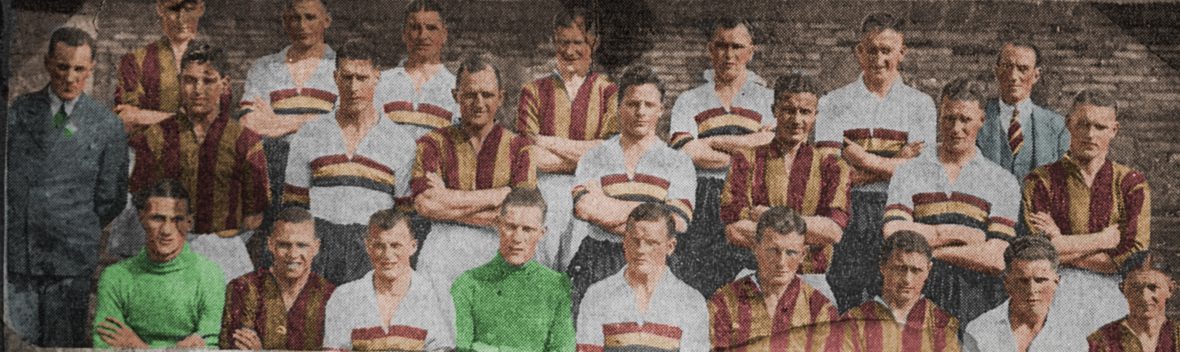
The 1907/08 season proved to be a major turning point for Bradford City. After the rejection of merger with Bradford Park Avenue in May, 1907 twelve months later the club was crowned champions of Division Two. The architect of the transformation was manager Peter O’Rourke who had been appointed in 1905 (pictured far right). It was his signing of namesake Frank O’Rourke (seated front right – circled) and James McDonald (seated front left – circled) in April, 1907 that was said to have transformed his team into promotion winners.

Links from here to more content about the history of Valley Parade

John Dewhirst

You will find other features about the history of Bradford City AFC on this site (from the origins of the club crest through to archive photographs), book reviews and sundry features about the history of Bradford from the menu above. If you are interested in the history of Bradford, have a look at VINCIT: the online journal of Bradford Sport History.

Harry Garnett’s jug

A silver ewer presented to Harry Garnett of Bradford FC in November, 1880 is being auctioned next month…

Despite the fact that Bradford established an enviable reputation for sporting excellence in the last quarter of the nineteenth century, the achievements of its two principal rugby teams Bradford FC and Manningham FC (who later converted to soccer at Park Avenue and Valley Parade respectively) has tended to be overlooked. Artefacts from the era are few and far between and so it is particularly interesting to discover that this item exists and is being auctioned next month.

87143-1-0.jpg

The trophy was presented to Harry Garnett on the occasion of his retirement as captain of Bradford FC in November, 1880 occasioned by his marriage the following month. Garnett had been a leading member of the club in the second half of the 1870s and under his captaincy the club had become known as the strongest in Yorkshire. Otley based Garnett had also been the second player from the club to be awarded an England cap by the Rugby Union in 1877.

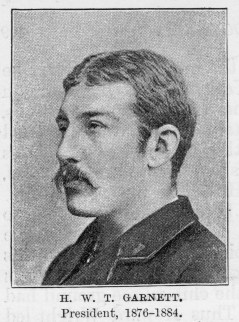
Garnett (1851-1928) is rightly credited for having pioneered rugby football in Bradford as well as in Yorkshire and he remained influential as a county administrator, president of the Yorkshire governing body between 1876-83 and in 1889 becoming the first Yorkshireman to become president of the RFU. He was also credited with having helped instigate the Yorkshire Challenge Cup competition that was first played for in the 1877/78 season. It says much about the developments at Park Avenue that he chose to sever his connections with Bradford FC completely in 1881, thereafter to all intents and purposes forgotten.

Garnett (2).jpg

Having previously been based at Apperley Bridge (at the field adjacent to the Stansfield Arms), Bradford FC moved to the newly constructed Park Avenue ground in 1880 following merger with Bradford Cricket Club. Although relocation brought a new era of sporting glory, Garnett had misgivings about changes that were taking place in the sport at the time. Garnett fell out with other members of Bradford FC and whilst the trophy was a generous gift it is notable that the presentation to him was poorly attended.

His marriage in December, 1880 at the age of 29 years was a high profile affair. Solemnised at the Chapel Royal, Savoy in London, the officiating clergyman was the chaplain-in-ordinary to Queen Victoria. Garnett was a gentleman and his marriage was the occasion for him to formally leave Bradford FC. However by then relations were already sour.

In November, 1880 the Leeds Times described a presentation to Garnett by ‘several members’ of the Bradford club at the Alexandra Hotel in Bradford – by which was meant that the event was attended by a minority of members. Garnett had made a rather pointed response to the effect that ‘no man played football with any hope of reward, and it was a pleasure to him to know that the club appreciated the services which he had rendered.’ The Bradford Daily Telegraph of 22 November, 1880 was more charitable: ‘There was a nice company of friends, a sumptuous dinner, and conviviality enough to make things pleasant and send home the diners in a happy frame of mind.’ Nonetheless, there is sufficient circumstantial evidence to suggest there having been a falling out. Although Garnett had been elected captain of the club in May, 1880 The Yorkshireman of 14 August, 1880 considered it surprising that ‘the respected captain of the former club was not invited to the Mayoral banquet which graced the inauguration of the new ground.’

Garnett appears to have played only a single game for Bradford FC in the 1880/81 season, as captain against York at Park Avenue in October, 1880 and this was his farewell appearance. According to The Leeds Mercury of 23 November, 1880 in that same month Garnett had spoken ‘on the subject of gate money, and contended that the tendency towards playing matches for the purpose of raising a large amount of gate money without any visible object would in time act prejudicially to the best interests of the game. He suggested that the surplus funds of a club at the close of a season be devoted to some charitable object, and thought that by doing so football would still continue to increase in popularity.’ On this evidence it is clear that Garnett was not in favour of developments at Bradford FC. Whether he was aware of monies being paid to Bradford FC players is unclear (such as the reimbursement of expenses for those new recruits travelling to Apperley Bridge in 1879/80).

There is more about Harry Garnett in my book Room at the Top.

Further details about the auction: http://www.thetelegraphandargus.co.uk/news/15352925.Piece_of_Bradford__39_s_sporting_history_to_go_under_hammer/

The Bantamspast ‘History Revisited’ series – How to obtain our books

history revisitedYou can buy copies of the four books in the series direct from BANTAMSPAST, PO Box 307 SHIPLEY BD18 9BT – cheques payable to BANTAMSPAST.
ONLINE PURCHASE FROM THIS LINK

Stockists in Bradford: Waterstones, Wool Exchange, Salts Mill bookshop and the Bradford PA club shop at Horsfall (BCAFC books apart!). You can purchase online through Amazon (distributed by Bradford based Precious Books) and ebay.

Tweet updates (and ebay searches): #bcafcobjects #reinventingbcafc #roomatthetop #lifeatthetop

Vol. 1  A History of Bradford City AFC in Objects by John Dewhirst, pub Oct-14 (limited copies only, now £20)

Vol2 Reinventing Bradford City by Jason McKeown, pub Mar-16 £20 – including p&p (a small number of hardback copies available, £30)

Vol3 Room at the Top by John Dewhirst, pub Jul-16 £20 (softback) / £30 (hardback) – including p&p

Vol4 Life at the Top by John Dewhirst, pub Jul-16 £20 (softback) / £30 (hardback) – including p&p

If you have any problems getting hold of copies contact us direct. Likewise, to join our mailing list to get news of the next two books in the series – vols 5 & 6 for release in the next 24 months – please email. Subscribers get books at a discount and the opportunity for their name to be printed in the book.


Wool City Rivals update

The fifth volume in the BANTAMSPAST ‘HISTORY REVISITED’ series covers the twentieth century rivalry of Bradford City and Bradford Park Avenue, continuing the story of their rivalry as rugby clubs narrated in ROOM AT THE TOP and LIFE AT THE TOP published last year.

The intention is that WOOL CITY RIVALS – which could as easily be described as FALL FROM THE TOP – will provide a definitive record of the City / Avenue rivalry and contain a considerable collection of memorabilia and relics of the two clubs. Whilst most of the research has been completed, considerable work is needed to finalise the design and artwork. If anyone has interesting examples of memorabilia that could be featured I am very keen to hear from you.

Refer tweets: @jpdewhirst or em glorious1911 at paraders dot co dot uk

*** Anyone interested in Bradford sports history is encouraged to visit VINCIT: http://www.bradfordsporthistory.wordpress.com/ which has new articles published monthly. The most recent is the story of the Bradford Charity Cup and a prestigious trophy that was competed for by rugby union, northern union and association football clubs.

Topical themes

Next month marks the 150th anniversary of the first competitive football fixture in Bradford which is featured on VINCIT:    https://bradfordsporthistory.wordpress.com/2016/12/30/455/

The insolvency and liquidation of Bradford Bulls is yet another story of financial failure in the district with history repeating itself. Again, a topical article on VINCIT:  https://bradfordsporthistory.wordpress.com/2016/08/05/taking-the-long-view/

Room at the Top and Life at the Top selected in The Guardian review of the Best Sports Books of 2016: https://www.theguardian.com/books/2016/dec/02/the-best-books-on-sport-of-2016-huw-richards

Forthcoming book: Fall from the Top, The Wool City Rivals

Plans for the next volume in the BANTAMSPAST HISTORY REVISITED series, FALL FROM THE TOP, THE WOOL CITY RIVALS are advanced and help is requested to bring the project to fruition.

The book features the twentieth century soccer rivalry of Bradford City and Bradford Park Avenue, continuing the story from LIFE AT THE TOP. There will be a much higher image content with examples of City and Avenue memorabilia, but in particular a large number of team and action photographs – a significant proportion of which will be in colour. Mindful of the fact that before too long the Wool City soccer rivalry will be forgotten and no longer part of living memory, this is the opportunity to record the past for posterity. Hence the appeal to anyone who has old City or Avenue relics and/or photographs that could be featured.

Help is also sought from people willing to assist with investigating local newspaper archives in Bradford Central Library. I was assisted by A-Level and undergraduate students in the production of ROOM AT THE TOP and LIFE AT THE TOP and the research work is arguably good experience for history students. Payment will be arranged.

Please contact the author, John Dewhirst by em: glorious1911 at paraders dot co dot uk  or tweet @woolcityrivals

A good selection of items has already been accumulated and much of the narrative history is written but the objective is to be exhaustive in the search for old memorabilia and archive content. The book will also require considerable artwork and design which will ultimately determine the publication date. Check this site for details!

Copies of the first volumes in the series – A HISTORY OF BCAFC IN OBJECTS, REINVENTING BRADFORD CITY, ROOM AT THE TOP and LIFE AT THE TOP are available on ebay, from Bantams Banter, Waterstones Wool Exchange, Salts Mill, Amazon and direct from the publisher. Details elsewhere on this site. Buy now for Christmas!