Remembrance Day reflections

Poppyremembrance

We remember

Wednesday, 11th November 2020 marks the 102nd anniversary of the end of World War One. It was a conflict that has a particular poignancy for Bradford City supporters with four serving and six former players of the club having lost their lives. The fatalities included Jimmy Speirs, team captain and scorer of the winning goal in the 1911 FA Cup Final replay as well as Bob Torrance, acclaimed as man of the match in the replay.

Whilst it is important to remember the sacrifice of the club’s players we should also recognise that the so-called Great War of 1914-18 impacted greatly on the football club. Indeed, what tends to be overlooked is that numerous supporters of the club were also among the war dead and injured. In turn the war touched upon the families of Bradfordians. In the aftermath of the war nothing was quite the same for either the city of Bradford or Bradford City. Aside from the personal tragedies, the city had lost its German community and the finances of Bradford City AFC were depleted to the extent that the club lost its first division status in 1922.

Historic links between sport and the military in Bradford

The war also redefined the links between the football club and the local military. When I undertook my research on the origins of football in Bradford, it became apparent that the historic ties between sport and the military in the district had long since been forgotten. This is ironic given the constant reminder provided by the traditional club colours of City and Avenue / Northern having been derived from military connections. My belief is that after the carnage of the Great War the military heritage tended to be overlooked, not necessarily for ideological reasons but because it was probably seen as outdated, if not irrelevant as people looked to the future.

The early history of Manningham FC – established in 1880 and the predecessor of Bradford City AFC in 1903 – had strong links with the citizen soldiers of Bradford. The generation of men involved with establishing ‘football’ clubs in Bradford during the second half of the 1870’s was typically connected with the Volunteer – or territorial – army units in the town and ‘athleticism’ in the widest sense was considered to be a form of military training by virtue of its health benefits.

The Volunteers had been established in 1859 to provide a home defence force to protect the UK from invasion and in Bradford the principal units were the 3rd Yorkshire (West Riding) Rifle Volunteer Corps and the 2nd Yorkshire (West Riding) Artillery Volunteers Corps.

One reason for the popularity of the Volunteers was that they provided recreational opportunities and in particular access to new sporting activities such as gymnastics and ‘football’ (which in Bradford meant rugby). There was even a dedicated side, Bradford Rifles FC established in 1875 which comprised of a high proportion of Bradford Caledonian FC players (one of the oldest clubs, established in 1873 and also the biggest), a number of whom subsequently became associated with Manningham FC in leadership roles.

This connection encouraged a natural sympathy towards the military but so too did the proximity of Valley Parade to Belle Vue barracks where the 3rd YWRRVC was based. Closer still were the artillery barracks adjacent to Cottingley Terrace just off Valley Parade. Both were used on various occasions for meetings as well as changing and training facilities by Manningham FC and the infant Bradford City club. (The story of the Bradford Rifles is told here on VINCIT)

The dominant political culture at Valley Parade and Park Avenue prior to World War One was unquestionably Conservatism and it was second nature for the two clubs and their membership to espouse patriotism. A good example of this was the decision to adopt claret and amber in 1884. This came at a time of patriotic fervour associated with the Sudan crisis and the excitement that Bradford men might actually go to war. Arguably it was the same enthusiasm thirty years later with spectators at Valley Parade being actively encouraged to enlist to fight on the western front.

The traditional sporting colours of Bradford were red, amber and black whose origin can be traced to the original Bradford Volunteers of the Napoleonic era. The colours of the local West Yorkshire regiment with whom the 3rd YWRRVC was affiliated were claret and amber.

The Valley Parade War Memorial

FullSizeRender

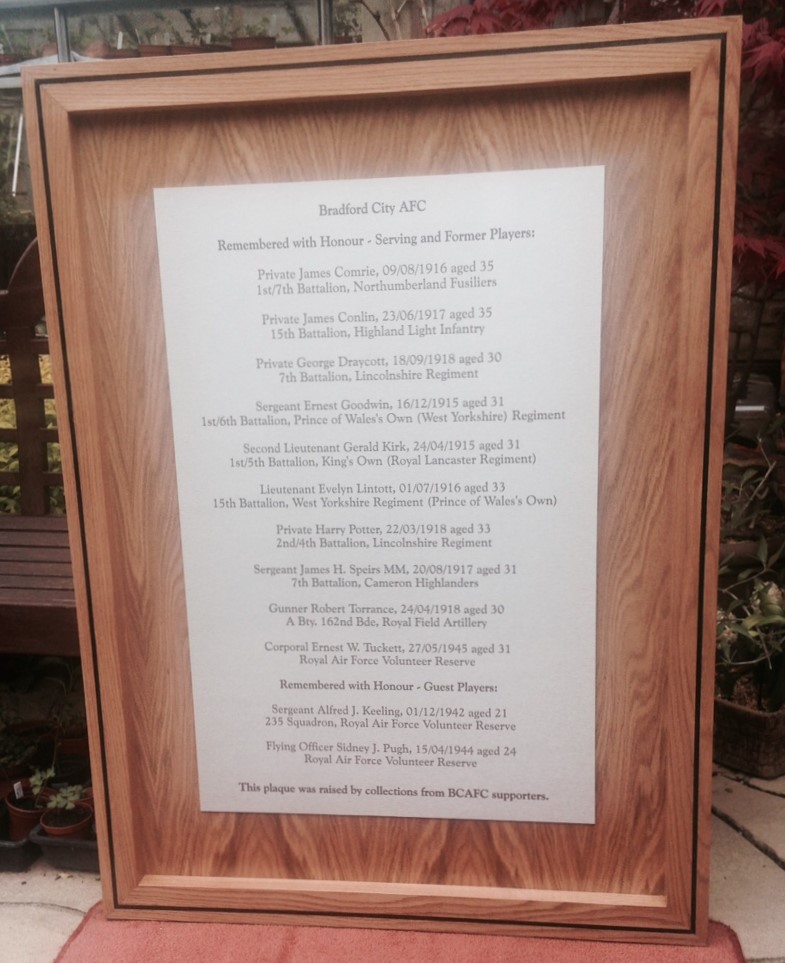
In addition to the 1911 FA Cup heroes Jimmy Speirs and Bob Torrance, the war dead included England internationals Evelyn Lintott and Jimmy Conlin, James Comrie, George Draycott, Ernest Goodwin, Gerald Kirk and Harry Potter. Unfortunately the status of Ernest Kenworthy who played two games for the club in 1906/07 was not established until after the erection of the memorial in the Valley Parade reception in 2015. (NB George Draycott, Ernest Goodwin, Harry Potter and Bob Torrance were serving players of BCAFC at the time of being killed in action.)

Subsequent to the war, Jimmy Speirs and others with a Valley Parade connection were remembered first and foremost as fallen soldiers among comrades in arms. So many men had been killed that there was a reluctance to differentiate former professional football players as deserving of unique attention and the players would have concurred with this treatment. Nowadays the fallen players are afforded particular prominence whereas prior generations tended to remember them among countless others who never returned. The distinct commemoration of footballers killed in action has thus been a more modern phenomenon.

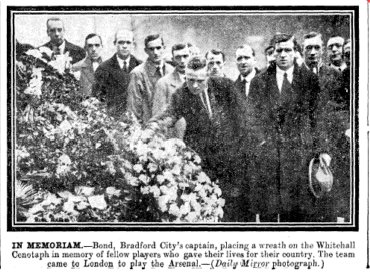
City players at the Cenotaph, New Year’s Day 1921

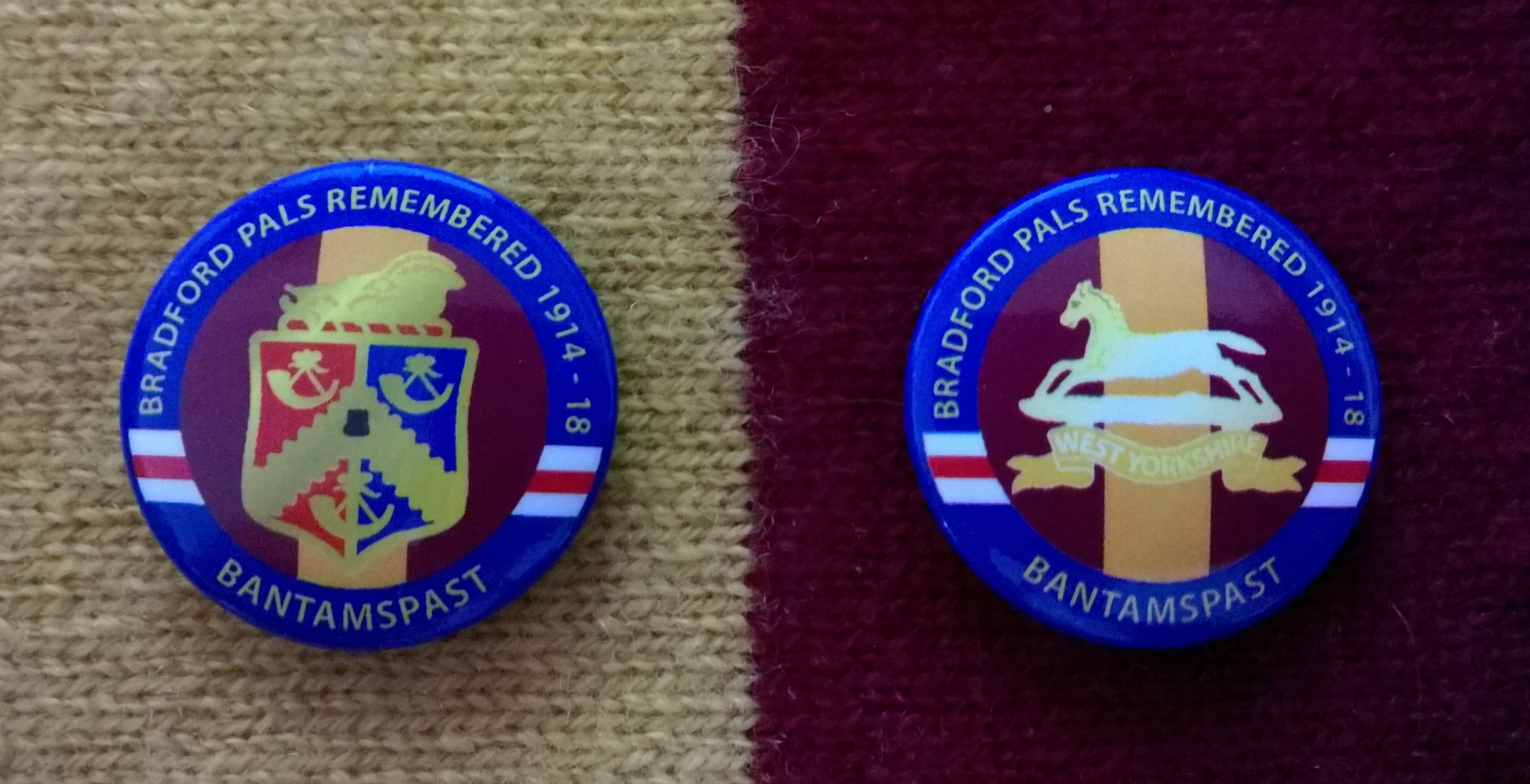
A memorial to the war dead of Bradford City was not erected at Valley Parade until 2015 and this hangs in the Valley Parade reception. (The person who made this possible was supporter John Barker of Farsley who arranged its production.) The memorial was funded by a badge sale that I helped organise through Bantamspast and the proceeds also helped fund a stone memorial to the Bradford Pals at Serre near the Somme battlefield in France.

bantamspast Bfd Pals badges

Further detail of Bradford’s military history is told my book ROOM AT THE TOP, available from Waterstones and Salts Mill or direct from BANTAMSPAST HISTORY REVISITED BOOKS.

John Dewhirst

I have written widely about the history of sport in Bradford: Links to my features on the history of Bradford sport

Read about Jimmy Speirs and Bob Torrance (published in BCAFC programme 2017/18).

Read about Bradford City’s tour of Germany in 1914

—————————————————————————————————–

The drop down menu above provides links to features published in the BCAFC programme, book reviews and sundry articles about the history of Bradford and its sport.

If you are interested in local sporting history, visit the dedicated online journal VINCIT where you will find further background about the military heritage at Valley Parade.

British Football’s Greatest Grounds: One Hundred Must-See Football Venues by Mike Bayly

This image has an empty alt attribute; its file name is 20201107_133710-002.jpg

Among my collection of football books is that of Simon Inglis, published in 1983: The Football Grounds of England & Wales. It has always been a favourite, as impactful to read now as it was when it was released, the story of how the stadia of the Football League had been developed and the state that they were in. Nothing like it had ever been produced and it instantly answered the sort of questions asked by supporters about the grounds that they had visited and the reasons for the sheer variety. Simon Inglis gave credibility to the study of stadia architecture, providing a degree of insight about something that had always been taken for granted. His first edition was followed by at least three updates and coverage of Scotland as well as Europe.

A critical examination of sports stadia became topical in the wake of the 1985 Valley Parade Fire Disaster and Inglis found himself invited to participate in radio phone-ins and regularly quoted in the media about the state of British grounds. To read his books now is a reminder of how much has changed in the last 35 years or so.

I have always been of the opinion that a town can invariably be judged by its football ground and its railway station. (It probably speaks volumes about my historic sensitivity about what is to be found in Bradford, particularly with regards the latter category.) During my journeys across the British Isles and whilst holidaying in Scotland I have always looked out for floodlight pylons and where possible tried to sneak a view. It seems to be a basic curiosity possessed by any football fan to see where other clubs play, even if they are not direct rivals.

British Football’s Greatest Grounds: One Hundred Must-See Football Venues by Mike Bayly (Pitch Publishing, 2020) does not attempt to replicate the original work of Simon Inglis but comparisons are inevitable. For a start, Bayly’s selection is not confined to the senior tiers of British football and nor does his book aim to provide the same sort of historic detail about the grounds that he features. Nonetheless I found his book equally impactful as those of Inglis in the 1980s, a reminder of the sheer diversity of British football grounds. The standard of photography goes a long way to emphasise this point.

Whilst Stuart Roy Clarke’s Homes of Football project is similarly notable for its images, that of Bayly is complemented by a detailed narrative that tells the story of how and why the respective grounds came to be that way. Unlike Clarke, the photos in Bayly’s book are exclusively of grounds themselves rather than including those of supporters.

During the seven years that Bayly has worked on the book a number of stadia have been abandoned (including that of Bootham Crescent which is featured) but otherwise the content is of existing venues. The mix is eclectic which adds to the charm of the publication and the surprises as you turn the pages. Westfield Lane, Frickley (where I recall watching City in a pre-season friendly maybe forty years ago) sits between Cappilow, Greenock Morton and Claggan Park, Fort William and you turn from The Emirates to the home of Buxton FC. (Yorkshire grounds covered are: Halifax, Sheffield Wednesday, Sheffield United, Huddersfield, York (Bootham Crescent), Frickley, Stocksbridge, Richmond, Hallam and Beeston, LS11.)

I particularly enjoyed the coverage of Scottish league and English non-league grounds with the quaint stands and facilities no longer to be found in the EFL (and long since forgotten in the Premier League). It is a reminder that many of the stadia that we visit are far more non-descript than those of times long gone. In fact more often than not they are pretty boring, Glanford Park vs The Old Show Ground of Scunthorpe being the prime example.

Bayly alludes to the fact that the photographs in his book provoke a certain nostalgia for old grounds. His words are particularly incisive: ‘Nostalgia is addictive and generational. And constant can be an antidote to the uncertainty of change. While there is a cautious note of sugar-coating for former times the continued – and on occasion, potentially unnecessary – modernisation of our game means older grounds will always occupy a tender place in our hearts.’ It is a sentiment that I can identify with but also something that I am uneasy with. My nostalgia for the character of the Valley Parade of old for example is tempered by experience of the disaster and the recognition that well before 1985 the ground was both decrepit and no longer fit for purpose.

I thoroughly recommend British Football’s Greatest Grounds: One Hundred Must-See Football Venues and I am sure that, like the books of Simon Inglis, this will be another to accurately record the era we live in for posterity. His feature of the new White Hart Lane stadium for example is a reminder that yet further modernisation of stadia is to be expected among the largest clubs at least. The design and layout is excellent and is another classic by Pitch Publishing that follows The Beautiful Badge: The Stories Behind the Football Club Badge by Martyn Routledge in 2018.

My only gripe about the book is the standard of paper on which it is printed, far more flimsy than might be expected but the consequence of publishing economics of which I am only too familiar.

Details of how to buy the book from this link.


=====================================

 You can read my other book reviews from here.

Details of my forthcoming book, a collaboration with George Chilvers: Wool City Rivals: A History in Colour

BCAFC programme feature: vs Southend United 3rd November, 2020

Programmes of old by John Dewhirst

Football programmes have traditionally been a staple of the match day experience, historically a collectable for many supporters. At Valley Parade, programmes have been produced for first-team fixtures since 1909 and the sale of single sheet team cards dates back even further. This season the match day magazine celebrates the rich heritage of old programmes from earlier years and today’s issue is based on the design from 1983/1984 when we played Southend United in the old Division Three.

Financial clues

The programme in 1983/84 was a very basic affair with minimal content and gave all the impressions that it had been designed and compiled as something of an after thought. Certainly, there was little effort invested in its production, in complete contrast to modern issues.

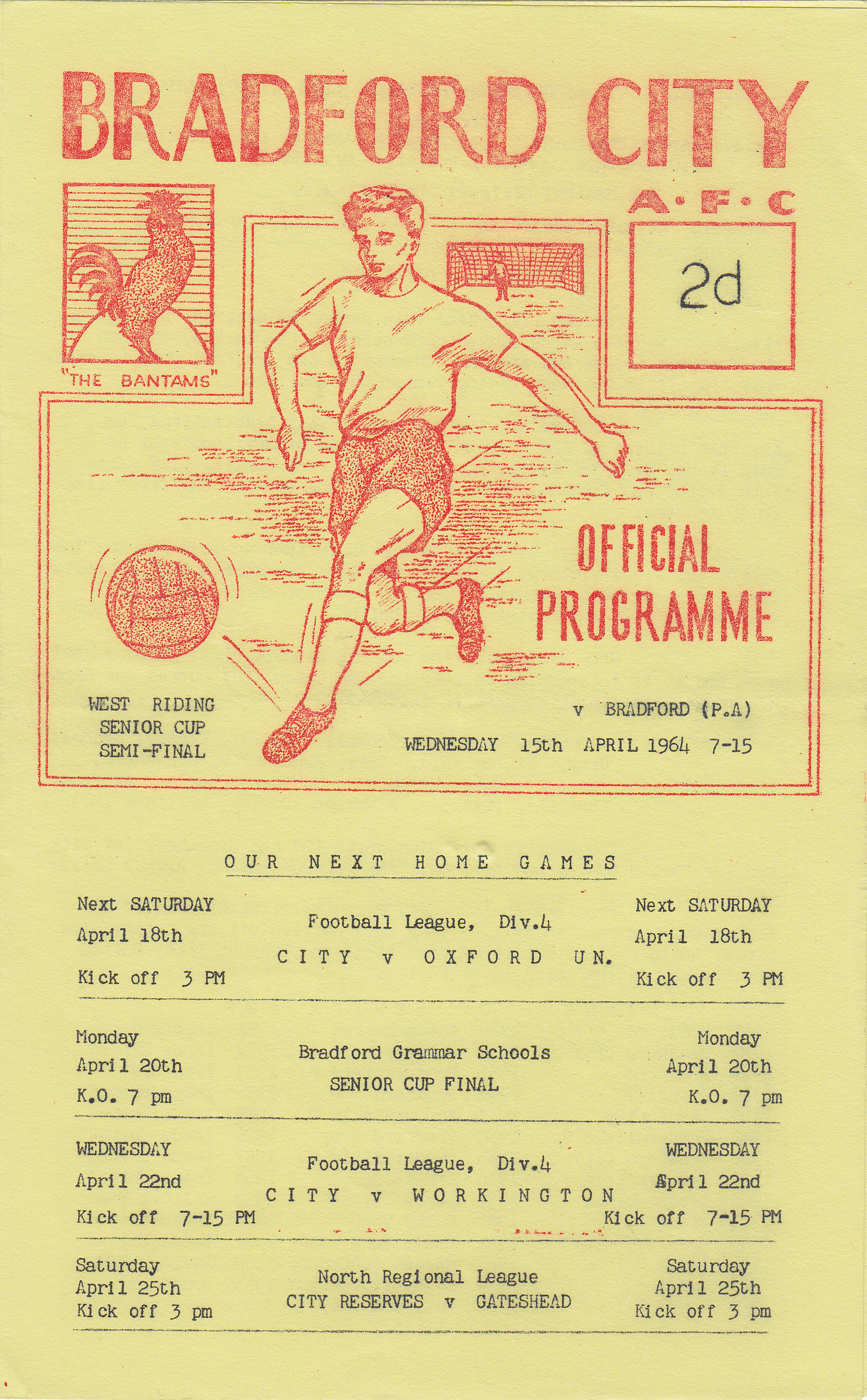
How a programme is designed, compiled and even printed says much about a club’s competencies and financial well-being. For example, the quality of paper on which programmes were printed is a good indicator of financial health. The adoption of lower grade, unbleached paper between 1919 and 1939 (compared to what had been used immediately before 1915) is worthy of mention. In particular the adoption of war-grade, rag paper in 1963/64 highlighted the perilous state of Bradford City finances at that time. Having finished 91st in the Football League in 1962/63 (and forced to apply for re-election) the club instigated a number of savings of which one was to produce the programme in-house, a venture that lasted only one season with printers re-engaged from August, 1964. Things were so bad that the programme was not even stapled, an economy that continued until March, 1966.  The club’s accounts for 1963/64 confirm a one third saving in print costs compared to 1962/63. Unfortunately, the £298 cost reduction had limited impact on total losses of £15,564!

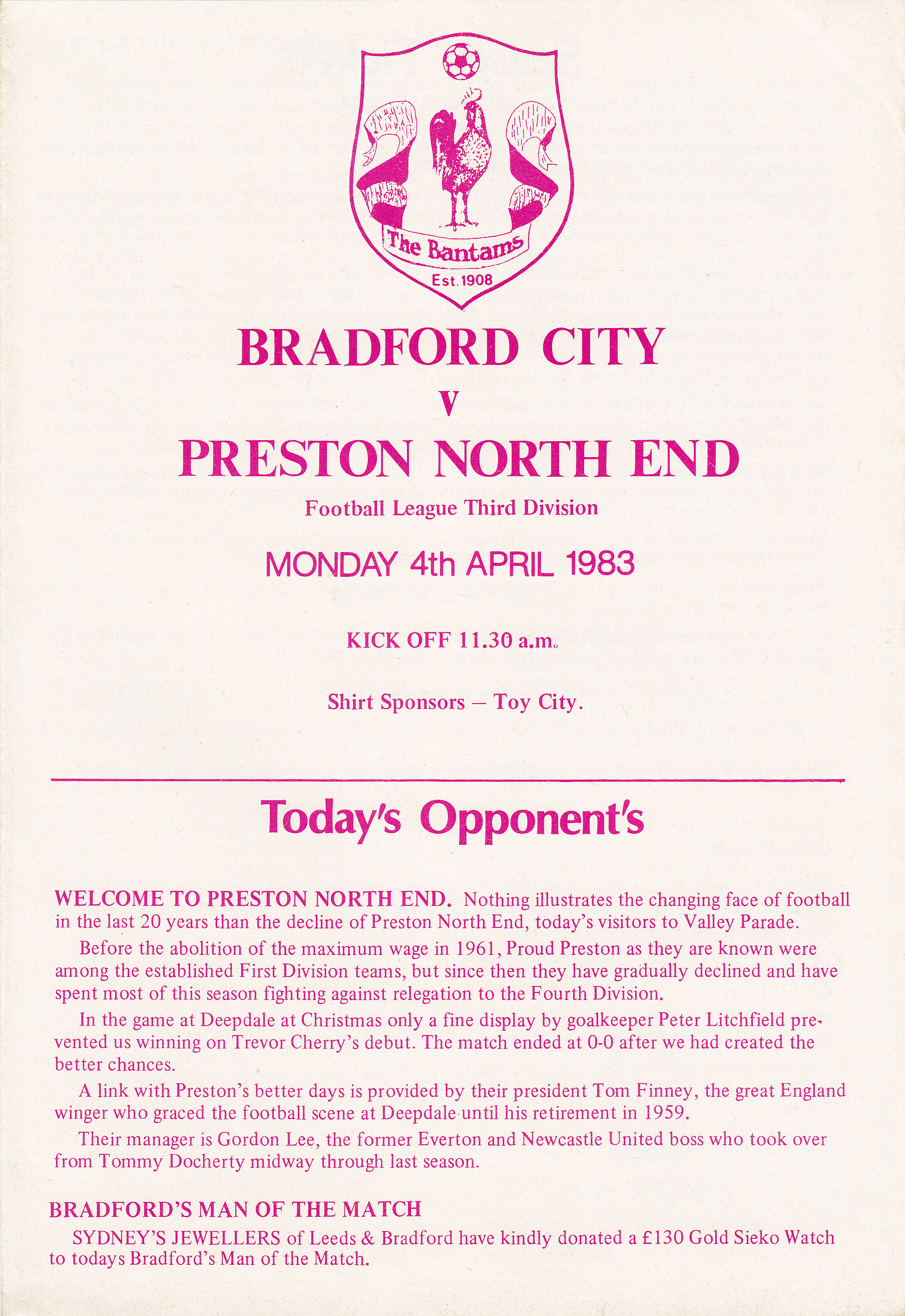
Subtle economies in the production of the programme in the early 1980s betrayed financial difficulties which explained to some degree why the quality of Bradford City programmes lagged behind that of other clubs. Although an improved version with a full colour cover had been introduced (for the first time) at the start of the 1982/83 season this didn’t last for long and the publication of four page and latterly single sheet issues by March, 1983 were symptomatic of the inability of the club to pay print bills, an early warning of the insolvency crisis the following summer. At least the club produced a programme in 1983/84 and after the excesses of earlier years it was probably considered appropriate to be economical.

The menus above provide links to features written by myself in the BCAFC programme during previous seasons.

Link here to galleries of historic BCAFC programmes on this blog

Link to feature about the historic development of the BCAFC programme since 1909 published on VINCIT.
Hysteria past: The Great Debate

Back in 1986 there was frustration among Bradford City supporters about life at Odsal. The club made a poor start to the 1986/87 season and found itself struggling at the foot of the second division.

Complaints that the club lacked ambition were heightened by Terry Yorath’s decision to leave Valley Parade where he had been assistant manager to Trevor Cherry since 1982 and join Swansea City as manager. (The Swans had been relegated to Division Four at the end of 1985/86 and the recruitment of Cardiff-born Yorath had been part of a relaunch of the club.)

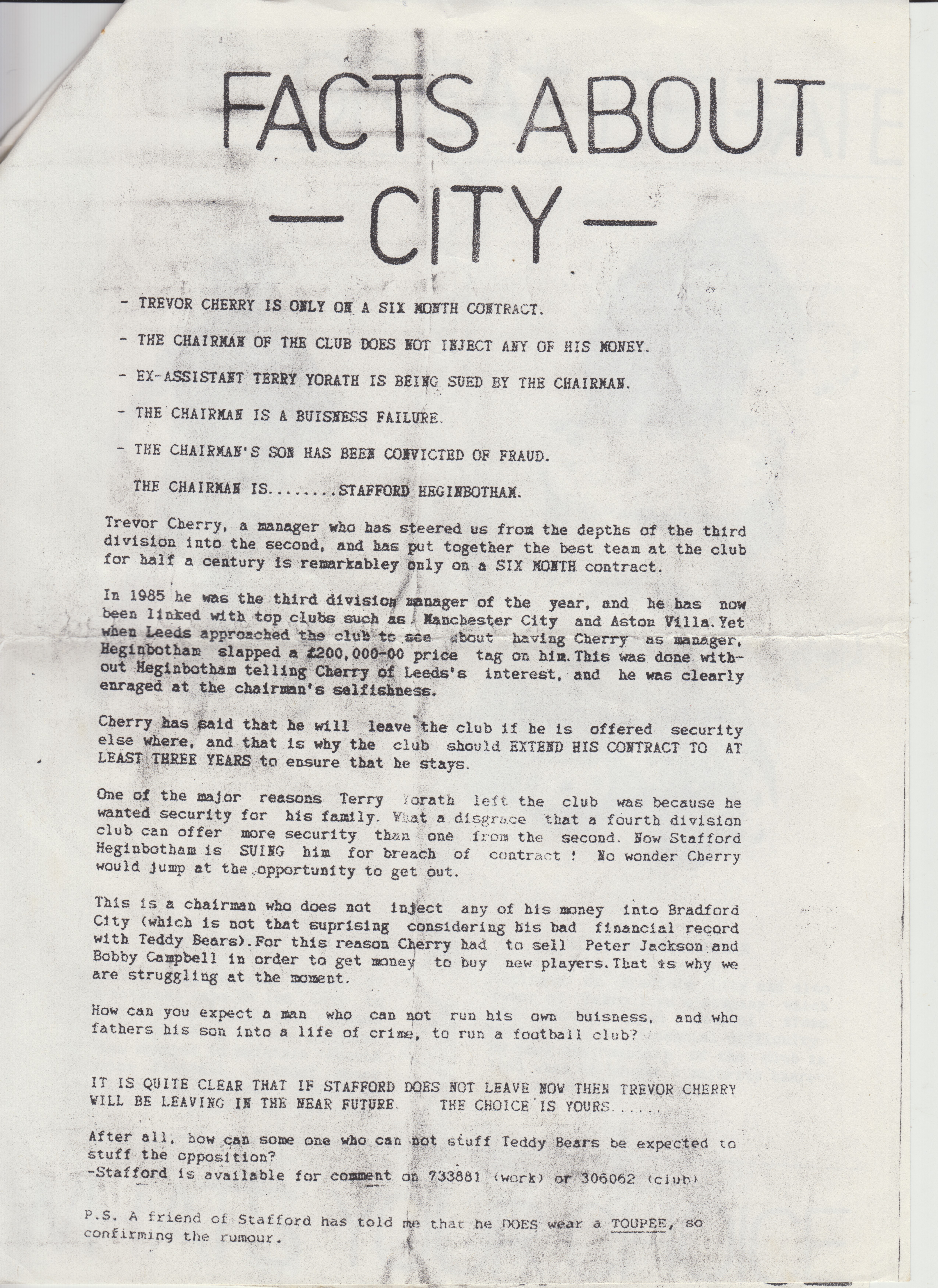
The directors of Bradford City AFC, and Chairman Stafford Heginbotham in particular, were subject to a fairly intensive and rancorous campaign of criticism that was co-ordinated by Patsy Hollinger, a longstanding supporter and terrace personality. That campaign involved correspondence to the local press, graffiti on walls and flyposting but in particular a series of fanzine publications.

I found the following whilst clearing out old memorabilia, a stapled two page handout that questioned the leadership of Mr Heginbotham…

I will upload copies of the fanzine published by Patsy Hollinger’s Star Travel Club (based at The Star Hotel on Westgate) in due course. Apart from being pretty amusing they are a timely reminder of times past.

BCAFC programme feature: vs Newport County 24th October, 2020

Programmes of old by John Dewhirst

This season the match day magazine celebrates the rich heritage of old programmes from earlier years and today’s issue is based on the design from 1978/1979 when Newport and City were both members of Division Four.

Old adverts

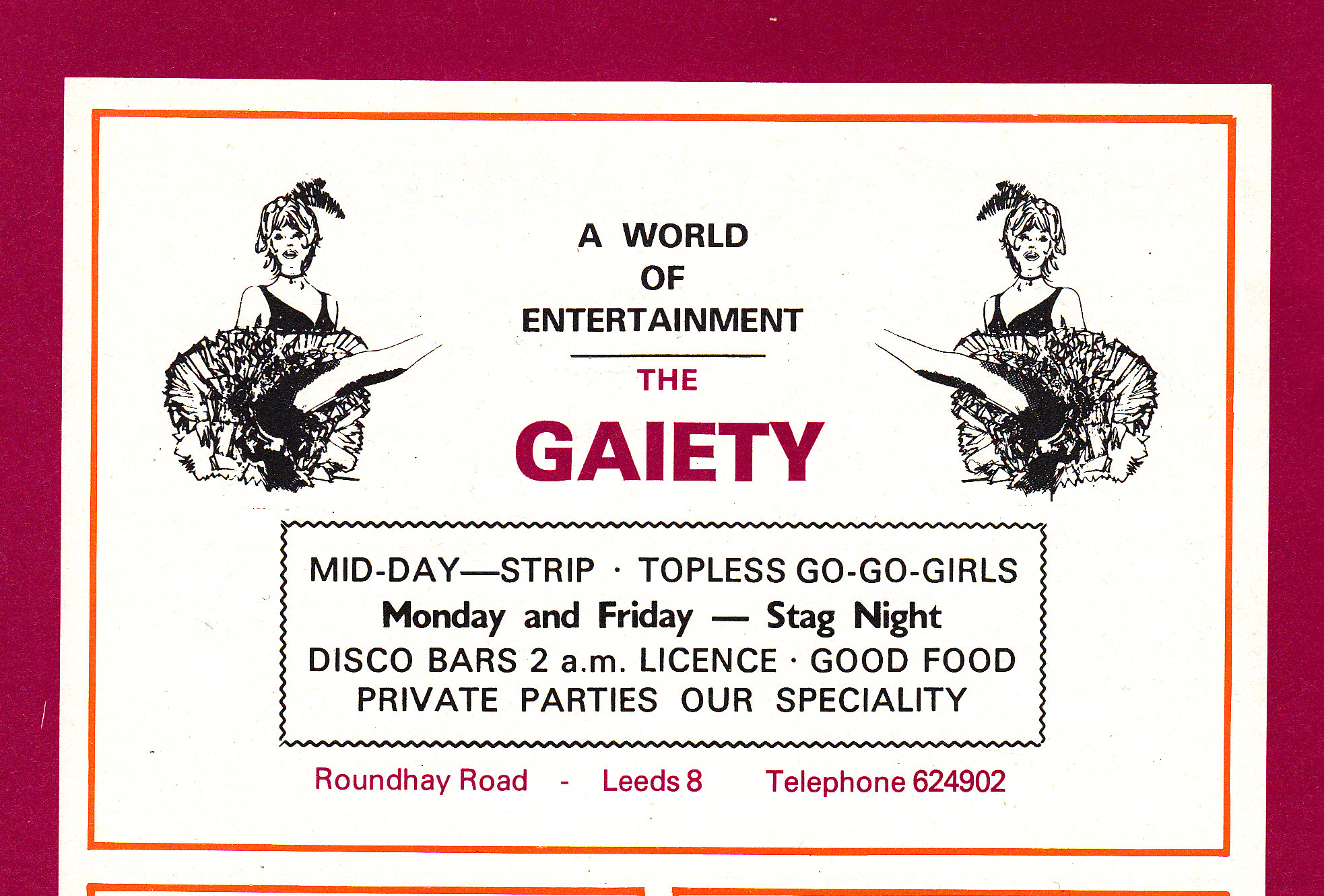
The programme for the 1978/79 season featured colour photographs of the Bradford City team and John Napier, manager on its cover. This is itself was ground-breaking and a radical departure from earlier designs. The club had recognised the value of an eye-catching cover to attract readers but sadly the editorial content was limited. It was poor value for money and flattered to deceive. What was more notable was the extent of advertising content which also reflected changes in society. A somewhat controversial inclusion at the time were adverts for a strip club with ‘Topless Go-Go Girls’ and a sex shop, the likes of which had never previously been featured in the club programme.

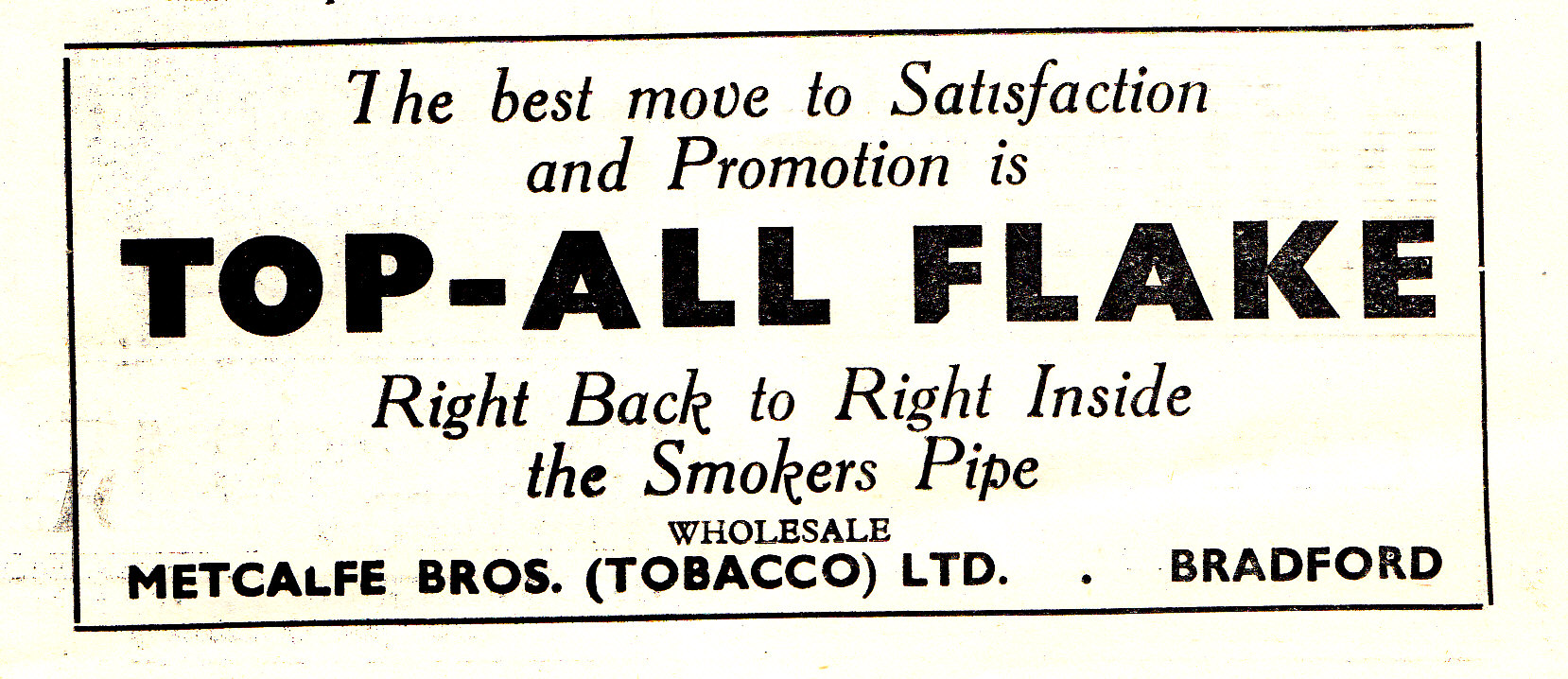
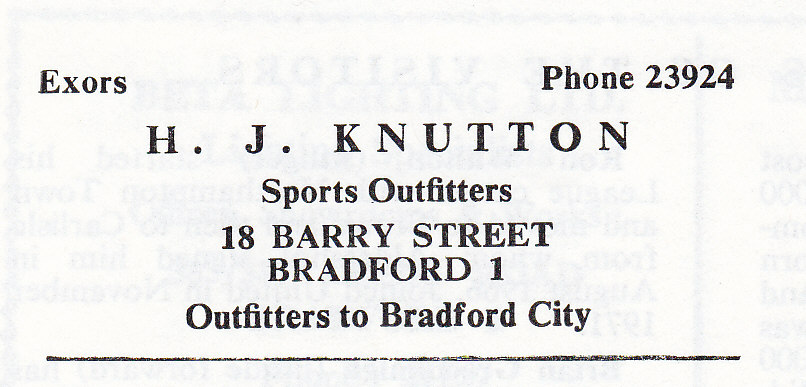
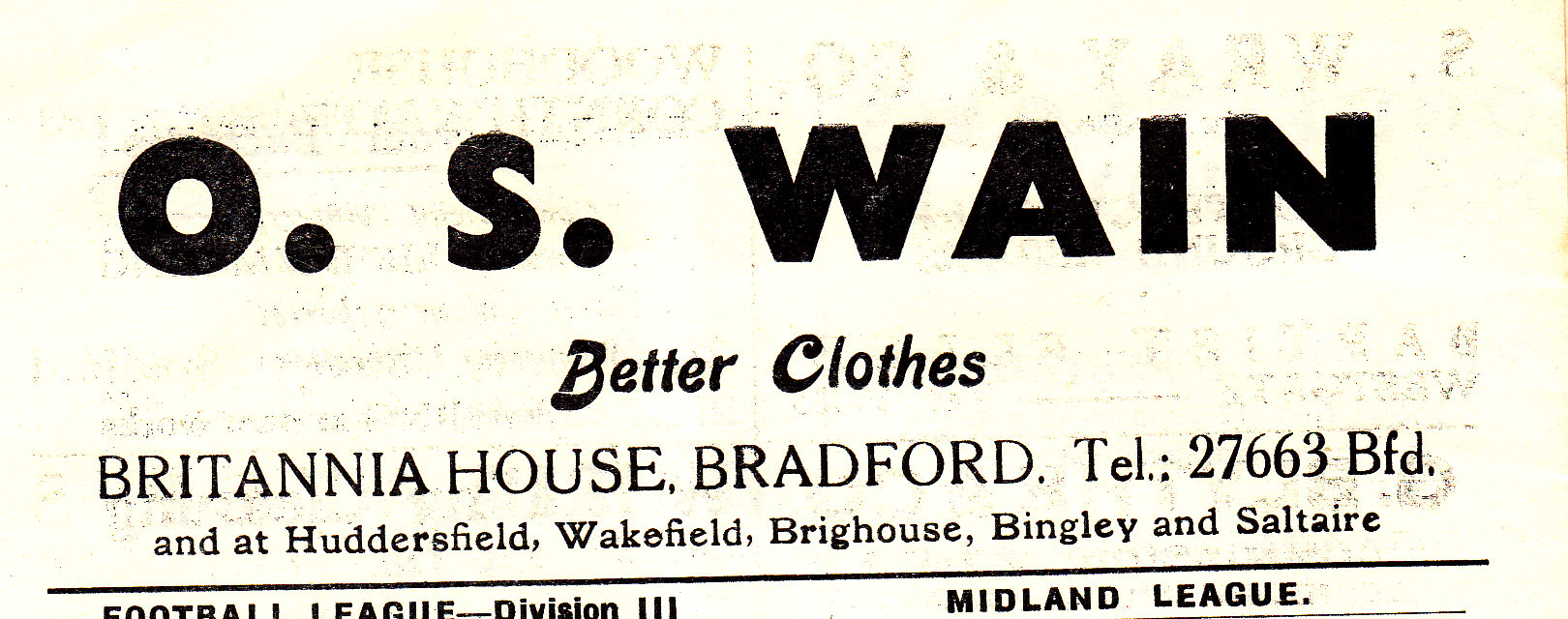
Old adverts provide an historical record and reminders of long-forgotten independent businesses that were based in Bradford: Hammond’s Sauce; HJ Knuttons; National & Provincial Building Society; OS Wain; Hammonds Ales and the Alfresco Garage to name but a few.

The adverts also provide an illustration of changing mass consumption patterns, for example bicycles advertised before World War One, transistor radios in the 1930s, rupture supports and surgical aids promoted through to 1922 and motor vehicles more frequently advertised from the 1950s. Raincoats were also regularly advertised through to the 1950s. The 1947/48 programme carried a rear page advert for newly released ‘Subbuteo Table Football’, a game that was a personal favourite during my own childhood in the early 1970s.

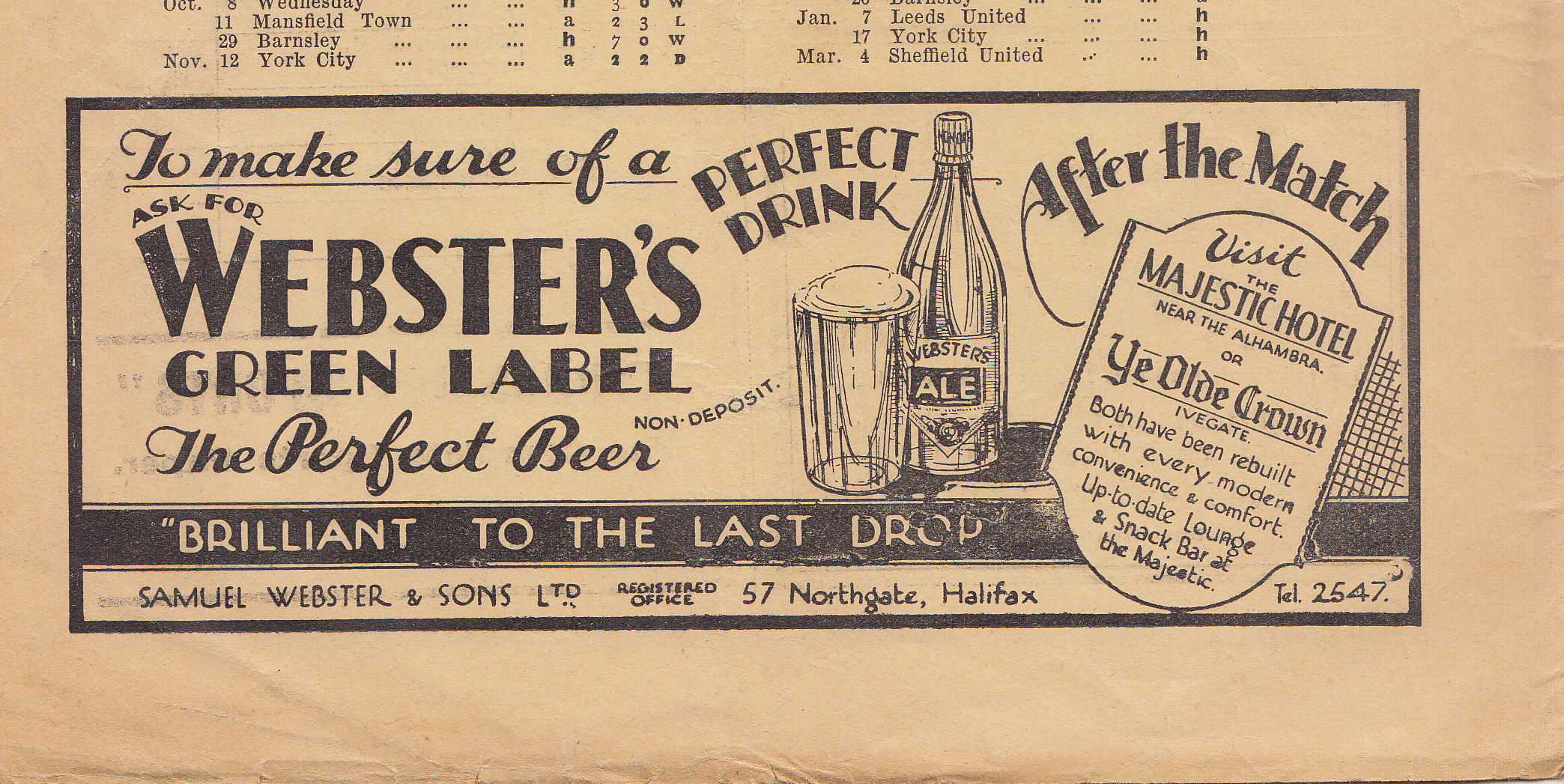
An increasing proportion of adverts for financial services is discernible in the last twenty years or so although adverts for credit existed a hundred years ago. Beer adverts have been a regular feature since 1910/11. Local tobacconists were also regular advertisers until the 1970s; by contrast adverts for national tobacco companies were less common. In the last twenty years there has been a higher proportion of business-to-business adverts as opposed to those aimed solely at consumers. In the latter category the disappearance of adverts for independent retailers has mirrored changes on the high street.

The menus above provide links to features written by myself in the BCAFC programme during previous seasons.

Link here to galleries of historic BCAFC programmes on this blog

Link to feature about the historic development of the BCAFC programme since 1909 published on VINCIT.
Pioneering black players in Bradford

Bradford has a proud record where black footballers have established themselves as pioneers in English professional football.

Ces Podd (pictured below), who made 494 league appearances for Bradford City between 1970-84 is the best known and in fact Ces holds the club record for the most appearances made by any player. Born in Saint Kitts in 1952, he was a student at Bradford College of Art when he made his debut and having established himself as a regular in the side was virtually ever-present at full-back during the ten seasons from 1972/73 and in 1981 became the first black player to be awarded a testimonial in English football. His testimonial saw Bradford City take on a Black XI and it raised a total of £5,147, a then club record.

During the 1970s, Joe Cooke (pictured below) was another pioneering black player at Valley Parade who made 245 league appearances in two separate spells between 1971-79 and 1981-84. Born in Dominica, Cooke’s family had emigrated to Bradford in the 1960s and he had been a member of the Bradford Boys side before signing professional at Valley Parade. During his first spell he played as centre forward and his 39 league goals between 1975-77 was a record for a black player, exceeding the 35 scored by Jack Leslie for Plymouth between 1927-29. In 1975/76 he scored a total of 24 in league and cup games and then 18 in 1976/77. During his second spell at Valley Parade he played as centre-half.

Joe and Ces were both members of the Division Four promotion winning teams in 1976/77 and 1981/82 and at the time it was relatively unprecedented for there to be so many black players on the same pitch, let alone the same side yet on 10th May, 1972 there were three black players in the Bradford City team that played Bolton Wanderers. Wingrove Manners was the third player but it proved to be his only appearance for the club.

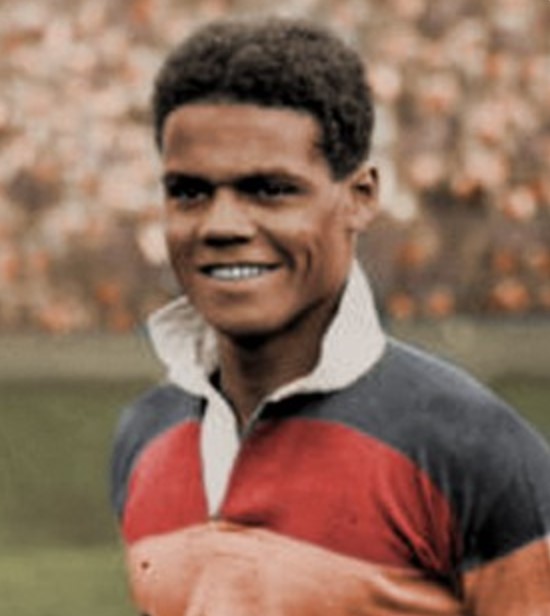
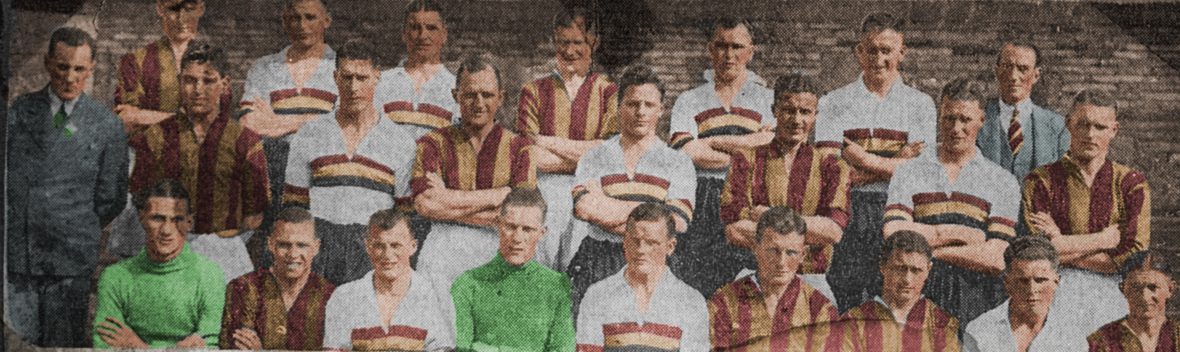
Previously, Eddie Parris (above – image colourised by George Chilvers) made a total of 142 league and cup appearances for Bradford Park Avenue between 1929-34 (the most memorable of which was his debut on 12th January, 1929 when he scored in the FA Cup Third Round tie at Hull, aged just under 18 years). In 1931 Parris was selected for Wales against Northern Ireland.

Nevertheless it was William Clarke (below – image colourised by George Chilvers) who was the first black professional footballer in Bradford, playing 92 league games for Bradford City between 1905-08 and Clarke was the scorer of the club’s first goal in Division One in September, 1908.

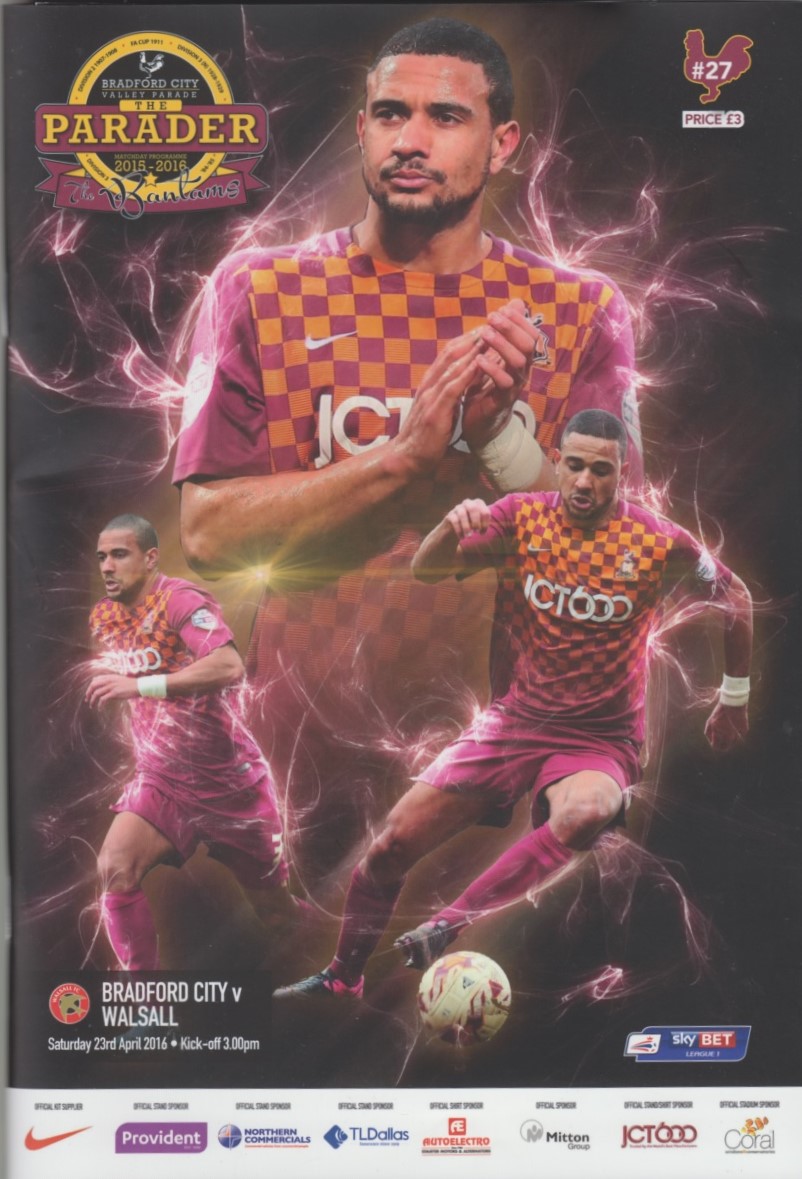
BCAFC programme feature: vs Walsall 20th October, 2020

Football programmes have traditionally been a staple of the match day experience, historically a collectable for many supporters. At Valley Parade, programmes have been produced for first-team fixtures since 1909 and the sale of single sheet team cards dates back even further. This season the match day magazine celebrates the rich heritage of old programmes from earlier years and today’s issue is based on the design from 1979/1980 when we were rivals with Walsall for promotion from Division Four. It was Walsall who secured promotion by finishing runners-up whilst we finished fifth after losing the last game of the season at Peterborough United.

For much of the 1970s the Bradford City programme was a very basic affair and relatively old-fashioned, not just in comparison to higher division clubs but also when compared to others in the fourth division. In 1977 there had been an attempt to modernise the programme with the inclusion of photographs for the first time and layout changed from a columnar newspaper style to something more recognisable as a magazine. Even so, the content was minimal. The following year there was further radical change with a colour photograph of the team featured on the front cover which was the first time that the club programme had had colour print.

The changes in 1978/79 proved unsuccessful and sales were disappointing. The following season the colour cover disappeared and the pages were cut from 20 to 16 although the price remained 20p. It was poor value for money and there is the sense that the club made the least effort possible to produce an obligatory match programme. All that can be said is that the cover was very eye-catching and it remains one of the more distinctive designs of old programmes.

The big change in programmes at Valley Parade after 1977 had been the increase in advertising content and in 1979/80 there was even the inclusion of an advert for a Bournemouth hotel, presumably to attract bookings for our away game at Dean Court in March, 1980. Another advert worthy of mention was that for Hammonds Chop sauce, a popular brown sauce then manufactured on Dockfield Road, Shipley. The brand still exists but production was moved from Shipley in 1985 to Harrogate Road in Bradford and then in 2002 it relocated to Littleborough. Hammonds had a close connection with Bradford City AFC and the former Hammonds Sauce Works Band regularly played at Valley Parade in the 1950s and 1960s.

Despite the innovations, the programme of 1979/80 had more in common with those of the 1950s and 1960s than the publications that we are familiar with nowadays. It has only been since 1997 that Bradford City has had what could be described as match day magazines and this has been driven by advances in desktop computers and digital technology. Ironically, the same developments threaten the future of match day publications and the shift to online media.

The menus above provide links to features written by myself in the BCAFC programme during previous seasons.

Link here to galleries of historic BCAFC programmes on this blog

Link to feature about the historic development of the BCAFC programme since 1909 published on VINCIT.
BCAFC programme feature: vs Harrogate Town 12th October, 2020

Programmes of old by John Dewhirst

Football programmes have traditionally been a staple of the match day experience, historically a collectable for many supporters. At Valley Parade, programmes have been produced for first-team fixtures since 1909 and the sale of single sheet team cards dates back even further. This season the match day magazine celebrates the rich heritage of old programmes from earlier years and today’s issue is based on the design from 1999/2000 – our first season in the Premier League.

First encounters

The promotion of Harrogate Town to the EFL is an incredible achievement and I confess that never in my wildest dreams did I believe that one day the two clubs would be competing at the same level in the senior competition of English football. It is sobering to consider that twenty years ago our clubs were six levels apart. The launch of the football pyramid and introduction of automatic promotion to the EFL in 1986/87 has brought with it considerable turnover in the membership of the lower divisions of the EFL and there has been considerable variety with the emergence of new sides.

Since our relegation to the lower divisions in 2004 we have had a fair number of new fixtures. A good proportion of those clubs have been southern based and so another Yorkshire side is most welcome. Harrogate Town become the 15th club from the three Ridings of the county to have competed in the League. Listed in order of when they first joined the League are those Yorkshire clubs: Sheffield United, 1892; Sheffield Wednesday, 1892; Barnsley, 1898; Middlesbrough, 1899; Doncaster Rovers, 1901; Bradford City, 1903; Hull City, 1905; Leeds City / United, 1905; Bradford (Park Avenue), 1908; Huddersfield Town, 1910; Halifax Town, 1921; Rotherham United, 1925; York City, 1929; Scarborough, 1987 & Harrogate Town, 2000.

The old Football League gradually expanded by adding a third division through incorporating former members of the Southern League in 1920, creating a northern section to the third tier in 1921 and then expanding membership to the regionalised third tier in 1950. Clubs finishing at the bottom of the league were required to apply for re-election although an ‘old pals’ act’ operated through much of the 1950s and 1960s to protect traditional league clubs from demotion. It was only in the 1970s that we began to see changes with the unsuccessful re-election of Bradford (Park Avenue) (1970), Barrow (1972), Workington (1977) and Southport (1978) – sides who have been recent opponents of Harrogate Town.  

Today’s programme is notable – and for some, collectable – as the first to feature a competitive fixture between our clubs, notwithstanding that there have been countless friendlies played at Wetherby Road. Featured on this page are other encounters with sides now firmly established as seniors from their first season outside of non-League football.

The menus above provide links to features written by myself in the BCAFC programme during previous seasons.

Link here to galleries of historic BCAFC programmes on this blog

Link to feature about the historic development of the BCAFC programme since 1909 published on VINCIT.

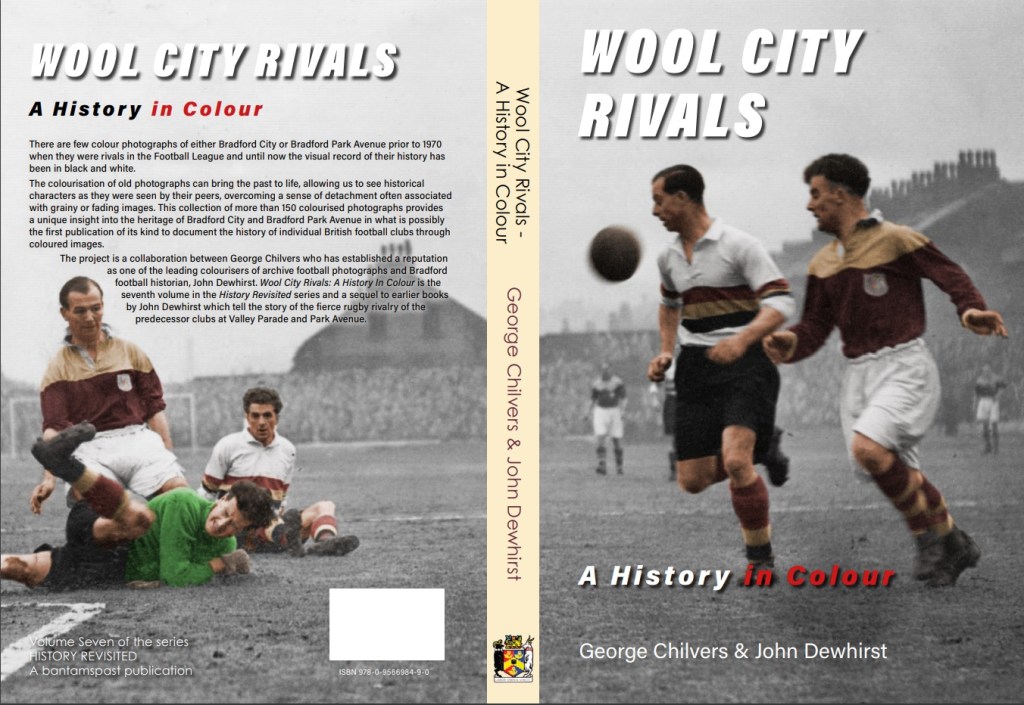
Wool City Rivals: A History of Bradford City and Bradford Park Avenue in Colour

The latest publication – and seventh volume – in the bantamspast History Revisited series is now in production and will go on sale in late November. Further details below:

Featured in the Bradford Telegraph & Argus, 5th October 2020

Review in the Yorkshire Post, 23rd December 2020

Review on the My Football Books website, 29th November 2020 (extracts below):

There are a handful of football books that sit in the category “it has to be seen to be believed.” This unique book sits very proudly in that group.

It’s a wonderful combination of beautiful pictures and a thoroughly detailed history of football in Bradford. A past which will leave many readers, if not done so already, looking to acquire the other titles in the bantamspast History Revisited series.

Football fans and history enthusiasts will adore this book. For those who appreciate both – this is an essential, and colourful, addition to your library. Enjoy!

The book is available to order from this link.

The History Revisited series provides a collection of books to offer a fresh perspective about the history of football in Bradford.

Wool City Rivals: A History in Colour by George Chilvers and myself follows my previous titles about the rivalry, Room at the Top and Life at the Top which were the third and fourth volumes in the series. Those earlier publications narrated the origins of sport in Bradford and the nineteenth century rivalry of the Park Avenue and Valley Parade clubs. I have two further books planned that will tell the story of the two Bradford rivals in the periods 1908-39 and 1939-74 respectively.

The books about the Wool City Rivals came about to explain how and why things occurred as they did rather than simply state what happened. My frustration has been that such questions tend to be overlooked in football histories and in consequence, left unanswered. Equally fundamental, I have discovered through my own research into the history of Bradford football that there have been superficial explanations as well as inaccuracies in earlier narratives that are misleading and need to be revisited. Bradford football is the prisoner of its history but sadly that history has been distorted by myths and erroneous claims.

I recall that as a teenager there was nothing to read about the history of either Bradford club and a motivation for this project has been to ensure that future generations who wish to discover that history will have a wide-ranging source of reference about Bradford football. Succeeding generations inherit football clubs and it is their prerogative to determine their identity and future traditions. All institutions including football clubs derive strength from continuity and a shared identity and that is why I believe awareness of their history is important and needs to be documented.

News about future books in the bantamspast History Revisited series will be provided on the BANTAMSPAST website [www.bantamspast.net] and through Twitter: @jpdewhirst. Updates will also be provided by email and if you wish to be added to our mailing please make sure that we have your details [em: books at bantamspast dot net].

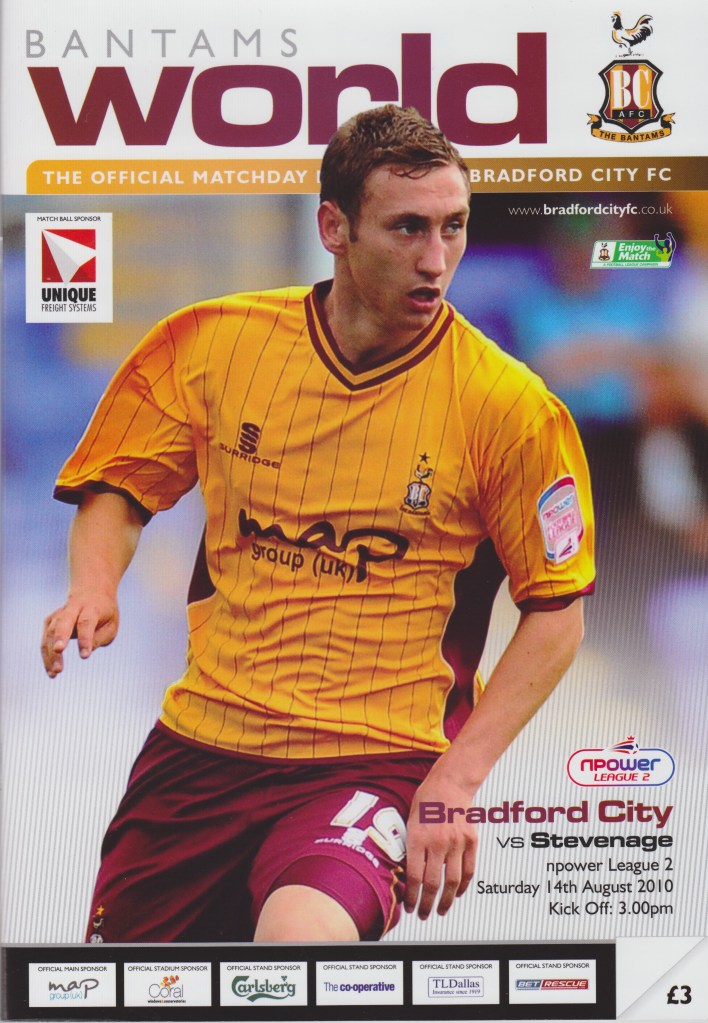
BCAFC programme feature: vs Stevenage 26th September, 2020

Programmes of old by John Dewhirst

Football programmes have traditionally been a staple of the match day experience, historically a collectable for many supporters. At Valley Parade, programmes have been produced for first-team fixtures since 1909 and the sale of single sheet team cards dates back even further. This season the match day magazine celebrates the rich heritage of old programmes from earlier years and today’s issue is based on the design from 1921/22 – the season that the club was relegated from Division One.

Social History

Old football programmes provide a unique insight into social and economic trends. For instance, club statements about the need to curb ‘youthful exuberance’ and anti-social behaviour were not exclusive to the 1970s as the following extracts show.

The programme for the game with Doncaster on 3rd October, 1962 included the comment: ‘Whatever one may think of a decision by a referee or action by a player, the answer is not to throw objects one may lay his or her hand on, and so bring the game into disrepute. Having seen someone throw an object, others are apt to follow suit and the damage is done.’ The following month, the programme for the Rochdale game on 17th November sought an end to pitch invasions and the ‘Supporters Notes’ by columnist ‘Ubique’ conveyed his irritation at the throwing of toilet rolls which had occurred at the Oldham away fixture a fortnight previously. By November, 1963 the programme notes were imploring youngsters not to let off fireworks in the ground.

The programme from the Everton fixture on 6th November, 1920 referred to Foul Language: ‘Several complaints have been made with regard to objectionable language at Valley Parade, and the directors of the club desire to warn offenders that they are liable to expulsion from the ground. There are more ladies at football matches nowadays, especially on the grandstands, than ever there has been in the past, and we are all delighted to see them, but it is not pleasant for them to have to listen to foul language. This cannot be tolerated and the directors would be glad to receive reports as to the identity of offenders in order that steps may be taken to impress upon them the need for keeping to Parliamentary language when letting off steam.’

On 26th February, 1977 the programme for the game with Torquay United included a full page notice from The Football Association advising supporters about the risk of ground closure as a consequence of misconduct. Similar warning notices were displayed around Valley Parade for the next month and followed an attack by a spectator on a Colchester player during the game between the promotion rivals in December, 1976. There were further incidents in the 1978/79 season when a spectator and a player were injured by stone throwing with a repeat of the FA notices in August, 1979. (It should be explained to younger readers that stones were readily available on the Spion Kop due to the decayed concrete terracing. Hence if you were so inclined you were not obliged to bring such ammunition into the ground.)

The menus above provide links to features written by myself in the BCAFC programme during previous seasons.

Link here to galleries of historic BCAFC programmes on this blog

Link to feature about the historic development of the BCAFC programme since 1909 published on VINCIT.