BCAFC programme feature: vs Crawley Town 13th April, 2021

Football programmes have traditionally been a staple of the match day experience, historically a collectable for many supporters. At Valley Parade, programmes have been produced for first-team fixtures since 1909 and the sale of single sheet team cards dates back even further. This season the match day magazine celebrates the rich heritage of old programmes from earlier years and today’s issue is based on a design from 1981/82.

In the 1981/82 season the club programme had two designs with the change in December, 1981 coinciding with the club’s revival of the Bantams identity which had been abandoned as old-fashioned fifteen years before. The club had subsequently promoted its traditional nickname, the Paraders.

By the beginning of the 1980s the dilapidated state of Valley Parade served to discourage the Paraders identity but the change to ‘Bantams’ was also about trying to raise the profile of the club. As in 1974, the then chairman Bob Martin was not averse to such rebranding, albeit on the cheap.

Having been appointed as player-manager during the 1981 close season, the former Derby County and England centre-half Roy McFarland had made an immediate impact at Valley Parade and by December, 1981 Bradford City was well placed for a promotion challenge from Division Four. The new Bantams identity was intended to proclaim the club’s ambition that, having narrowly missed promotion in 1980, the goal would be achieved in 1981/82.

The programme at the start of the season had been called ‘The Parader’ and featured a silhouette of a floodlight and football stands on its cover. Ironically the image was not that of Valley Parade but of Park Avenue, the designer – Pete Bell – having been a former Avenue fan. If you look closely, the finials of the former Dolls House pavilion at Park Avenue can be clearly seen but this point of detail was overlooked when the design was authorised by the club. The chances of this having occurred when the two Bradford sides were rivals in the Football League would have been unheard of.

The new programme cover likewise had a basic design and was called ‘The Bantams’ with the club’s new crest being prominent. In an era that predated computer clipart or graphics, the image approximated more to a hen than a bantam. (Of the three different bantam-themed crests used by the club in the early 1980s it was evident that no-one at Valley Parade at the time knew what a bantam looked like.) The other feature of the cover was a primitive sketch of three players, two of whom wore the club’s white shirt with claret trim (a design that we can expect to see more of next season).
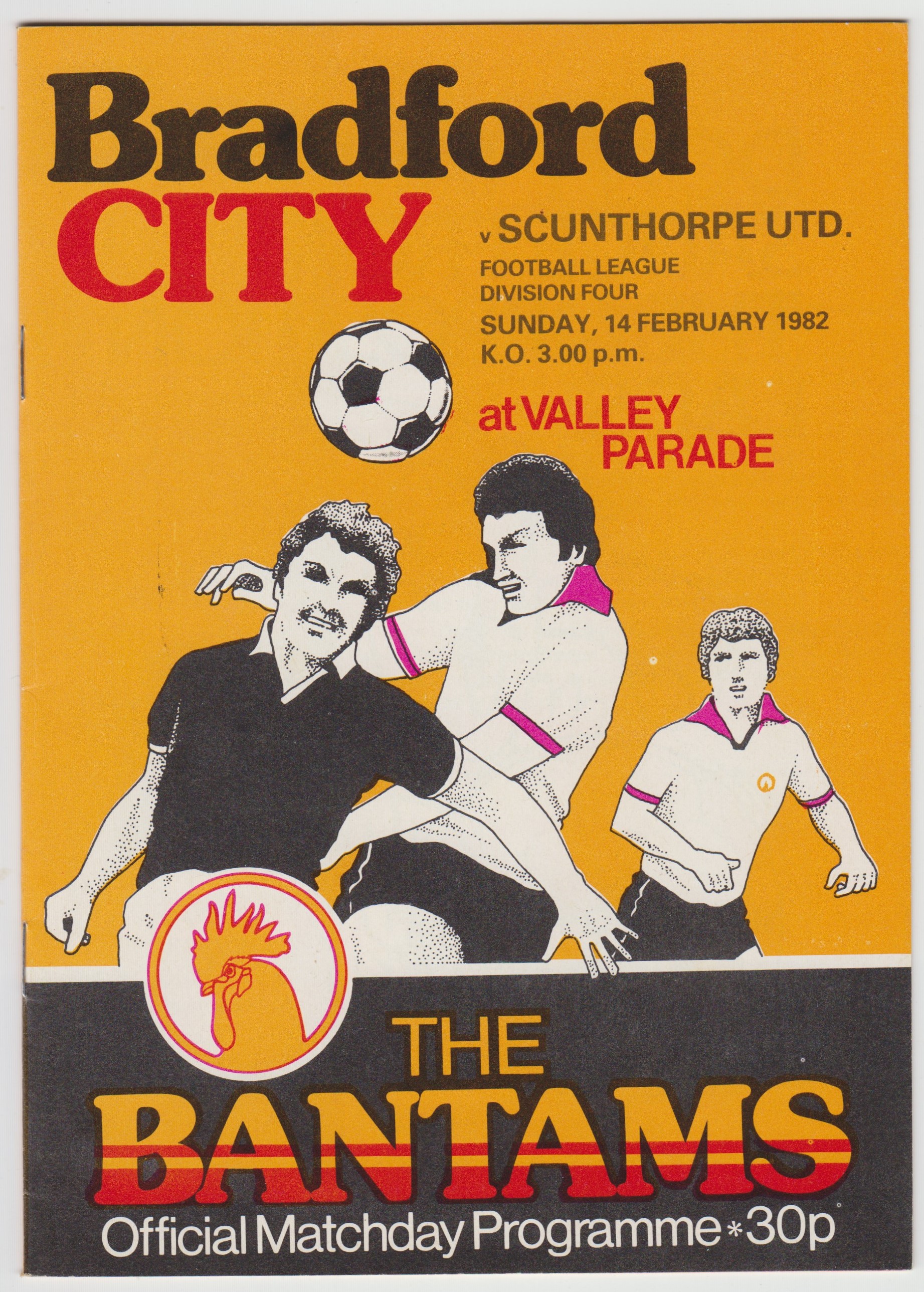
The programme cover for the fixture with Scunthorpe United on 14th February, 1982 featured the new design. Other than the change of cover, the content and internal layout of the programme in 1981/82 remained unchanged. For that matter, despite the new nickname there was little change at Valley Parade although Bob Martin would probably claim that the new Bantams identity was inspirational in helping to secure promotion as runners-up behind Sheffield United.

The switch of identity mid-season was probably more notable for the change in editorial in the Telegraph & Argus. All of a sudden, there was a shift of reference in match reports from Paraders in favour of the Bantams as if that had been the nickname all along.

Other than a new range of souvenirs, the new programme cover was the most obvious display of the new identity at Valley Parade. However, Bradford City AFC was not the only club at that time resorting to design and rebranding on the cheap. In 1982, Scunthorpe United introduced a new ‘Iron Fist’ crest having launched a competition for a new design which was advertised in their programme. Mine was the winning design having been sketched on a sandwich wrapper whilst travelling back to Bradford on a CTC’73 coach from The Old Show Ground in October, 1981. Oh, how football branding and marketing has evolved in the last forty years!

The menus above provide links to features written by myself in the BCAFC programme during previous seasons.

Link here to galleries of historic BCAFC programmes on this blog

Link to feature about the historic development of the BCAFC programme since 1909 published on VINCIT.
Glorious 1911

In 1911 – only eight years after soccer had been launched at Valley Parade – Bradford City AFC won the FA Cup against Newcastle United in the replay at Old Trafford, Manchester on 26th April. It remains the club’s greatest achievement and a defining part of the club’s identity.

1911 FAC Final replay

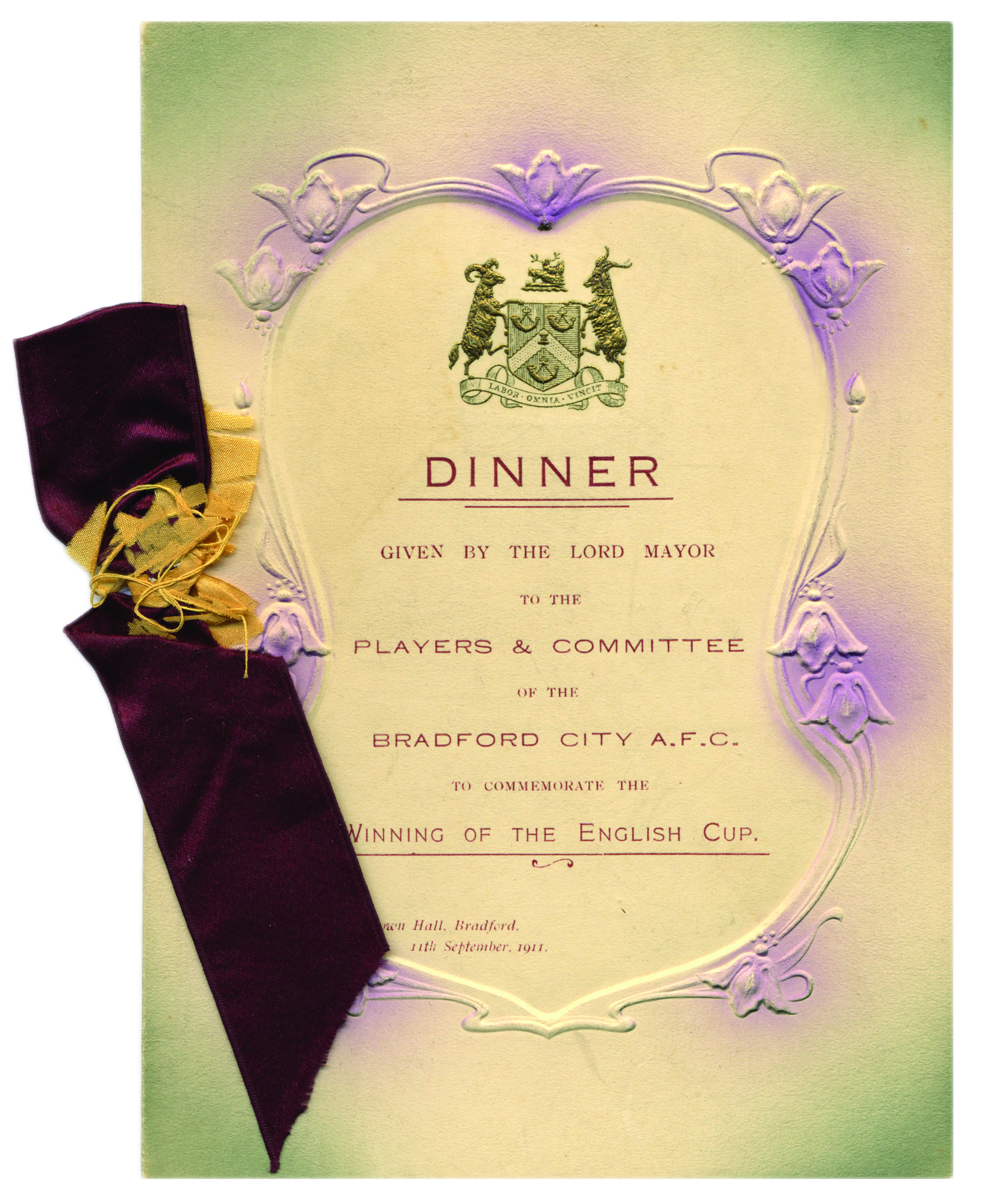
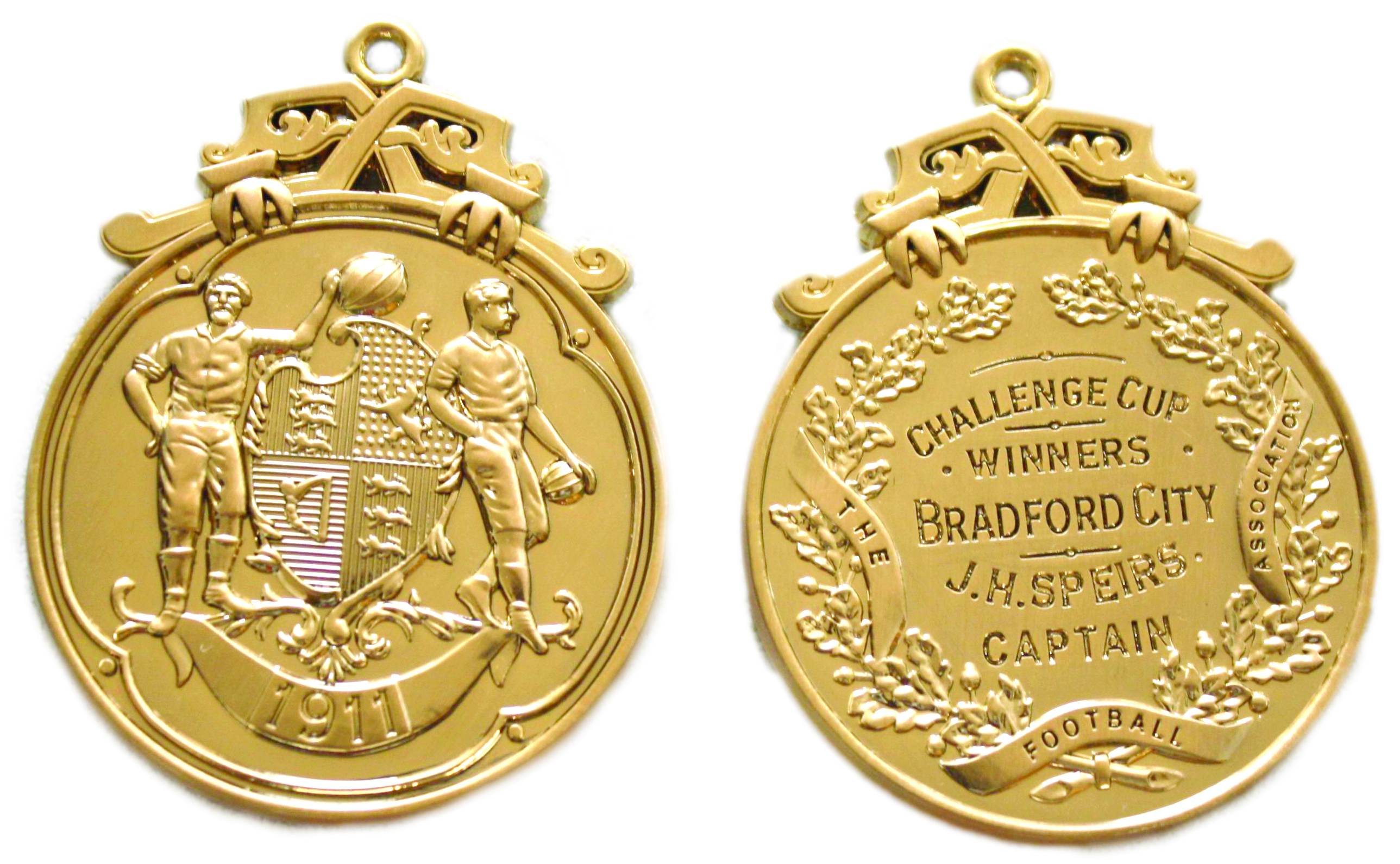
Until the emergence of the Premier League in 1992 the FA Cup commanded enormous interest both domestically and abroad and prior to World War One the FA Cup overshadowed the Football League Championship in terms of prestige. Numerous commemorative items were produced to capitalise on the interest.

On 27th April, 1911 under the headline ‘Twas a Famous Victory’ the Bradford Daily Telegraph reported: ‘Never in the history of Bradford has such a sporting triumph been consummated… The eyes of the English speaking world are upon Bradford today; the team have brought honour and glory not merely to themselves and to the club, but to the city of their football adoption.’

telegraph

WH Smiths published a team card for the final at Crystal Palace and the other example was published by The Sportsman. The latter is notable for the number of adverts evidently aimed at a London based readership. My understanding is that a single, definitive or official programme was not published until the 1920 FA Cup Final at Stamford Bridge. Hence it is quite possible that these team cards were not the only ones available in April, 1911.

1911 final good scan

The following is an account of the achievement published in the club’s own match day programme:

The 1911 FA Cup success followed in a tradition of earlier sporting achievements by the senior Bradford clubs, most notably Bradford FC winning the Yorkshire Challenge Cup in 1884 and Manningham FC the inaugural Northern Union championship in 1896. However what was unprecedented was the assembly of people – estimated to be 100,000 – who greeted the successful team on its successful return from Manchester to Bradford on 26th April, 1911. That same evening there was a celebratory dinner at the Midland Hotel, the first of many.

front cover

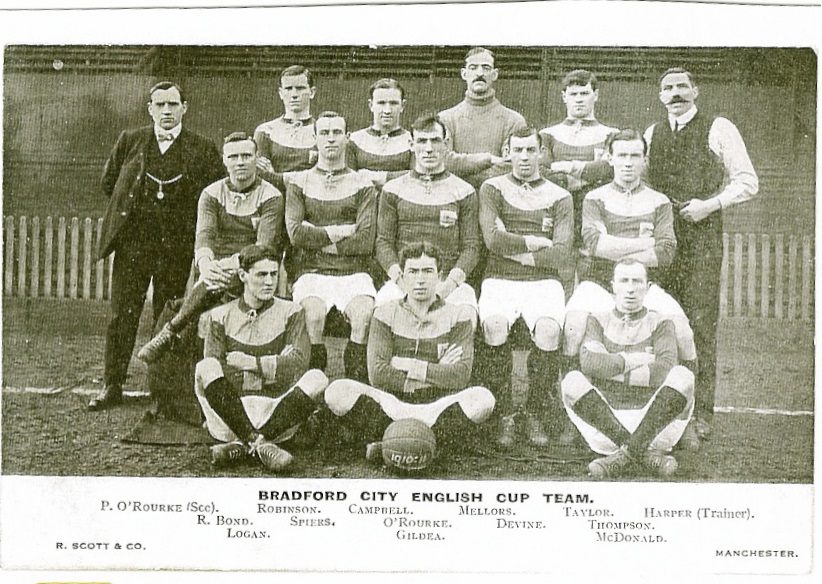
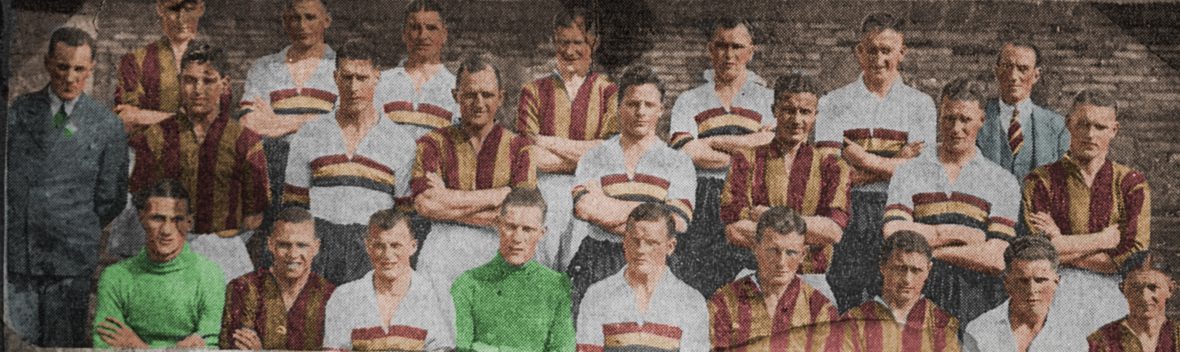
We also remember the fact that two members of the FA Cup winning team were killed in World War One: Jimmy Speirs who had scored the winning goal and Bob Torrance, man of the match in the Cup Final replay. 

1911 FA Cup medal replica.jpg

1911 fac final team.jpg

John Dewhirst

The drop down menu above provides links to previous programme articles, archive images, book reviews and features on the history of Bradford sport.

Updates to this site are tweeted: @jpdewhirst

===============================================================

Details here about the bantamspast History Revisited book series: BANTAMSPAST HISTORY REVISITED BOOKS  including the latest volume WOOL CITY RIVALS – a history of the Bradford City / Park Avenue rivalry in colour

==============================================================

The Midland Hotel where the victorious Bradford City squad and officials celebrated after returning from Manchester with the trophy on 26th April, 1911.

BCAFC programme feature: vs Tranmere Rovers 20th April, 2021

Football programmes have traditionally been a staple of the match day experience, historically a collectable for many supporters. At Valley Parade, programmes have been produced for first-team fixtures since 1909 and the sale of single sheet team cards dates back even further. This season the match day magazine celebrates the rich heritage of old programmes from earlier years and today’s issue is based on the design from 1975/1976.

Every football supporter has his/her favourite club iconography, typically a crest or the design of a particular piece of merchandise. Programme covers likewise are often remembered not just for their design but for the era with which they are associated. That featured today is definitely among my favourites and evokes memories of two significant seasons in the club’s history.

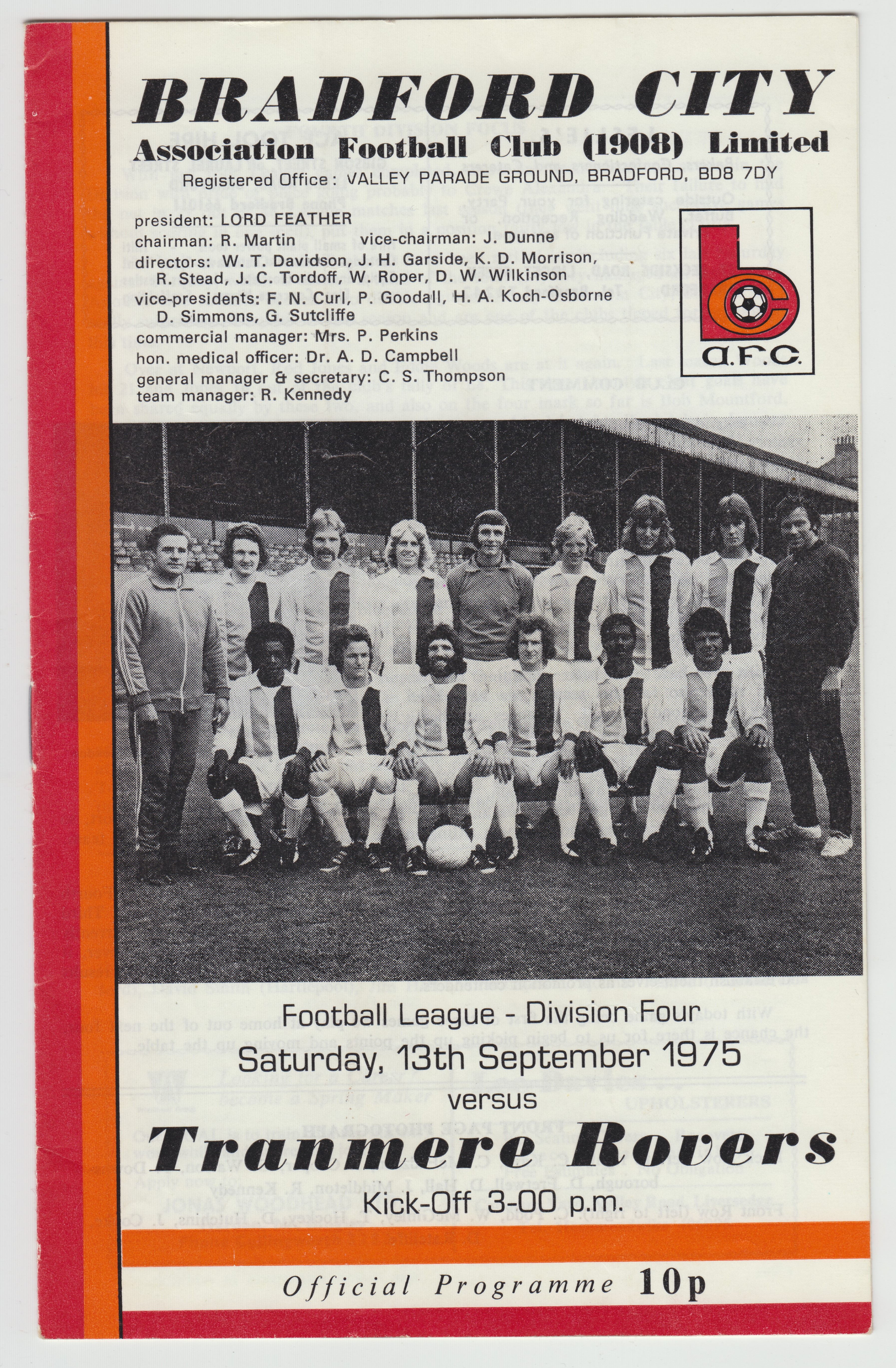
Today’s issue is based on the cover of the programme from the game with Tranmere Rovers on 13th September, 1975 and features a design that was adopted for the seasons 1975/76 and 1976/77. Whilst it can hardly be described as an artistic or innovative design, I have always considered it something of a classic, even iconic.

The simple, balanced layout was impactful and incorporated considerable content from the club crest to the team photograph to the full listing of club officials and directors. The incorporation of the club colours also matched the style of the team shirts with single stripes on a white background. Even the font used for the main headings was characteristic of Bradford City AFC, having been widely used on club stationery and tickets during the early seventies. Whereas so many modern matchday publications are bland and based around similar templates, the strength of this design is that it was truly unique to Bradford City.

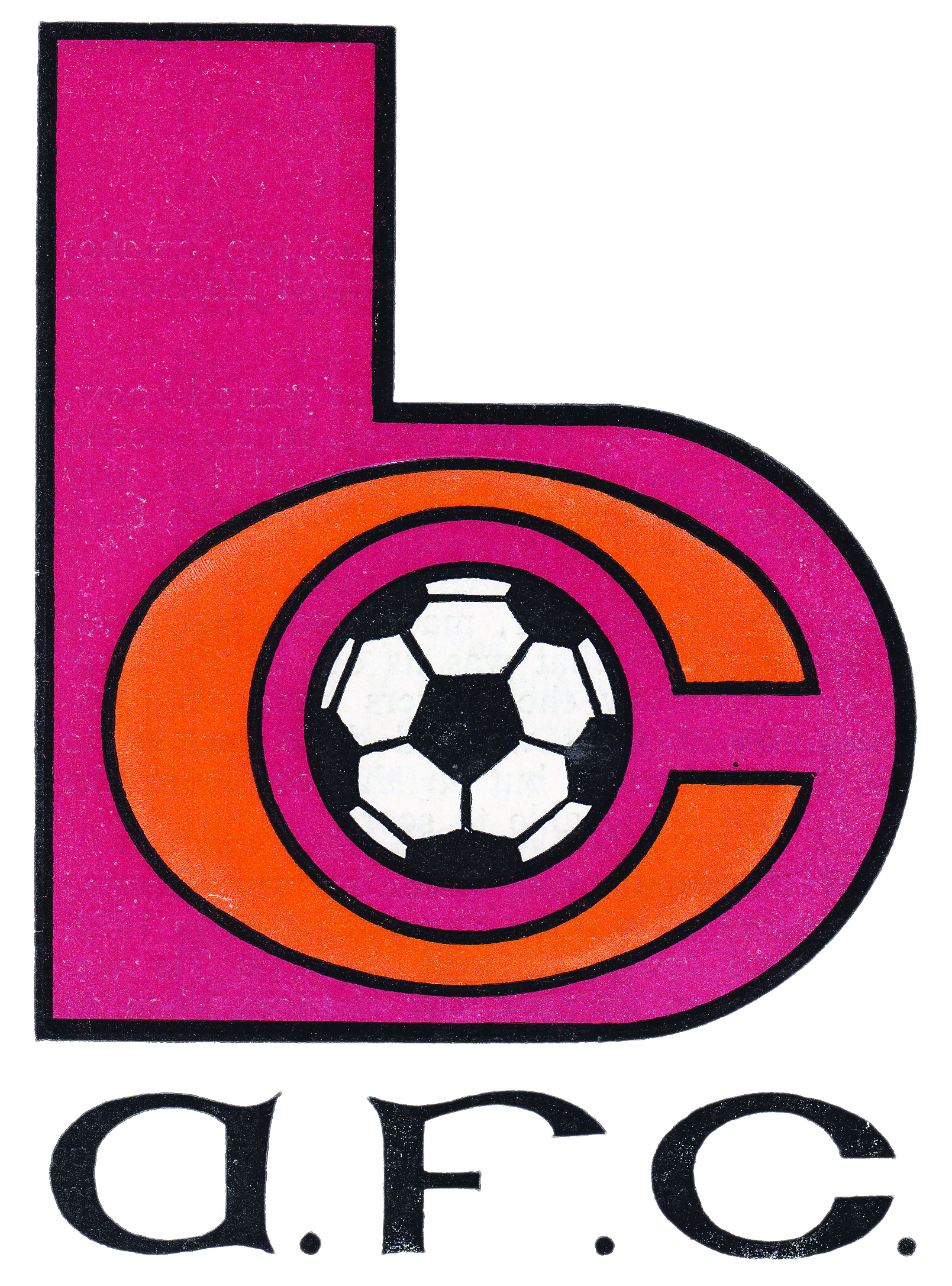
The club’s ‘bc – afc’ monogram logo of that time dated from 1974 and had marked a radical shift to minimalist design and an attempt to introduce a fresh image for the club. The new badge was designed on the back of an envelope (literally so) in the commercial office at Valley Parade, inspired by the identity of the new Bradford Metropolitan District Council which had adopted a modern style monogram bmdc logo without any reference to traditional heraldic devices.  The simple style of the programme cover between 1975-77 arguably matched the same modernising sentiments. (NB Such are the cycles of fashion that the ‘bc logo’ was abandoned in 1981 and the local authority later reverted to a more traditional logo.)

The impulse for change in 1974 had been the liquidation of Bradford Park Avenue and in April, 1974 the BCAFC board had even announced its decision to rename the club as Bradford Metro FC to signify a fresh start as a united Bradford club. Whilst the timing was in response to the demise of Bradford Park Avenue, the choice of name was also inspired by changes in government organisation that year. Bob Martin was convinced that the new metropolitan district would bring with it more people who would identify with Bradford and that the sole remaining football club in the district needed to capitalise on the opportunity.

Like the new club identity, the proposed team colours of amber and brown (the same as the new Bradford authority and its dustcarts) were equally radical. However City supporters, backed by former chairman Stafford Heginbotham, were unanimous in rejecting the proposal which the directors were then forced to abandon. Nevertheless, Bob Martin introduced a predominantly all-white playing strip with solitary claret and amber stripes as a sop to tradition. (White had been the club’s traditional third colour and eventually gave way to claret and amber in 1983.)

The meeting with Tranmere in September, 1975 resulted in a 3-0 home victory which was one of the few highspots in a league campaign in which City remained in the bottom half of the basement division. By the end of 1975 there were genuine fears tat the club might struggle to avoid finishing in the bottom four and be forced to apply for re-election. Despite the new look, the club still lacked money and financial problems were at the heart of the matter. It was a miraculous FA Cup campaign during 1975/76 in which the Paraders reached the Quarter-Finals that literally saved the club. It was Southampton who eventually ended the improbably cup dream in a memorable Sixth Round tie at Valley Parade in March, 1976. The funds raised from cup gates that season, as well as the revived public interest in the club, provided the momentum for a successful promotion campaign in 1976/77.

You can read more about historic City crests and nicknames on my blog from this link

John Dewhirst

The menus above provide links to features written by myself in the BCAFC programme during previous seasons.

Link here to galleries of historic BCAFC programmes on this blog

Link to feature about the historic development of the BCAFC programme since 1909 published on VINCIT.

BCAFC programme feature: vs Crawley Town 13th April, 2021

Football programmes have traditionally been a staple of the match day experience, historically a collectable for many supporters. At Valley Parade, programmes have been produced for first-team fixtures since 1909 and the sale of single sheet team cards dates back even further. This season the match day magazine celebrates the rich heritage of old programmes from earlier years and today’s issue is based on the design from 1980/81.

In 1979/80 Bradford City narrowly missed promotion to Division Three, denied following defeat in the final game at Peterborough United. Despite being tipped in the 1980 close season as favourites to be promoted, the 1980/81 campaign ended in disappointment and a 14th place finish. The last home fixture against Hereford United in May, 1981 was watched by just 1,249 – a record low crowd at Valley Parade for a league match.

The programme of that season was similarly a disappointment and aside from its garish cover it had little to distinguish it. The kindest words would be to describe it as cheap and cheerful, a common characteristic of lower division programmes of that era.

The minimal editorial content betrayed the fact that there was no-one at the club with the commitment to producing a quality issue. However, it also reflected the fact that it was more difficult to compile and produce such a publication at a time when PCs, word processing and digital design software were virtually unheard of.

Most of the content was unchanged from one issue to the next and at the start of the season the printers produced a stock of standard pages with advertising content. Pre-printed templates with claret and amber inks were also produced upfront for the cover and editorial pages as a means to minimise production costs. Needless to say, there were few photographs and they were all printed in low resolution black and white. The editorial deadlines also meant that information was not always up to date, a particular issue at Christmas and Easter.

Programmes of this vintage are readily available on ebay for little cost and they provide interesting insights about social and economic change. For example few of the businesses advertising in the programme still exist, an advert for Leyland cars being particularly poignant. Likewise, that for Worthington Sports, an independent sports business that boasted being official suppliers to BCAFC. Or Sunwin Travel at Sunwin House that advertised itself as travel experts for rail tickets, air bookings, sea journeys and express coaches. No web addresses to be seen!

The fixtures printed in the programme are also a reminder of change. Of those competing in Division Four that season, nine are no longer league clubs (Aldershot, Hartlepool, Torquay, Stockport, York, Hereford, Darlington, Bury and Halifax); one is now established in the second tier (Bournemouth); eight are now in the third tier (Lincoln, Doncaster, Milton Keynes as legal successor to Wimbledon, Peterborough, Rochdale, Crewe, Wigan and Northampton); and just six are now back in the fourth tier (Mansfield, Tranmere, Port Vale Scunthorpe, Southend and ourselves).

In 1980 Crawley Town FC competed in the Southern League Southern Section, three levels below the Football League and few could have imagined then that they would achieve League membership. Crawley Town FC has a long history going back to its formation in 1896 as Crawley FC (with the club’s name changed to Crawley Town in 1958) but for most of its existence operated as an amateur and semi-professional side. In many ways the club’s current status in the football world reflects wider economic changes in the UK and the relative affluence of the South East.

In 1984 Crawley Town secured promotion to the Southern League Premier Division and it was not until 2004 that the club was promoted to the Conference (what is now known as the National League). In 2011 it won promotion to the EFL and this is now Crawley’s tenth season at the senior level.

The menus above provide links to features written by myself in the BCAFC programme during previous seasons.

Link here to galleries of historic BCAFC programmes on this blog

Link to feature about the historic development of the BCAFC programme since 1909 published on VINCIT.

BCAFC programme feature: vs Forest Green Rovers 2nd April, 2021

Football programmes have traditionally been a staple of the match day experience, historically a collectable for many supporters. At Valley Parade, programmes have been produced for first-team fixtures since 1909 and the sale of single sheet team cards dates back even further. This season the match day magazine celebrates the rich heritage of old programmes from earlier years.

The compilation of this feature has been an interesting exercise in selecting old programmes, looking at their historical context and examining the evolution of the matchday publication. I believe that they are important records not only of the history of the football club but also of social history. Above all else they are a reminder of the changes that have occurred in the sport as well as in Bradford.

Today’s programme for example is based on the cover design from the 1989/90 season which ended with our relegation from the second tier. If it wasn’t bad enough to finish second bottom of the table there was the appointment of John Docherty in March, 1990. If we didn’t know it by the end of that season, the next twenty months were not exactly going to be entertaining from a ‘football’ perspective.

Programmes that season had different colour photographs on the cover of each issue. These featured City players in the then first choice strip of claret and amber stripes and black shorts or the away kit, another traditional design, of white shirts with black shorts.

Flicking through old programmes of that season, a number of themes stand out from a modern perspective to which I draw attention.

In 1989/90 the club shirt was sponsored by Grattan, the (printed) catalogue clothing retailer. Prominent on the second page of the programme was a full-page advert for the firm who boasted being ‘League Leaders in Home Shopping’. Whilst Grattan still exists, it’s fair to say that a different form of home shopping is more commonplace nowadays.

Another advert promoted the ‘City Chat Lines’ which offered ‘plenty of interesting chat, interviews, competitions, news and your very own opinion line’. Anyone calling the 0898 888 640 number today is unlikely to hear anything relating to BCAFC but in 1990 it was considered a fantastic commercial opportunity for the club to generate income. It was a premium call line and I recall complaints at the time it was relatively expensive. City Chat Lines was an initiative made obsolete by the internet but arguably it was a forerunner of content currently found on the club’s webpages (NB it was not until 1996 that City fans had their first online presence).

Business adverts in the programme of 1989/90 stand out for the brevity of contact details – no internet or social media addresses, nor mobile phone numbers in those days. And the telephone code for Bradford was then 0274!  It would be a long time before mobile phones became commonplace and in 1989/90 they were still referred to as car phones which is where they tended to be used. By the way, there were no adverts for such phones in the programme which said a lot about their cost.

The last programme of that season included an interesting comment about closed circuit television which had become identified as an important means of crowd control and monitoring. That season marked the completion of the installation of CCTV at every League ground (NB all 92 as this was still prior to the Premier League). The work had been funded by the Football Trust and it was boasted that the cameras had a range of 150 metres and an ability to recognise faces. The same article mentioned that the Football Trust received £9.5m every year from the ‘Spot-the-Ball’ competition run by Littlewoods, Vernons and Zetters. Oh the days of analogue film media!

Printed football fanzines were then very popular at most grounds in the UK. At Valley Parade I suspect that The City Gent came close to outselling the programme at the time and the club sought to capitalise on the popularity by giving the then editor, Mick Dickinson a page in the programme to write about the fanzine scene. It was an interesting feature that regularly included contacts and correspondence from visiting supporters. Again, the internet has played its part in reducing the sales of both fanzines and programmes and the circulation of The City Gent is now a fraction of its peak.

The then commercial manager at the club in 1989/90 was Tony Thornton whose page ‘Commercial Corner’ included the proud boast ‘Come on down to the City Shop, it’s bursting at the seams with goods listed below and many more and the price is right.’  As examples of merchandise, Bukta tracksuits were priced at £22.99/£29.99; Bukta replica shirts at £9.50/£11.99; and shell pants (the then new scourge of high street fashion) at £19.99 whilst ties could be bought for £4.95. The retail revolution at Valley Parade had still to occur and it was not until 1996 that Geoffrey Richmond transformed the offering, but nonetheless in 1989/90 the club had made tentative steps to generate more income from this source.

Final mention is of the advert for the National & Provincial Building Society, then a major employer in the city. Anyone remember that big office block opposite City Hall??

The menus above provide links to features written by myself in the BCAFC programme during previous seasons.

Link here to galleries of historic BCAFC programmes on this blog

Link to feature about the historic development of the BCAFC programme since 1909 published on VINCIT.

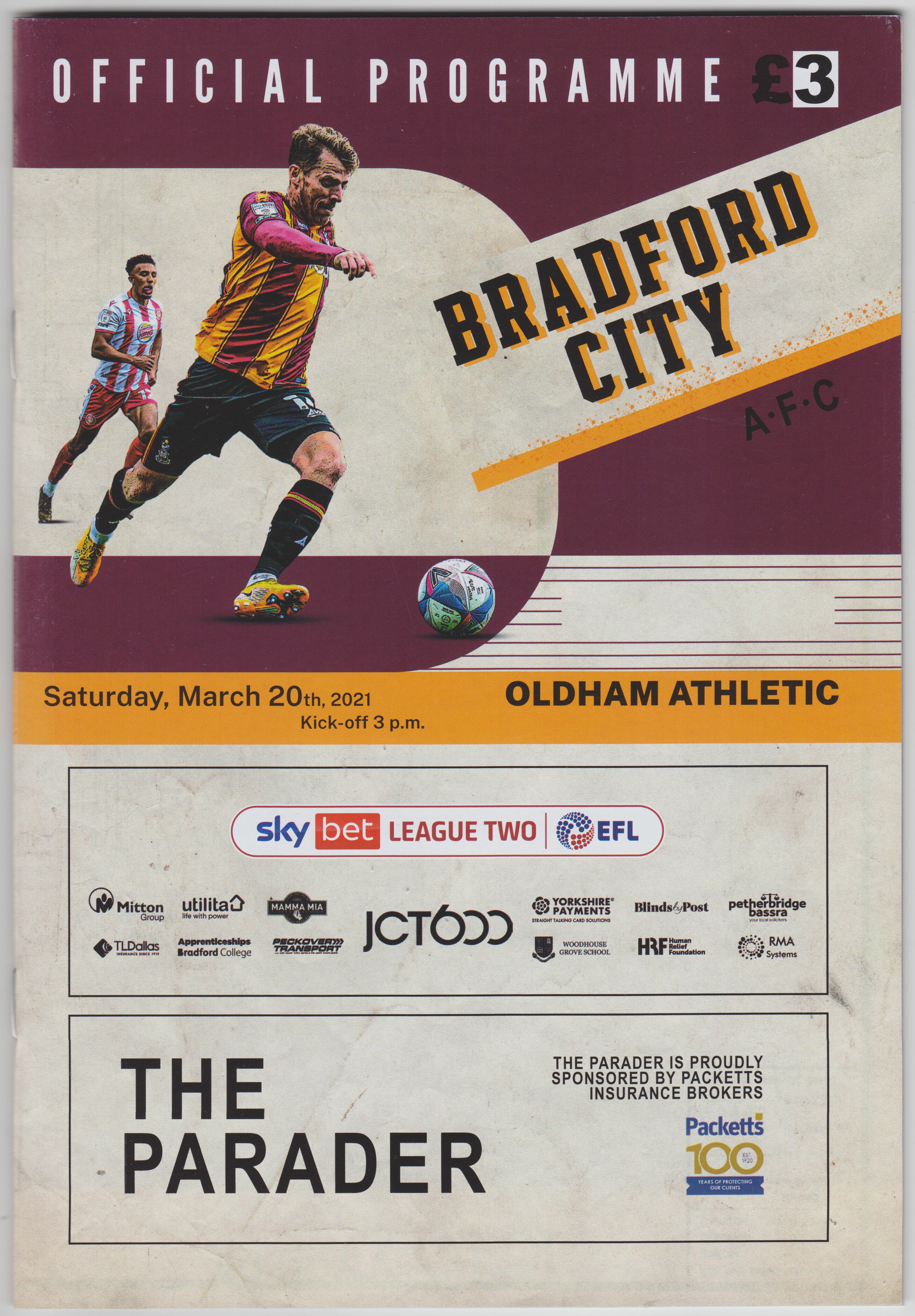
BCAFC programme feature: vs Oldham Athletic 20th March, 2021

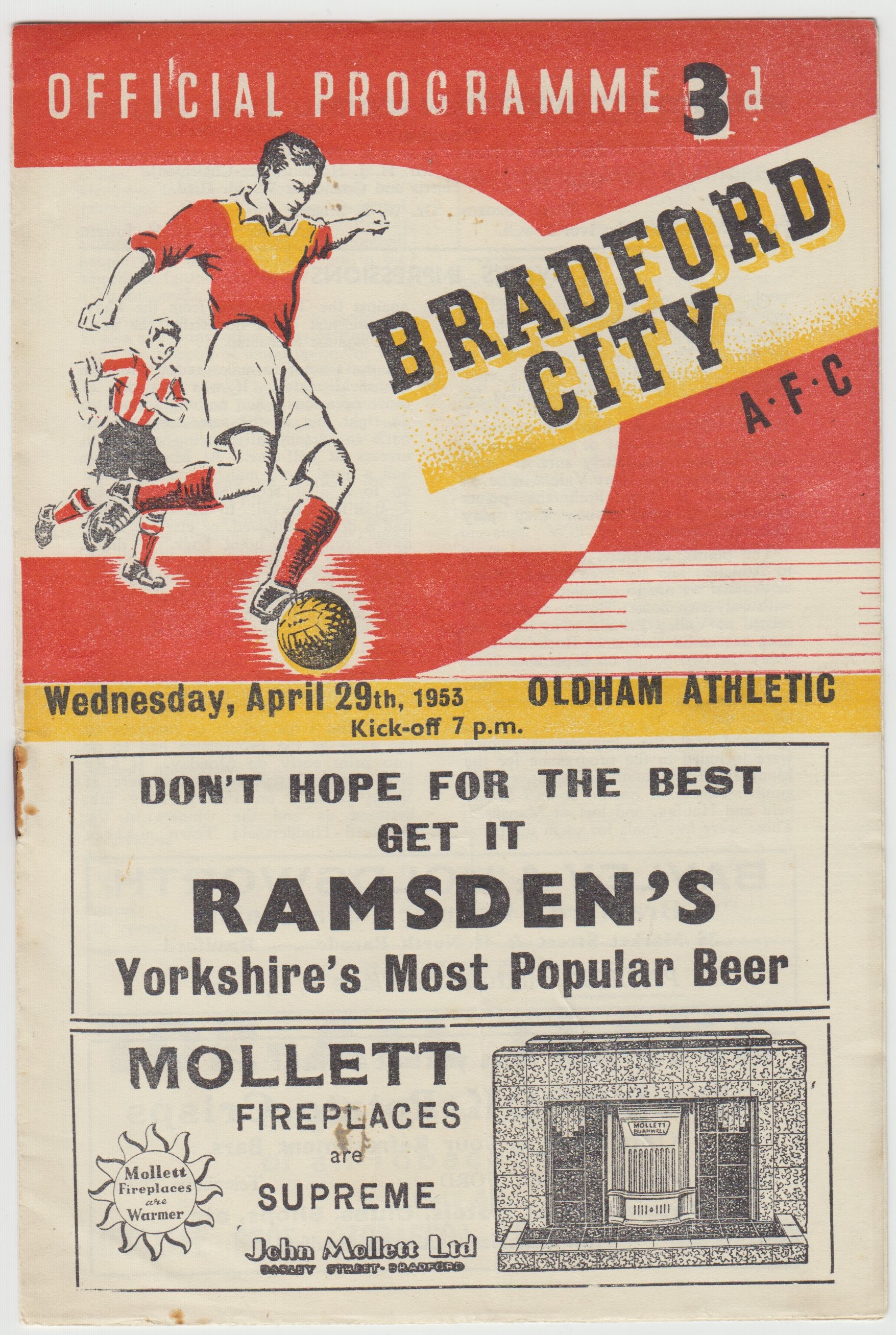
Football programmes have traditionally been a staple of the match day experience, historically a collectable for many supporters. At Valley Parade, programmes have been produced for first-team fixtures since 1909 and the sale of single sheet team cards dates back even further. This season the match day magazine celebrates the rich heritage of old programmes from earlier years and today’s issue is based on the design from 1952/1953 when we were rivals with Oldham Athletic in Division Three (North).

During the 1950s the content of the Bradford City programme was very basic and there was little change from one year to the next. To be fair this was not unusual among clubs and neither was it confined to the lower divisions. Government control of paper supply was not finally lifted until 1956 and paper remained in short supply until the end of the decade. The size of the programme was also smaller than what had been produced before the war with an inch shaved off both the length and the width. The quality of paper used to produce the programme in the early 1950s differed considerably on occasions and my interpretation is that it was a case of using whatever paper the printer could supply.

With corresponding high costs of production, it made sense to economise and as a consequence minimal effort was invested in the programme. Higher print/paper costs forced a 50% increase in the cover price in December, 1952 and it remained at 3d until 1964 (having been 2d since 1944). It was not until the 1960s – and post 1966 in particular – that football clubs recognised marketing and commercial opportunities through match programmes and the cost of paper was no longer as prohibitive.

Midway in the 1956/57 season came a change in cover design but the content remained the same with no more than eight pages including the front and rear cover. Team cards for reserve games and friendlies were a single page issue and featured the civic crest that was also used as club badge by both Bradford City and Bradford Park Avenue.

In the immediate post-war period the standard of the programme published at Park Avenue was consistently better than at Valley Parade. In some ways it was a form of proxy competition between the two clubs and it is difficult to avoid the conclusion that the Bradford leadership was acutely sensitive to the branding of their club. By contrast the Park Avenue programme covers were much more formal, as if to imply seniority.

It was not until 1958 and the restructuring of the English lower divisions from regional to national formats that there were radical changes in programme design. Typically, the southern clubs had been more adventurous in their commercial activities – programme publishing included – and this appears to have encouraged change at northern clubs. Oldham for example embraced such change but at Valley Parade it was confined to new cover designs. Between 1959-66 Bradford Park Avenue was the more innovative in programme design, pioneering a pocket size no more than 8cm by 13cm that would also appear at Boundary Park. It was the introduction of the City Gent character in 1966 that heralded a new era at Valley Parade with a radical mid-season redesign of the cover and an increase in size to 12 pages.

The menus above provide links to features written by myself in the BCAFC programme during previous seasons.

Link here to galleries of historic BCAFC programmes on this blog

Link to feature about the historic development of the BCAFC programme since 1909 published on VINCIT.

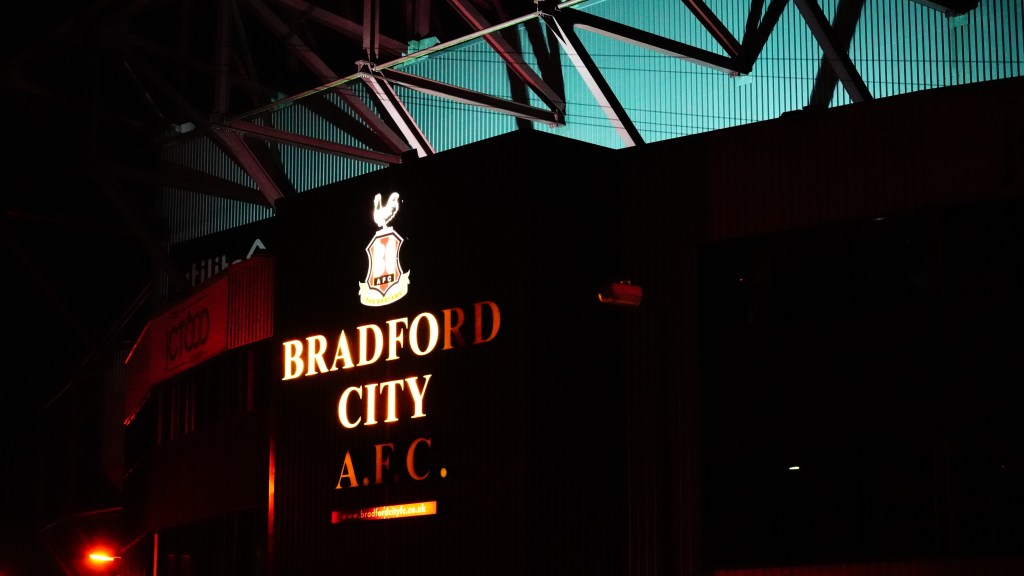
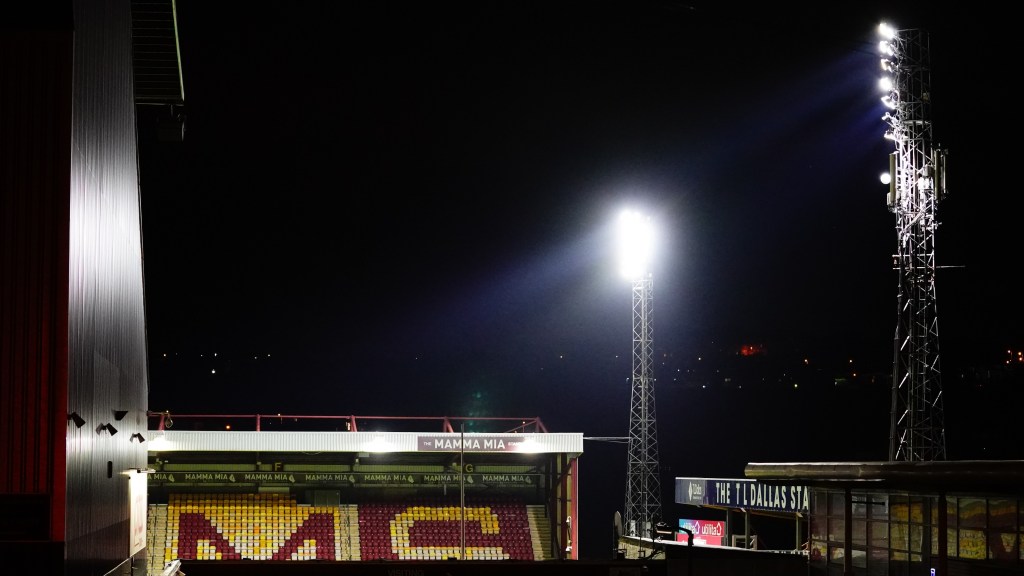
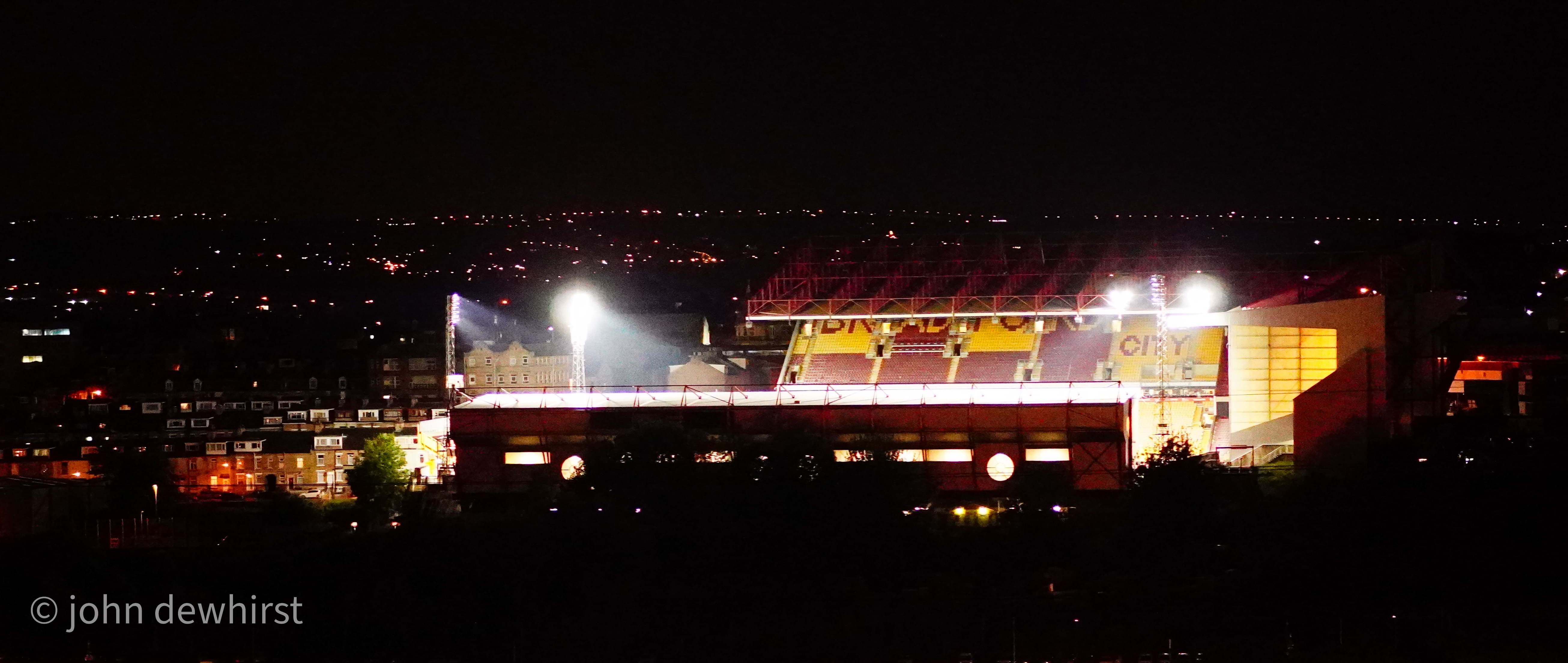
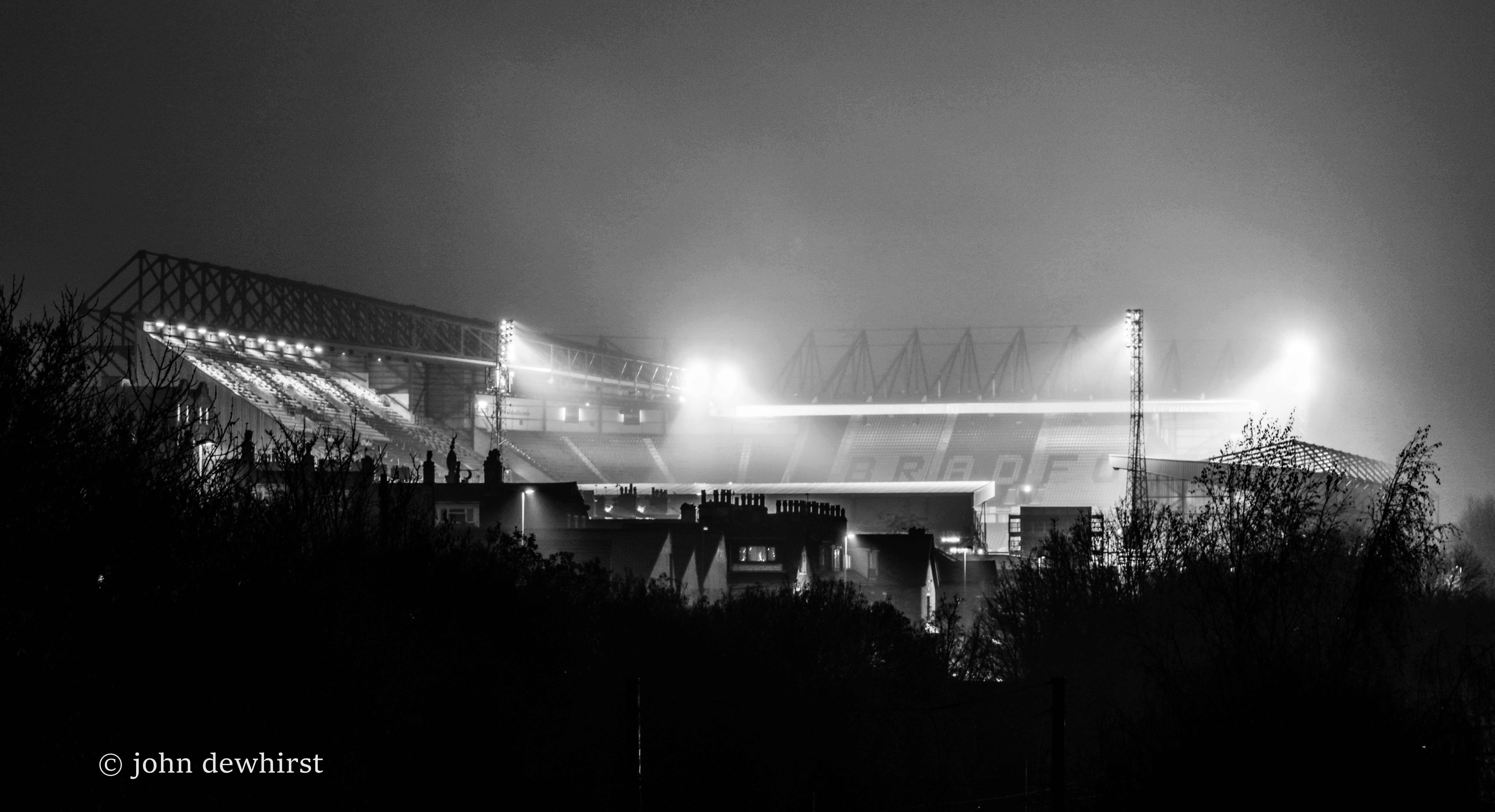
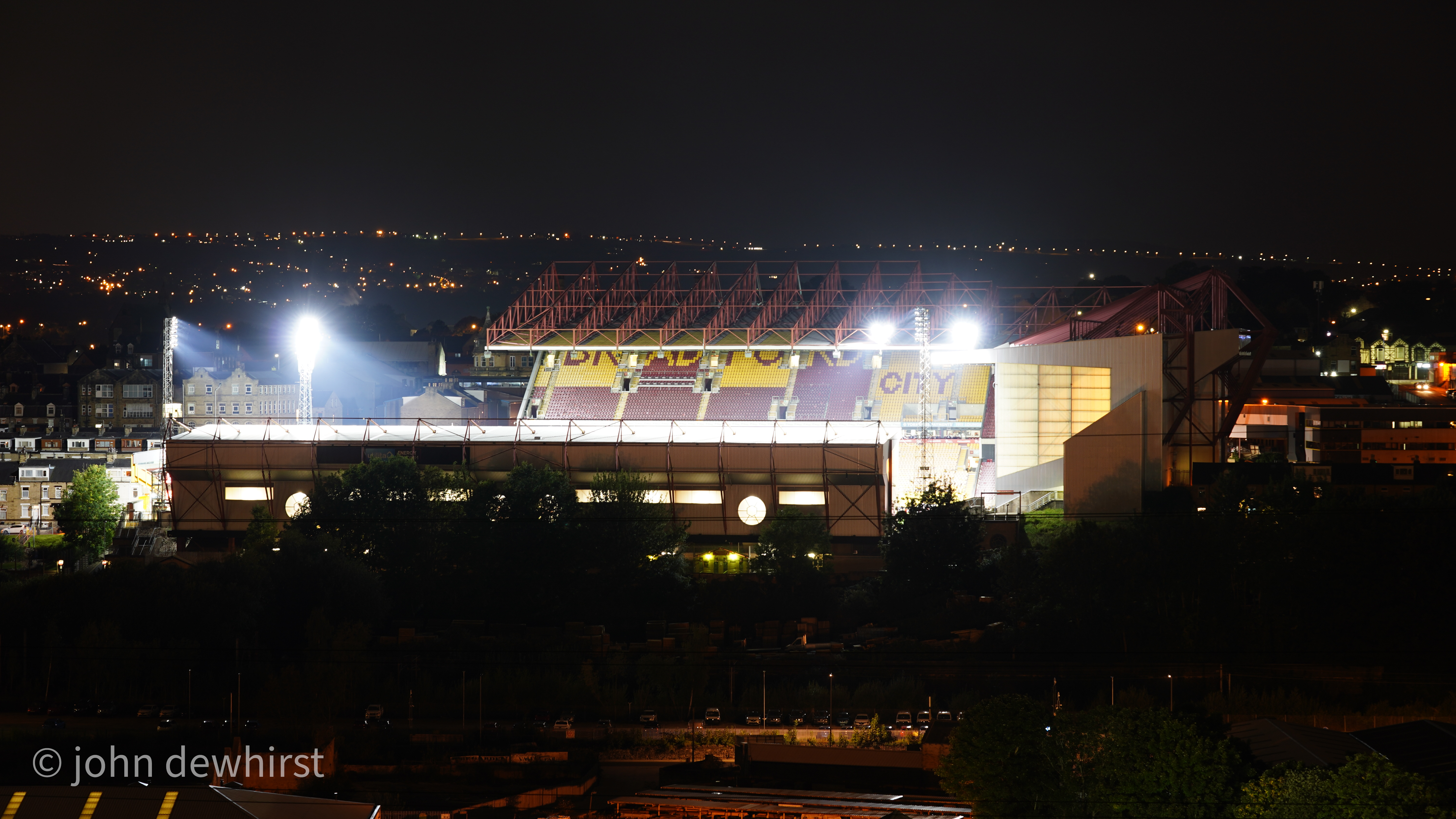
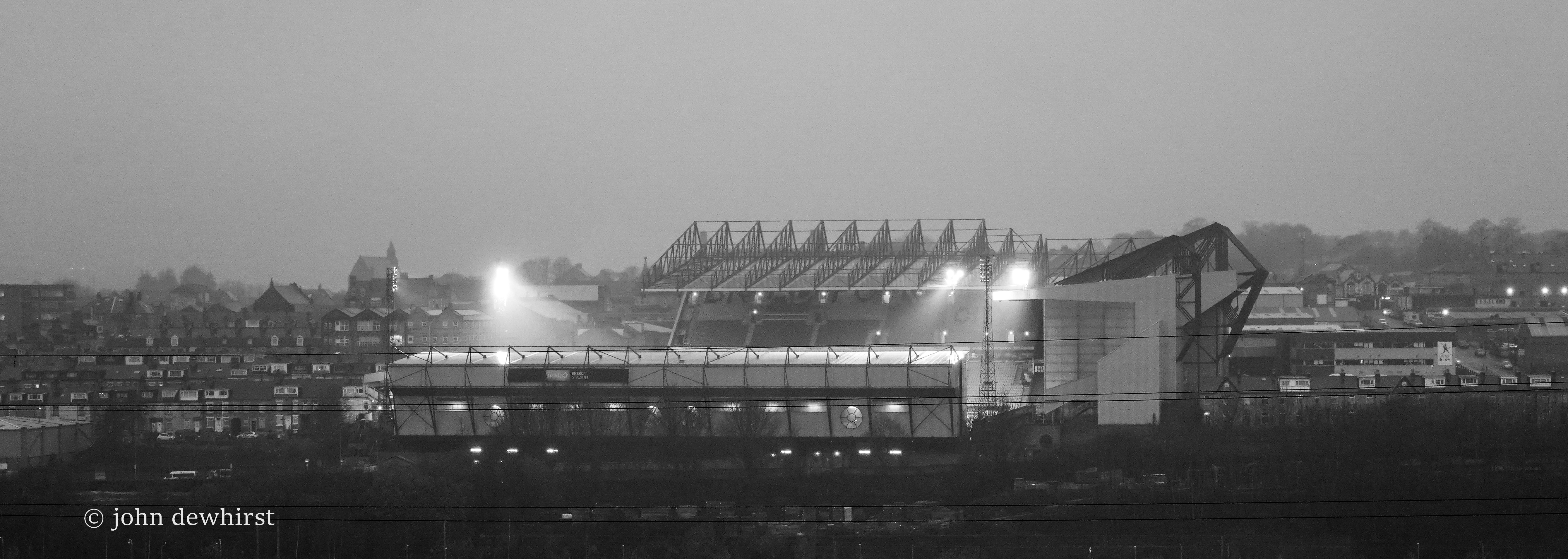
Valley Parade under floodlights

Photos taken in October / November, 2020.

If anyone wants to use these on social media I have no issue. I know that one in particular features on a number of Twitter profiles. However, I would ask to be credited.

@jpdewhirst

Sundry images being tweeted with the tag #floodlightfriday and also #scottishgroundsofthe80s

Thanks for visiting my blog, the content of which is mainly – although not exclusively – about Bradford City AFC. The menu above gives access to my features published in the BCAFC matchday programme, content on local history as well as my reviews of sundry sports books that have local coverage.

Those interested in the history of Valley Parade will find an extensive selection of old photographs and detail about how the ground has been developed since 1886 from this link.

Refer to the menu above for links to other blog features.

My Twitter account is @jpdewhirst – followers can expect a variety of stuff but in the main my photographs, archive images, Bradford sports artefacts and BCAFC / BPA memorabilia.

*** Details of my new book (2020) in collaboration with George Chilvers: Wool City Rivals – A History in Colour which tells the story of the rivalry of Bradford City and Bradford Park Avenue in the Football League, 1908-70. (Available only online from the link.)

Copies of my other books in the bantamspast History Revisited series can be purchased online as well as in Waterstones (Wool Exchange) and the Salts Mill bookshop when they reopen after lockdown.

BCAFC programme feature: vs Bolton Wanderers 6th March, 2021

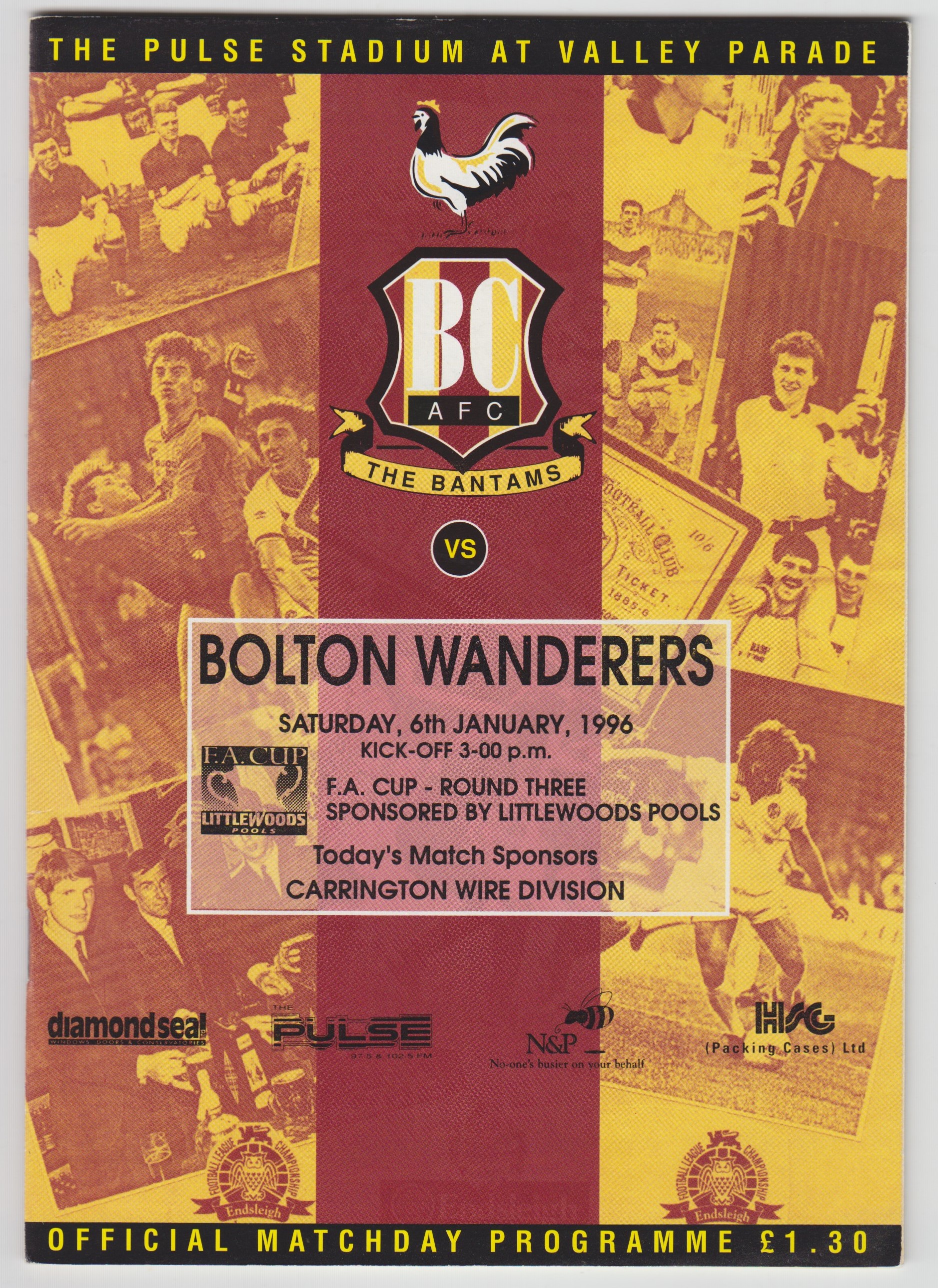
Football programmes have traditionally been a staple of the match day experience, historically a collectable for many supporters. At Valley Parade, programmes have been produced for first-team fixtures since 1909 and the sale of single sheet team cards dates back even further. This season the match day magazine celebrates the rich heritage of old programmes from earlier years and today’s issue is based on the design from 1995/96 when Bolton Wanderers were the visitors to Valley Parade for a Third Round FA Cup tie.

The cover of the programme in 1995/96 was one of the most distinctive to have been used in the history of the Bradford City publication, incorporating half a dozen archive images from preceding decades. It was nonetheless a throwback to the traditional way of producing a programme with the cover remaining unchanged – other than the name of the opposition – for each issue. The motive for this was once again that of economy and the bright cover disguised the fact that the content was minimal.

In February, 1994 the Bradford printer Wheeldens had been displaced by the in-coming chairman, Geoffrey Richmond. From the outset his motive was to minimise the cost of the programme whilst also increasing its financial contribution and there was a high advert content in the 36 pages of that produced in 1995/96. Whilst the new heritage cover represented an improvement, by contemporary standards the match programmes between 1994 and 1996 were still mediocre. It was not until 1996/97 that Richmond made a concerted effort to improve the publication and the era of ‘match day magazines’ at Valley Parade began.

There have only been 50 first team competitive fixtures between Bradford City and Bolton Wanderers with 15 games having been won by City and 18 by Bolton. Of those there have been two FA Cup ties, both won by Bolton (including a 3-0 win in January, 1996) and four League Cup games of which two resulted in a City victory and one in favour of Bolton. In the Football League Trophy in 2019 there was a draw. It means that in League competition, Bolton have the edge with 15 wins compared to 13 for the Bantams whilst there have been 15 draws.

Despite defeat by Bolton in the FA Cup in 1995/96 we still made it to Wembley that year and history was made on 26th May, 1996 when Bradford City played at the stadium for the first time in the club’s history, winning the League Division Two (third tier) Play-Off Final.

Our last League victory over Bolton was in April, 1993 when we won 2-1 at Valley Parade. Possibly our most memorable victory in modern times was on 6th May, 1985 when our 2-0 win at Burnden Park secured the Division Three Championship.

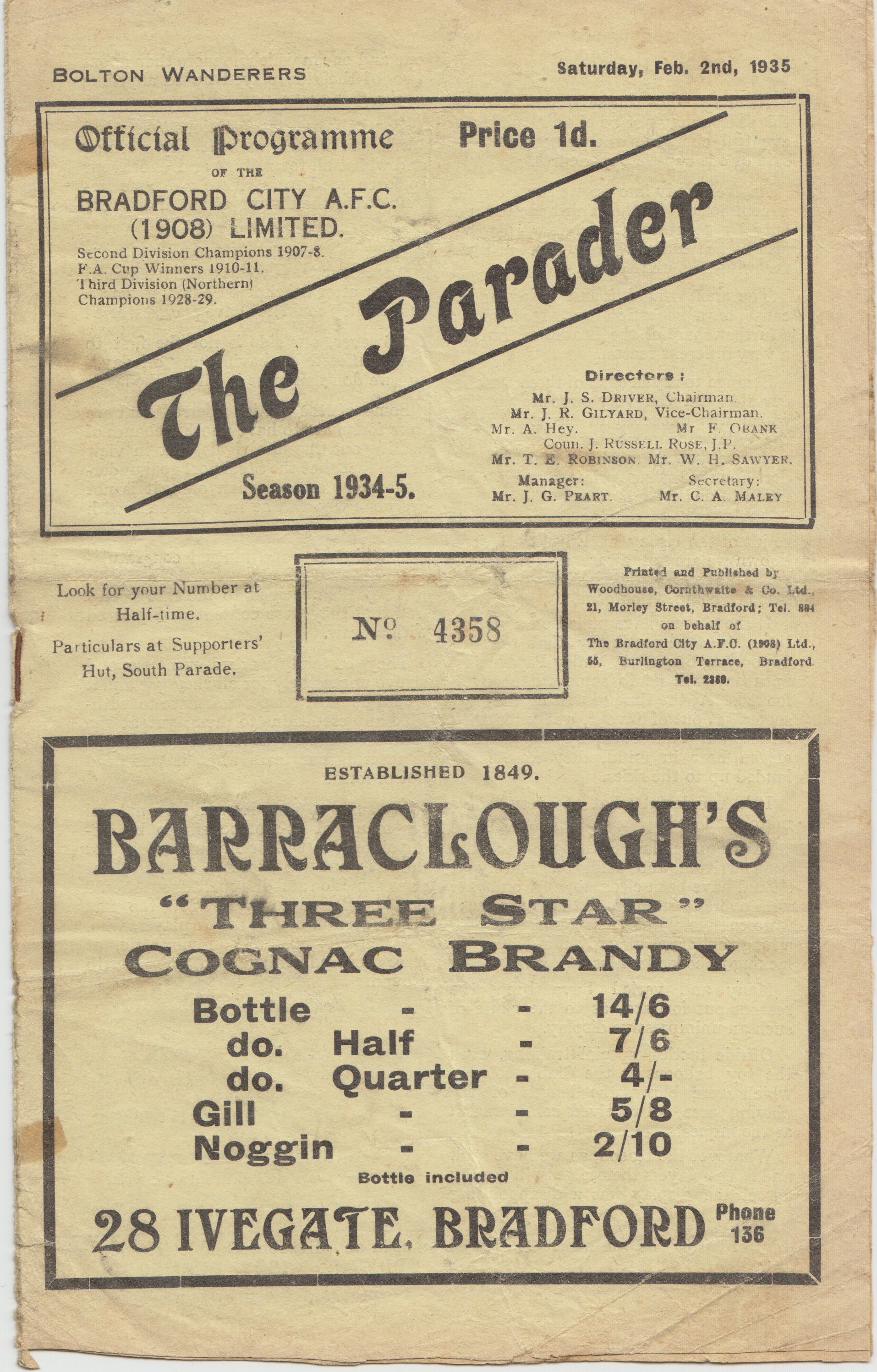
Meetings between the sides were relatively commonplace before the last war but subsequent to the 1934/35 season when Bolton won promotion to Division One, we did not meet again in League competition until 1971/72. The cover of the programme from the game between the sides in February, 1935 (a 1-1 draw) is reproduced on this page, an eight page issue that was typical of the era and indeed, until the 1960s.

Even with the emergence of ‘match day magazines’ the basic content of a programme has continued to revolve around the same ingredients: statements of club health by the team manager and/or club chairman; detail of fixtures and results; supporters’ club announcements; a brief background to the opposition club including pen pictures of its players; team line-ups; and advertisements. One feature that no longer exists is a section to record half-time scores. Both the 1996 issue and that from 1935 provide a unique insight into social and economic trends, an invaluable record for future historians.

The menus above provide links to features written by myself in the BCAFC programme during previous seasons.

Link here to galleries of historic BCAFC programmes on this blog

Link to feature about the historic development of the BCAFC programme since 1909 published on VINCIT.

BCAFC programme feature: vs Mansfield Town 2nd March, 2021

Football programmes have traditionally been a staple of the match day experience, historically a collectable for many supporters. At Valley Parade, programmes have been produced for first-team fixtures since 1909 and the sale of single sheet team cards dates back even further. This season the match day magazine celebrates the rich heritage of old programmes from earlier years and today’s issue is based on the design from 1992/93.

The cover of the programme is a reminder of the diagonal design shirts that were worn between 1991-93 with the distinctive two-tone blue away shirts. The striking kit design accompanied the restoration of the official ‘bantams’ identity with the current club crest having been introduced in 1991.

The new crest incorporated the traditional shield and the BCAFC monogram that had featured in earlier versions. On top of the shield sits a bantam. Unfortunately, the depiction of the bird in white overlooked the fact that when the nickname had originally been introduced in 1908, emphasis was given to claret and amber plumage!

As a publication, the 1992/93 match day programme looks very dated by today’s standards and at the time it compared poorly with those of other clubs. The kindest observation to be made is that it was economical in content. A distinguishing feature however was the colour action photograph on the cover that was changed with each issue

The meeting with Mansfield on 2nd January, 1993 resulted in a dour 0-0 draw. Having been relegated from the second tier in 1990 there had been little promise of a serious challenge at promotion but by the end of 1992 there were hopes that the outlook was brighter. The point from the Mansfield game left Bradford City in 6th position behind leaders Stoke City, Leyton Orient, West Bromwich Albion, Hartlepool United and Rotherham United.

Other sides in our division that season included Bolton, Brighton, Swansea, Burnley, Fulham, Reading, Hull, Bournemouth, Wigan, Blackpool and Huddersfield (NB bottom placed on 2nd January, 1993) all of whom subsequently played in the Premier League which was then in its inaugural season.

City finished 1992/93 in 10th position whilst Mansfield Town were relegated (22nd). Huddersfield Town meanwhile escaped the drop and finished 15th. The early 1990s was something of a doldrums period for Bradford City, finishing 7th in 1993/94 and 14th in 1994/95 before that memorable Play-Off victory at Wembley in 1996 and our return to the second tier. The prospect of playing in the Premier League however was then still something beyond our wildest dreams.

Subsequent to our meeting in January, 1993, Bradford City did not play against Mansfield Town again until 2007/08. Of course, that followed our relegation to the basement division which came only six years after our two season spell in the Premier League.

In total there have now been 65 first team contests between the sides, of which City have won 25 and lost 23. Ten of those have been cup games with City undefeated against Mansfield in the FA Cup (winning four and drawing one) and of meetings in the League Cup, City have won three and lost just once whilst Mansfield can boast victory in the Freight Rover Associate Members Cup in 1985. In league competition therefore Mansfield have the edge with 21 victories against City’s 18.

Despite securing four points from Bradford City in the 2007/08 season it was insufficient to prevent Mansfield Town finishing second to bottom and losing its League status. The Stags subsequently spent five seasons in the National League, winning the championship in 2012/13 and hence last season was the first encounter between the sides since 2007/08.

The menus above provide links to features written by myself in the BCAFC programme during previous seasons.

Link here to galleries of historic BCAFC programmes on this blog

Link to feature about the historic development of the BCAFC programme since 1909 published on VINCIT.

BCAFC programme feature: vs Leyton Orient 23rd February, 2021

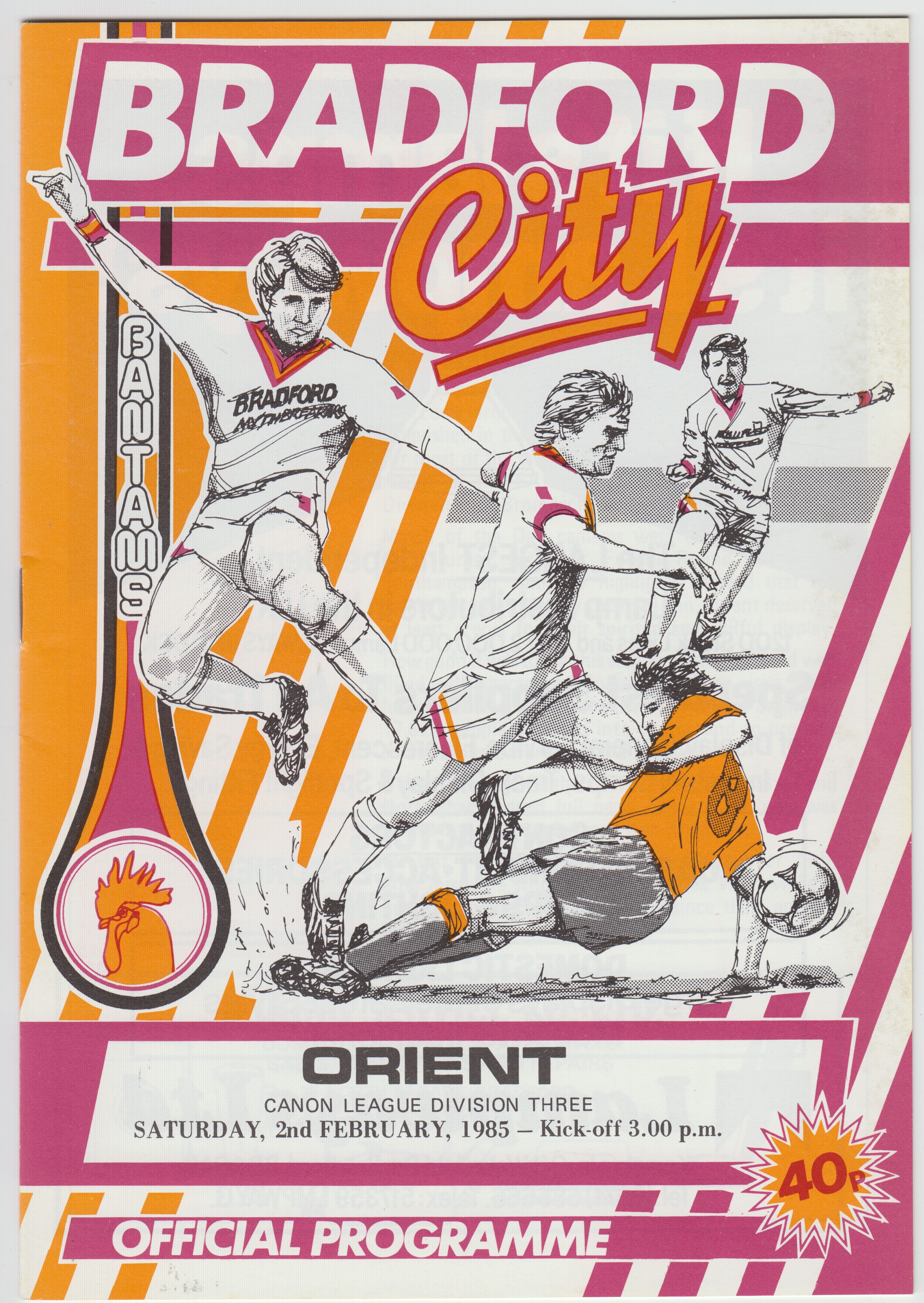
Football programmes have traditionally been a staple of the match day experience, historically a collectable for many supporters. At Valley Parade, programmes have been produced for first-team fixtures since 1909 and the sale of single sheet team cards dates back even further. This season the match day magazine celebrates the rich heritage of old programmes from earlier years and today’s issue is based on the design from 1969/70 – the last visit of Barrow AFootball programmes have traditionally been a staple of the match day experience, historically a collectable for many supporters. At Valley Parade, programmes have been produced for first-team fixtures since 1909 and the sale of single sheet team cards dates back even further. This season the match day magazine celebrates the rich heritage of old programmes from earlier years and today’s issue is based on the design from 1984/1985 when we played Orient during our Division Three Championship winning season.

The cover of our programme for the 1984/85 season was crude to say the least and appears to have been drawn by tracing the outline of an action photograph. It is highly unlikely that a design agency had been engaged for the purpose.

I doubt that I am the only Bradford City supporter delighted to see Leyton Orient back in the EFL after a two year exile in the National League between 2017-19. Relegation from the third tier in 2015 was followed by relegation from the basement two years later but the manner in which the club collapsed after the disappointment of a play-off defeat in 2014 is something that we can relate to.

Our fixture with Leyton Orient last March never took place due to the Covid emergency and so today is the club’s first visit to Valley Parade since the meeting in November, 2014 that ended with a 3-1 home victory and this is only the second season that the two clubs have been rivals in the basement division. Of the previous twenty-one seasons that we have been matched at the same level, twelve have been in the third tier, eight in the second and one (last season) in the fourth.

All of the meetings in the old Division Two were before the war with the first game between the sides in December, 1905 (a 3-0 home win in Bradford) and the last in September, 1926 (a 1-3 home defeat). Before World War One we defeated Clapton Orient (as the club was then known) four times and lost only once in six meetings between 1905/06 and 1907/08. Bradford City finished as champions of Division Two in 1908 and achieved a double over the London side in that season.

During the 1920s Clapton Orient was something of a bogey side for City who lost five and drew five of the ten games between 1922/23 and 1926/27. Following the Paraders’ relegation to Division Three (North) in 1927 it meant that our paths did not cross again until September, 1969. Since then the results have been pretty even with City winning ten games compared to nine by Orient / Leyton Orient.

In aggregate City have won 14 and lost 15 league games and 12 have been drawn (including that last season in London). The one meeting between the sides in the FA Cup was at Valley Parade in November, 2008 which the visitors won.

Our highest victory, 4-0 was achieved in March, 1991 (the programme of which is featured). This was the third home game in succession that the Bantams had scored four goals against the O’s with the two preceding meetings at Valley Parade in February, 1985 and January, 1984 both ending 4-1. The game in 1984 is remembered as the ninth game in a run of ten successive victories that saw the club rise from the relegation zone in meteoric fashion. The programme for the game in 1985 – the season when Bradford City finished as champions of Division Three – is also featured. When the clubs had met the previous September in London there was little indication that City might top the division after a disappointing 0-1 reverse.

The programme for our meeting in December, 2013 which finished 1-1 had Jon McLaughlin (now at Rangers) on its cover and is also reproduced below. 

The menus above provide links to features written by myself in the BCAFC programme during previous seasons.

Link here to galleries of historic BCAFC programmes on this blog

Link to feature about the historic development of the BCAFC programme since 1909 published on VINCIT.