For those who found this link in connection with my comments about the calls for a new investigation into the VP85 fire I won’t disguise my disappointment about how events are unfolding. It feels that the overwhelming majority of City supporters of the generation who lived through the fire are being held to ransom by Martin Fletcher’s crusade that dismisses any views counter to his own. Our feelings and sensitivities are secondary to his.
My interpretation of what happened and my response to his allegations can be found elsewhere on the web – the claret and banter forum is as good a place as any to search.
I do not deny the trauma that Martin Fletcher has suffered but he is not the only survivor of the tragedy. Nor does he have the monopoly version of events. His alegations are simply not recognised by those of us familiar with the club thirty years ago. In my opinion his book is selective in its evidence but skilfully written – I suspect by a ghost writer – to persuade the reader by its heavy emotional overlay. It fails however to take into account the context of the events and the fact that in 1985 the priority was not the 56 who perished, but the countless survivors who were also victims. The investigation and the handling of the disaster was successful in the way that it allowed the local community to ‘get back to normal’ without the further grief of an extensive and an unnecessarily lengthy investigation. For that we were grateful. We all accepted it was an accident and I remain firmly of that opinion. Do you really need a lengthy inquiry to conclude any more than that?
With all respect to Martin, as a young child living in Notts in the mid 80s, he simply would not have been aware of what went on in Bradford in the immediate aftermath of the fire. To suggest that we were in denial or had lost our faculties is ludicrous. Indeed the Bradford community with the support of local agencies – including the police – surely deserves credit for how it responded.
As regards the allegations of arson there were good reasons why they didn’t carry weight thirty years ago. Given that Bradford swarmed with investigative journalists in 1985-86 isn’t it bizarre that the story didn’t have traction then – at a time that memories were fresh – if it seems so compelling now. Does he genuinely think that we didn’t ask our own questions about what had happened or that we lacked the intelligence to make sense of what had happened?
There is cynicism in Bradford about Fletcher’s campaign. Of how his book was launched at the time of the Hillsborough Inquiry when it is common knowedge that publishers had rejected his manuscripts on previous occasions. Without a doubt there is clever media manipulation of the message he seeks to promote. In fact he has achieved a coup by convincing a relatively inexperienced and naive local MP to rally to his cause. Yet this is a campaign being driven from outside Bradford and unlike Hillsborough there is no campaign in the city for justice and for a fresh inquiry.
Bradfordians have been dismissed by Fletcher as being in denial but the generation of us who lived through the disaster cannot be accused of collective dementia. He says that he speaks on behalf of the victims yet in May, 2015 when I attended events to mark the anniversary of the disaster – including the private screening of Gabby Logan’s film at which the families of the 56 were invited – nobody was crediting him for his campaign. In fact quite the opposite. He may claim to be speaking on behalf of the victims but the survivors were victims too and he certainly does not speak for me.
The only winners in a fresh inquiry will be journalists, lawyers, publishers and shrinks. It won’t bring people back, it won’t change what happened and it won’t make people feel any better. And will Martin ever accept that his version of the ‘truth’ is not shared by anyone else but conspiracy theorists?
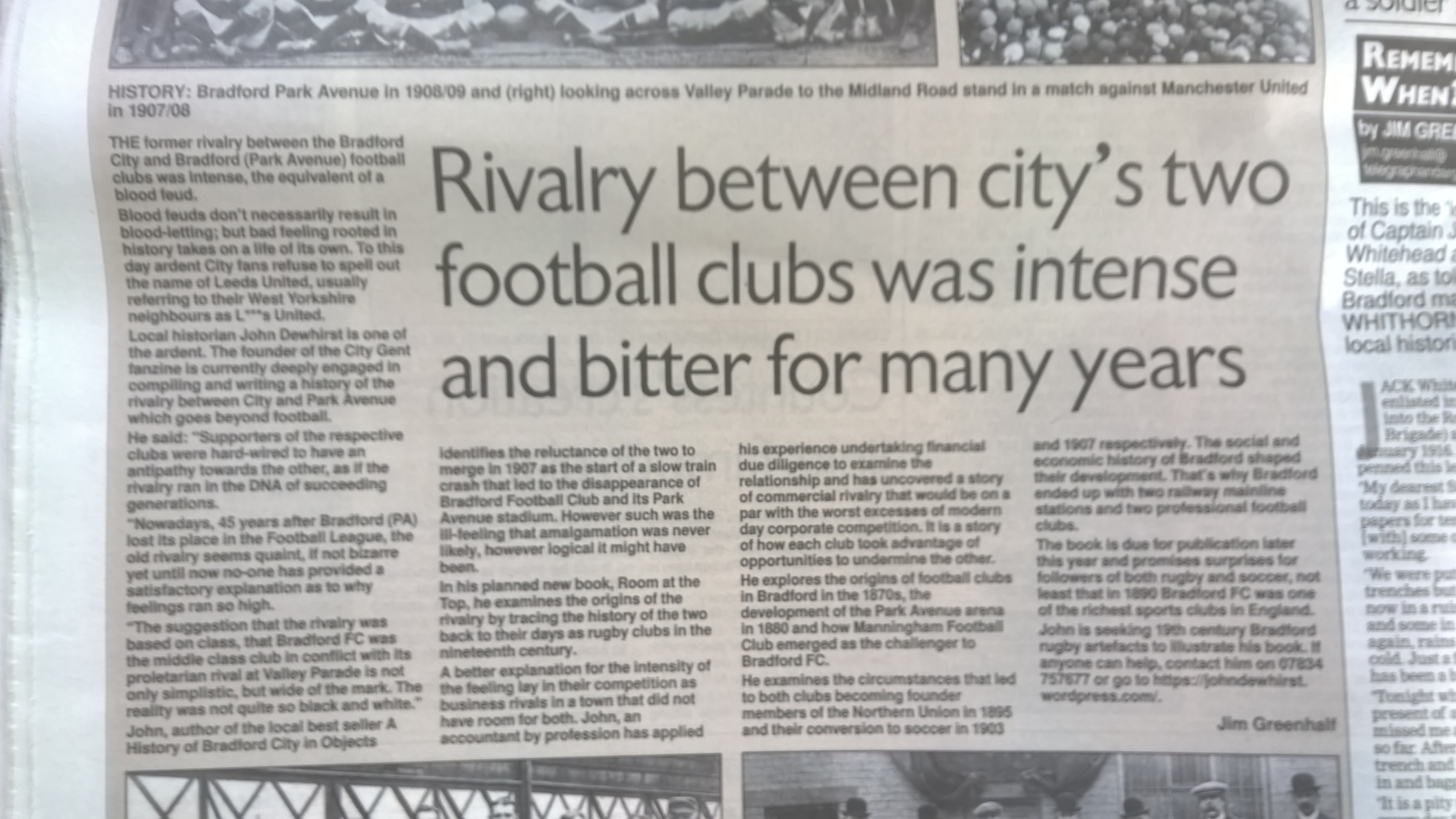
This site promotes my own books and next year I shall be releasing a history of the two Bradford clubs with a focus on their origins. That history actually has a bearing on what happened in 1985. The VP disaster was ultimately the consequence not just of negligence – which has never been denied – but financial failure. The main stand at Valley Parade was originally a temporary expedient when it was first developed and extended between 1907-08. A cantilever stand had been planned even before the outbreak of World War One but by 1920 those plans were abandoned. In 1907, at the very time the main stand was being erected, there were at least five instances of fire at British football grounds. There had even been a fire at Park Avenue the previous decade. Sadly, crowd safety was never a concern in England for too long and in that regard the positive outcome of the VP disaster was the instigation of safety standards in its wake.