
Feature in the T&A on Monday 28th December about vols 2 & 3 of the BANTAMSPAST ‘HISTORY REVISITED’ SERIES:
More updates on WIDTHOFAPOST and tweets @woolcityrivals
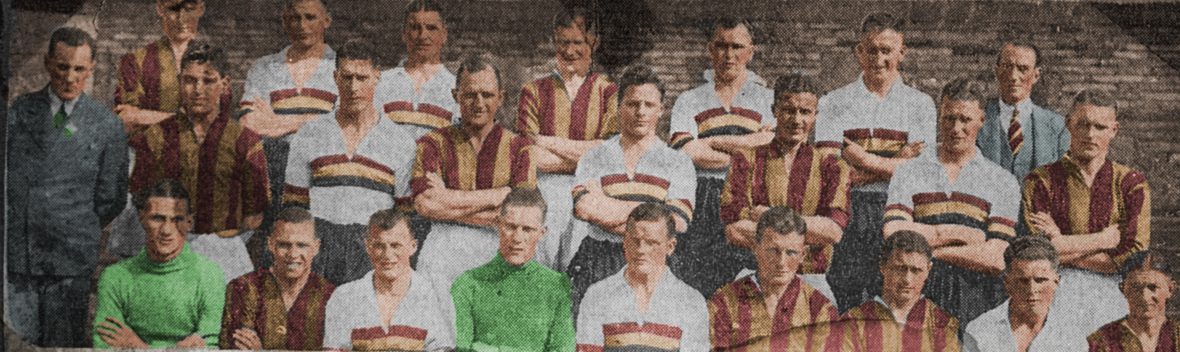
Feature in the T&A on Monday 28th December about vols 2 & 3 of the BANTAMSPAST ‘HISTORY REVISITED’ SERIES:
More updates on WIDTHOFAPOST and tweets @woolcityrivals
For those who found this link in connection with my comments about the calls for a new investigation into the VP85 fire I won’t disguise my disappointment about how events are unfolding. It feels that the overwhelming majority of City supporters of the generation who lived through the fire are being held to ransom by Martin Fletcher’s crusade that dismisses any views counter to his own. Our feelings and sensitivities are secondary to his.
My interpretation of what happened and my response to his allegations can be found elsewhere on the web – the claret and banter forum is as good a place as any to search.
I do not deny the trauma that Martin Fletcher has suffered but he is not the only survivor of the tragedy. Nor does he have the monopoly version of events. His alegations are simply not recognised by those of us familiar with the club thirty years ago. In my opinion his book is selective in its evidence but skilfully written – I suspect by a ghost writer – to persuade the reader by its heavy emotional overlay. It fails however to take into account the context of the events and the fact that in 1985 the priority was not the 56 who perished, but the countless survivors who were also victims. The investigation and the handling of the disaster was successful in the way that it allowed the local community to ‘get back to normal’ without the further grief of an extensive and an unnecessarily lengthy investigation. For that we were grateful. We all accepted it was an accident and I remain firmly of that opinion. Do you really need a lengthy inquiry to conclude any more than that?
With all respect to Martin, as a young child living in Notts in the mid 80s, he simply would not have been aware of what went on in Bradford in the immediate aftermath of the fire. To suggest that we were in denial or had lost our faculties is ludicrous. Indeed the Bradford community with the support of local agencies – including the police – surely deserves credit for how it responded.
As regards the allegations of arson there were good reasons why they didn’t carry weight thirty years ago. Given that Bradford swarmed with investigative journalists in 1985-86 isn’t it bizarre that the story didn’t have traction then – at a time that memories were fresh – if it seems so compelling now. Does he genuinely think that we didn’t ask our own questions about what had happened or that we lacked the intelligence to make sense of what had happened?
There is cynicism in Bradford about Fletcher’s campaign. Of how his book was launched at the time of the Hillsborough Inquiry when it is common knowedge that publishers had rejected his manuscripts on previous occasions. Without a doubt there is clever media manipulation of the message he seeks to promote. In fact he has achieved a coup by convincing a relatively inexperienced and naive local MP to rally to his cause. Yet this is a campaign being driven from outside Bradford and unlike Hillsborough there is no campaign in the city for justice and for a fresh inquiry.
Bradfordians have been dismissed by Fletcher as being in denial but the generation of us who lived through the disaster cannot be accused of collective dementia. He says that he speaks on behalf of the victims yet in May, 2015 when I attended events to mark the anniversary of the disaster – including the private screening of Gabby Logan’s film at which the families of the 56 were invited – nobody was crediting him for his campaign. In fact quite the opposite. He may claim to be speaking on behalf of the victims but the survivors were victims too and he certainly does not speak for me.
The only winners in a fresh inquiry will be journalists, lawyers, publishers and shrinks. It won’t bring people back, it won’t change what happened and it won’t make people feel any better. And will Martin ever accept that his version of the ‘truth’ is not shared by anyone else but conspiracy theorists?
This site promotes my own books and next year I shall be releasing a history of the two Bradford clubs with a focus on their origins. That history actually has a bearing on what happened in 1985. The VP disaster was ultimately the consequence not just of negligence – which has never been denied – but financial failure. The main stand at Valley Parade was originally a temporary expedient when it was first developed and extended between 1907-08. A cantilever stand had been planned even before the outbreak of World War One but by 1920 those plans were abandoned. In 1907, at the very time the main stand was being erected, there were at least five instances of fire at British football grounds. There had even been a fire at Park Avenue the previous decade. Sadly, crowd safety was never a concern in England for too long and in that regard the positive outcome of the VP disaster was the instigation of safety standards in its wake.
Click on the link to read…
Late Tackle review of Objects Oct-15
A History of BCAFC in Objects can be purchased through Amazon http://www.amazon.co.uk/gp/product/0956698441?keywords=john%20dewhirst&qid=1444753369&ref_=sr_1_1&sr=8-1
or from Waterstones, Wool Exchange branch in Bradford.
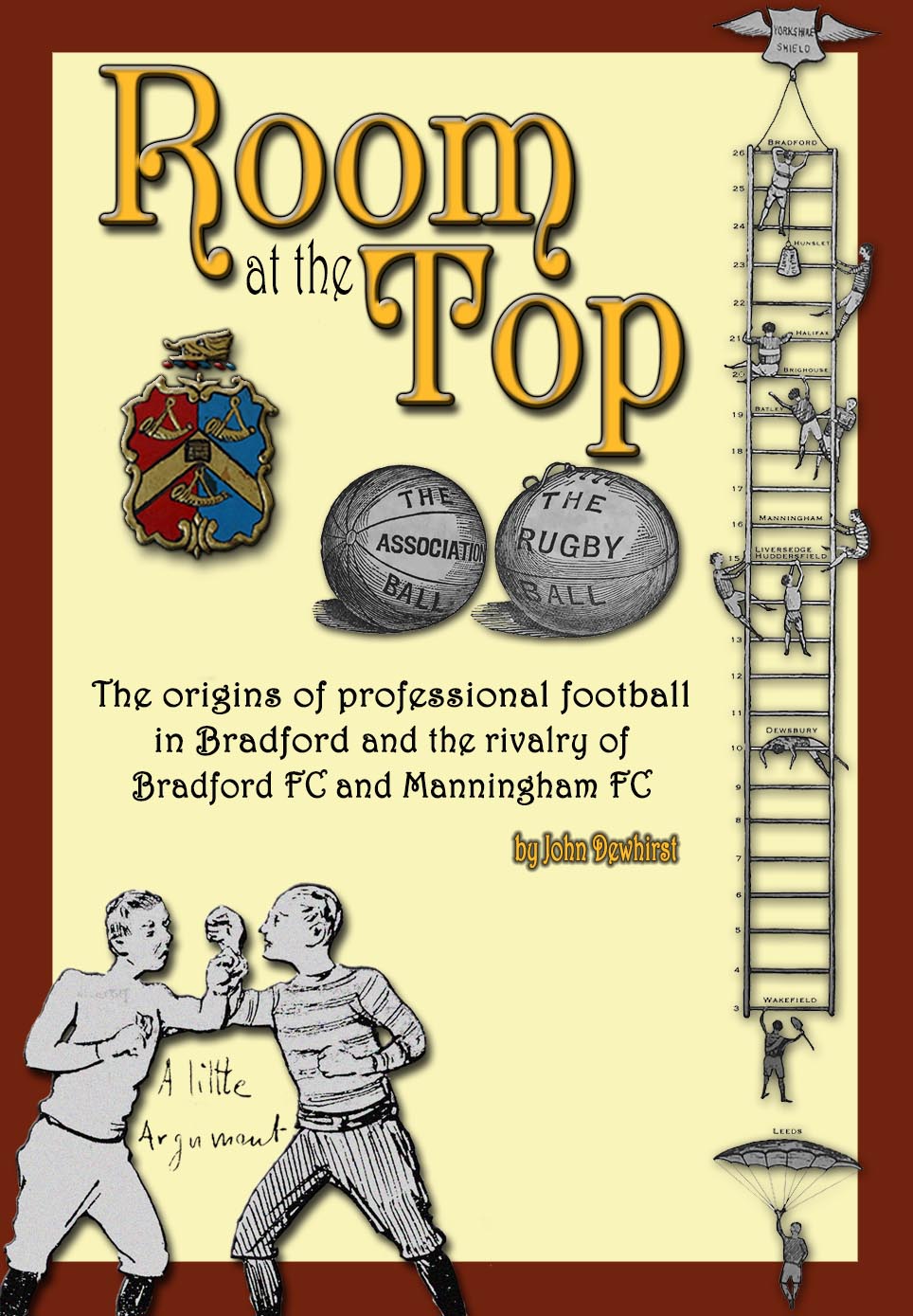
Thanks to Mark Doyle @cardinal_tales for his help
Thanks to those offering artefacts to feature – I am hoping to include as many illustrations as possible but this book will be much more text heavy than OBJECTS.
Jim Greenhalf included a feature on the planned book in today’s Telegraph & Argus:
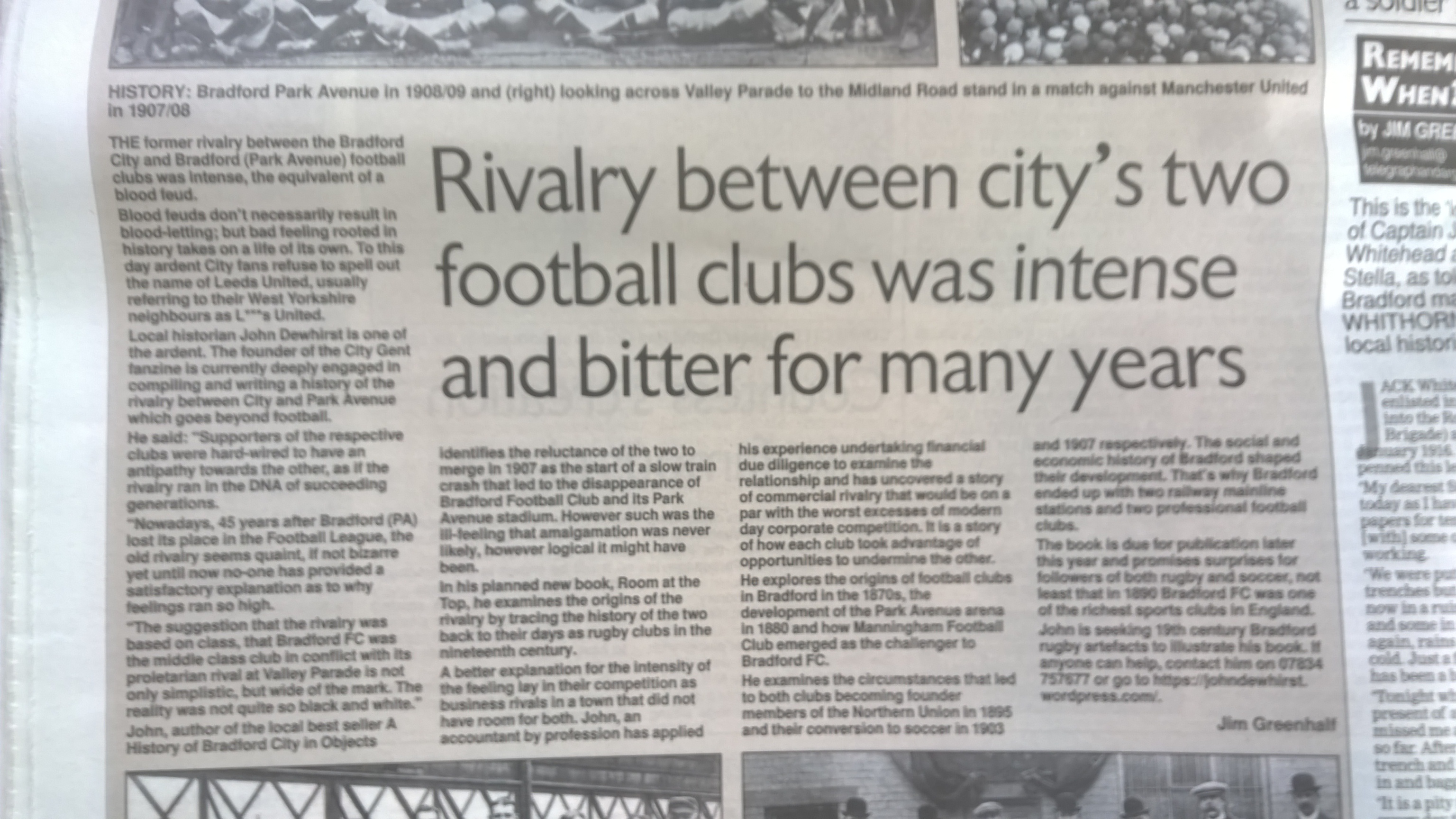
The sequel to A HISTORY OF BCAFC IN OBJECTS – Volume 2 in a series ‘History Revisited’ by Bantamspast
ROOM AT THE TOP
The origins of professional football in Bradford
and the rivalry of Bradford FC & Manningham FC
by John Dewhirst
The former rivalry between the Bradford City and Bradford (Park Avenue) football clubs was intense, the equivalent of a blood feud. Supporters of the respective clubs were hard-wired to have an antipathy towards the other, as if the rivalry ran in the DNA of succeeding generations.
Nowadays, 45 years after Bradford (PA) lost its place in the Football League, the old rivalry seems quaint, if not bizarre yet until now no-one has provided a satisfactory explanation as to why feelings ran so high. It wasn’t a matter of sectarianism and the suggestion that the rivalry was based on class, that Bradford FC was the middle class club in conflict with its proletarian rival at Valley Parade is not only simplistic, but wide of the mark. The reality was not quite so black and white.
A planned new book, ROOM AT THE TOP examines the origins of the rivalry by tracing the history of the two back to their days as rugby clubs in the nineteenth century. It reveals that a better explanation for the intensity of the feeling lay in their competition as business rivals in a town that did not have room for both. John Dewhirst, an accountant by profession has applied his experience undertaking financial due diligence to examine the relationship and has uncovered a story of commercial rivalry that would be on a par with the worst excesses of modern day corporate competition. It is a story of how each club took advantage of opportunities to undermine the other.
Dewhirst explores the origins of football clubs in Bradford in the 1870s, the development of the Park Avenue arena in 1880 and how – and why – Manningham FC emerged as the challenger to Bradford FC. He examines the circumstances that led to both clubs becoming founder members of the Northern Union in 1895 and their conversion to soccer in 1903 and 1907 respectively. He looks at the social and economic history of Bradford that shaped their development and the timing of what occurred.
Dewhirst, author of the local best seller A HISTORY OF BRADFORD CITY IN OBJECTS identifies the reluctance of the two to merge in 1907 as the start of a slow train crash that led to the disappearance of Bradford FC and its Park Avenue stadium. However such was the ill-feeling that amalgamation was never likely, however logical it might have been.
The book is due for publication in November, 2015 and promises a number of surprises for followers of both rugby and soccer, not least that in 1890 Bradford FC was one of the richest sports clubs in England. It uncovers previously forgotten detail about the history of both Park Avenue and Valley Parade as well as other early football grounds in Bradford. And ROOM AT THE TOP will also tell the likely origins of the colours worn by both clubs and subsequently inherited by City and Bulls.
The book should appeal to supporters of Bradford Bulls and Bradford & Bingley RUFC and not just those of Bradford City AFC or Bradford Park Avenue AFC. The format and size will be similar to the first volume in the series, A HISTORY OF BCAFC IN OBJECTS and details will be confirmed later this summer.
A subsequent volume will cover the history of the rivalry in the twentieth century, from 1908 to 1974
Further information on the progress of the project will be provided on this site. If you would like to be put on the mailing list please contact glorious1911-at-paraders-dot-co-dot-uk
If you can help with nineteenth century Bradford rugby artefacts to illustrate the book please contact the author at the email address above or on 07834 757 677
Twitter @woolcityrivals
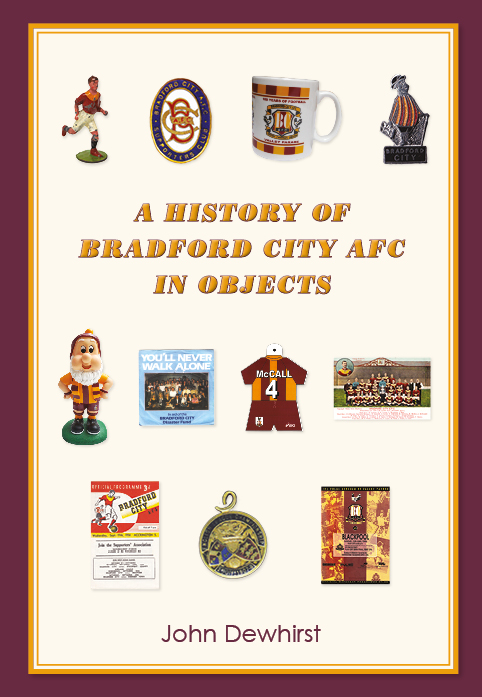
Volume 1 of a new series ‘History Revisited’ by Bantamspast
A HISTORY OF BRADFORD CITY AFC IN OBJECTS by John Dewhirst
published by Bantamspast, October 2014
ONLINE PURCHASE FROM THIS LINK
The book is just that, albeit not constrained to the usual 100 object limit.
What you get is a 344, all colour publication featuring more than 1,000 items of City memorabilia and historic club artefacts. It includes a 67,000 word definitive history of the club including the story of organised supporter groups at Valley Parade to the present day. It provides an alternative record of the club through surviving artefacts and memorabilia and has been well received by football supporters not only in Bradford but across the UK as a unique production.
Feedback reviews can be read on Amazon http://www.amazon.co.uk/dp/0956698441 but also include the following comments:
Hunter Davies: ‘Lucky old Bradford City – this is the best illustrated history of any club I have ever read. I am so envious of all John’s football treasures and memorabilia, which will appeal to and interest and amuse and fascinate all real football fans, not just those of Bradford City’
Simon Parker, T&A: ‘a unique way of following the club’s path to the present day. I can’t recommend it highly enough’
David Conn, Guardian: ‘A History of Bradford City AFC in Objects, a new book by lifelong supporter John Dewhirst, appears not much more promising than a compulsive collection of memorabilia – but it is much more than the sum of its badges, pennants and other ephemera which the author admits his wife and three daughters would eagerly de-clutter tomorrow. Any risk of appearing parochial is avoided by the care with which the objects are set out, the clean design and Dewhirst’s detailed explanations. It adds up to a labour of love, testament to a cherished institution and the 111 years in which it has played.’
Tom & Dom of BANTAMS BANTER: ‘the greatest toilet reading book of all time’
Football Book Reviews: http://footballbookreviews.com/reviews/book-review-a-history-of-bradford-city-afc-in-objects-the-definitive-record-of-memorabilia-from-a-hundred-seasons-of-league-football-1903-2014-by-john-dewhirst
Bradford City supporters have also acclaimed it as possibly the best book published ever about the Bantams.
A HISTORY OF BRADFORD CITY AFC IN OBJECTS is available from Waterstones (Wool Exchange), Bradford Salts Mill, Saltaire as well as Amazon, price £30.
Twitter @bcafcobjects


 Wool City Rivals