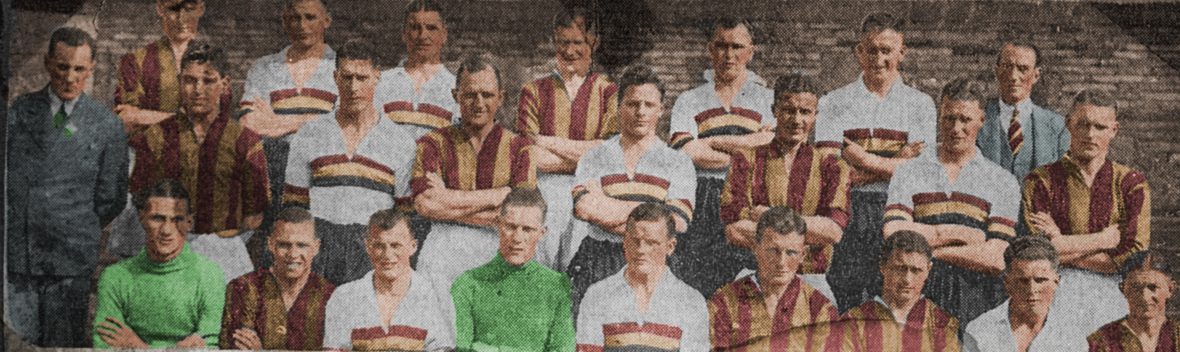
The attraction of the FA Cup

My feature in the match day programme, Bradford City vs Chesterfield FA Cup Round One, 4th November, 2017

Attendances for games in the early rounds of the FA Cup are nowadays a fraction of league gates, a phenomenon that is not unique to Bradford City. And yet, prior to the 1980s at least, the FA Cup was always certain of attracting decent crowds to Valley Parade even for first round contests. In fact, the FA Cup was invariably a highlight of the season and the draws eagerly awaited. From a financial perspective, success or otherwise in the FA Cup could dictate profit or loss over a season.

Cup campaigns feature prominently in the history of Bradford City AFC, most notably triumph in the FA Cup Final of 1911 and celebrated giant-killings including that of Chelsea in 2015. In this context it is disappointing that our game with Chesterfield will be attended by so few, particularly given bumper average league attendances.

The predecessor club at Valley Parade, Manningham FC also had a strong cup-fighting tradition and its original rise to prominence was derived from performances in the Yorkshire Challenge Cup (rugby union competition) during the 1880s. The most celebrated cup achievement of Manningham FC was when the club reached the final in 1885 only to be defeated by Batley.

Manningham FC were defeated by Bradford FC at Park Avenue in the Yorkshire Cup in March, 1884 and again two years later. When the clubs were drawn together in March, 1887 it had all the makings of an ultimate grudge confrontation. The night before that game was due to take place there was a heavy snowfall in West Yorkshire and the match at Park Avenue was called off. However it subsequently transpired that Bradford FC officials had made no effort to clear the pitch and despite the weather, other games had taken place elsewhere in the county. It was alleged that the Bradford club had deliberately sought to get the tie re-arranged knowing that the Manningham FC players would be unable to play mid-week. Bradford FC was censured by the Yorkshire RU and the controversy ended in the high court with the club withdrawing from the Yorkshire Cup competition for the next two seasons in protest.

The event became enshrined in Bradford sporting legend and helped define the subsequent rivalry of the successor soccer clubs. The historic allure of the FA Cup in Bradford was enhanced by the prospect that City might be drawn against its Park Avenue rivals. Indeed, I confess that I held out hope that there could have been a meeting between Bradford City and the reformed side at either Valley Parade or Horsfall in the first round.

City and Avenue met in the FA Cup on three occasions (all at Park Avenue) with City being victorious twice. In March, 1920 both City and Avenue were defeated in the quarter-finals, the nearest that the city ever came to its sides meeting in the final stages of the competition.

Chesterfield FC have previously been drawn against Bradford City in the FA Cup three times and only once have City been winners. In November, 1903 they were in fact the first club to defeat Bradford City in the competition, winning 2-1 at Saltergate in the fourth qualifying round.

In January, 1938 second division Chesterfield defeated City in a second replay of the third round tie. It was a result that caused considerable disappointment in Bradford because having been relegated to Division Three (North) in 1937, the City club had hoped that the FA Cup could provide an opportunity for glory and financial relief. Non-League Walker Celtic had caused a shock by drawing at Valley Parade in the first round but the 11-3 victory in the replay set a club record in the competition. Victory at Wrexham in the second round then led to the tie with Chesterfield. The first game at Valley Parade attracted a crowd of thirteen thousand but the second replay at Bramall Lane was watched by 21,061.

The last time Chesterfield played Bradford City in the FA Cup was in November, 1975 when the visitors were defeated 1-0 at Valley Parade in the first round. The attendance on that occasion was 4,352 and it is sobering to note that there were only two league games that season which attracted a higher crowd. The defeat of third division Chesterfield by Bradford City (who were then members of Division Four) proved the start of a memorable cup run and the club progressed to the quarter finals and eventual defeat by Cup winners Southampton. Few of us expected that feat to ever be repeated and yet in 2014/15 City once again reached the last eight of the competition, reason enough as far as I am concerned that the FA Cup does not deserve to be overlooked.


John Dewhirst

  • Thanks for visiting my blog. Scroll down for details about my books in the BANTAMSPAST History Revisited series which tell the history of sport in Bradford – and in particular football. The books seek to explain why things happened as they did instead of simply recording what occurred and readers may be surprised at the extent to which they contradict many of the myths and superficial narratives that have circulated previously.
  • If you are interested in Bradford sport history visit VINCIT: http://www.bradfordsporthistory.wordpress.com 
The Grand Bazaar of October, 1927

My feature published in the BCAFC programme vs Charlton Athletic on 21 October, 2017.

Among the various relics in my collection of Bradford City memorabilia, one of my favourites is a book published in 1927 to accompany the grand fund-raising bazaar in October of that year.

It is an evocative publication with illustrated adverts of long gone Bradford businesses that are equally fascinating as the editorial content. The rear cover features the FA Cup trophy adorned with claret and amber ribbons and the wistful epitaph ‘Glorious 1911’, a reminder of a former era of glory. In addition to a statistical record it includes a history of Bradford City written by the journalist William Sawyer. The edition was updated in 1953 to mark the club’s jubilee but incredibly, it remained the only account of the history of the club until 1988.

Organised by the Bradford City Supporters’ and Shareholders’ Association, the bazaar was an initiative to restore the finances of the parent football club which had been relegated to Division Three (North) after a calamitous season in 1926/27 during which the team had won only 7 of its 42 league games. New money was desperately needed to provide a degree of stability and recruit players. In May, 1927 supporters had been told that the club desperately needed £5,000 to remain solvent and there had been concerted effort during the summer to promote the sale of season tickets.

Lottery legislation restricted options and bazaars were therefore a common response to a financial crisis. Halifax Town had had one in 1923 and the supporters club at Park Avenue likewise in November, 1925 which raised £1,000. The Bradford City bazaar took place between 26-29 October, 1927 at Church House on North Parade and would have been recognisable as a typical community fete with various stalls selling home produce and refreshments as well as attractions such as tombolas. What is notable is that everyone associated with the club was involved including players, officials and their wives. It was a genuine collective effort.

In the nineteenth century bazaars had been a traditional response by members of sports clubs in Bradford to raise funds and in November, 1896 Manningham FC had organised a fund raising bazaar in the Belle Vue drill hall. On that occasion the Manningham committee invited a celebrity Indian cricketer, Prince KS Ranjitainhji (an undergraduate at Cambridge University) to be guest of honour but regrettably he sent a telegram at short notice to apologise for his non-attendance.

Typically bazaars were more significant for galvanising support and common purpose than the amounts they raised. However, they allowed supporters of a club to feel that they were doing something to safeguard its future and hence they had a benefit to morale. Although the proceeds of the bazaar in 1927 helped the club, the amount was immaterial in terms of transforming the finances and there was general disappointment that only £1,150 was raised.

Nonetheless I can’t help but feel that it must have been a unique event. It is one that I believe is deserving of commemoration on its centenary as a reminder that Bradford City has invariably relied upon the support of volunteers to survive. For that matter, it might be quite amusing to restage the bazaar as a ‘Roaring Twenties weekend’ so make a note in your diaries as a reminder for 2027.

* * * * * * * * * * * * * * * *

Thanks for visiting my blog. Scroll down for details about my books in the BANTAMSPAST History Revisited series which tell the history of sport in Bradford – and in particular football. The books seek to explain why things happened as they did instead of simply recording what occurred and readers may be surprised at the extent to which they contradict many of the myths and superficial narratives that have circulated previously.

If you are interested in Bradford sport history visit VINCIT: http://www.bradfordsporthistory.com

Twenty Years ago

The following was published in the Bradford City programme v Oldham Athletic on 17 October, 2017

On 18th October, 1997 a goalless draw at Port Vale left Bradford City in sixth position in the second division with five wins and four draws out of the first eleven games. The Richmond era was by now in full swing. After narrowly avoiding relegation at the end of the previous season, there had been an ambitious policy to strengthen the team during the summer in pursuit of the ultimate promotion. Scarred by the disappointment of the ‘nearly season’ ten years before, few supporters were prepared to get carried away and indeed, it was often said that Richmond had more ambition than the fans. However, with a quarter of the season completed, in 1997 there was a growing sense of self-belief. After all, in February of that year the club had signed a Brazilian, Edinho and on 27 March, 1997 Her Majesty The Queen had visited Valley Parade. It seemed that anything was possible.

It was a remarkable phase in the club’s history and one that has tended to be overlooked after the financial implosion that eventually occurred five years later. At the time it was about living a dream but none of us could ever imagine the roller coaster ride that was about to begin.

Bradford City was not the only club enjoying the high life. Five other clubs more used to lower division fare found themselves that season in what was then called Football League Division One. Of Bury, Crewe, Port Vale, Stockport and Tranmere, the latter two are currently outside the top four divisions and Oxford United was another that suffered loss of League status. The headline of the season however was the relegation of Manchester City alongside Stoke City and Reading.

Today’s opponents Oldham were in the division below us, alongside three clubs currently in the Premier League – Bournemouth, Burnley and Watford, and two others who are now outside the Football League – Wrexham and York City. In the Premier League were Blackburn, Coventry and Wimbledon and in the League’s basement were Brighton, Cardiff, Chester, Darlington, Hull, Scarborough and Swansea. If ever a season in recent memory had to be selected as a snapshot of upward and downward mobility, I would nominate 1997/98 as my choice.

Games with Manchester City were some of the most memorable that season. Defeat at Maine Road in November, 1997 signalled that the club was not yet strong enough for a sustained promotion challenge. Another defeat at the ground in the FA Cup third round in January, 1988 cost manager Chris Kamara his job. Kamara’s £625k signing of John McGinlay from Bolton Wanderers in November, 1997 proved to be one of the biggest transfer flops in the club’s history.

The highest attendance at Valley Parade that season was for the fixture with Manchester City on 28 March, 1998 which attracted ‘only’ 17,099 of which there could not have been more than three thousand from Manchester. The Sky Blues – Uwe Rosler, Kinkladse et al, were a big part of the story that season and results at Valley Parade had a big bearing on their fortunes. Other than our victory in that League game, it was a home defeat for City on the last day of the season that sealed the fate of the Manchester side – victory for Portsmouth at Valley Parade secured that club’s own escape.

John Dewhirst

The formation of Bradford City

The following is my column published in the Bradford City matchday programme on 30 September, 2017 (v Doncaster):

Doncaster Rovers FC was formed in 1879 and was first elected to the Football League in 1901. What is quite unique for the club is that it has had no less than four distinct periods as members of the Football League: 1901-03; 1904/05; 1923-98; and 2003 to date.

In May 1903 Bradford City AFC gained election to the Football League alongside Stockport and Burnley at the expense of Doncaster. City led the ballot of applicants securing 30 votes, followed by Stockport County 20; Burnley 19; Doncaster Rovers 14; Crewe Alexandra 7; West Hartlepool 7; Southport Central 4; and Willington Athletic 1.

It was an unprecedented outcome that a club which had not even played a game should be allowed to join the League and, needless to say, the Doncaster officials and supporters were aggrieved. The complaint was made that ‘Bradford was a paper club without players’ and that undue influence had been brought to bear on the delegates to procure votes. Indeed, the Football League was anxious to get representation in West Yorkshire and Doncaster Rovers were sacrificed accordingly.

Ironically it was the example of Doncaster Rovers that had enabled Bradford City AFC to be formed in the first place. Faced with losses and the declining popularity of Northern Union rugby, Manningham FC had sought to introduce professional soccer to Valley Parade. The principal obstacle however was the lack of funds to raise a team and it was Doncaster who provided the idea of how best to do so.

Doncaster Rovers had regularly staged an archery contest which to my knowledge dated back to at least 1891. In essence it was a lottery, but was promoted as a contest of skill to avoid running foul of legislation on gambling. It thus exploited a legal loophole and chairman Alfred Ayrton identified it as the obvious solution to the needs of Manningham FC.

The event took place at Valley Parade on New Year’s Day, 1903. There were prizes with a total value of £500, the first prize being £85 of furniture, the second a grand piano and the 150th for 5s. A total of 115,000 tickets were sold in blocks of 30, 40 and 50 at 6d apiece which raised £2,875 and one individual was reported to have bought 120, equivalent to £3. The ticket stubs were attached to a 16 ft revolving target and from a platform, independent archers fired arrows until all 150 prizes were claimed.

A subsequent version of events was that the Chief Constable had plotted a raid to arrest the participants but the mayor of Bradford was invited by Ayrton to shoot the first arrow and in so doing averted police action.

The success of the archery contest gave stimulus to the association project. It meant that Manningham FC could secure its short term survival by paying off its debts and the remaining funds allowed Manningham FC to recruit professional soccer players and stake its claim for membership of the Football League.


The record League attendance at Valley Parade, September 1927

The following was published in the Bradford City AFC programme (vs Rotherham United) on 16 September, 2017:

On 17 September, 1927 Bradford City hosted Bradford (Park Avenue), the first meeting of the sides in a Football League fixture since the 1920/21 season when the two were members of Division One. Such was the interest that it attracted a reported crowd of 37,059 to Valley Parade, a record for a League fixture at the ground. (The record attendance is recorded as 39,146 for the FA Cup quarterfinal tie with Burnley in March, 1911.)

The attendance was a measure of the enthusiasm for derby football in Bradford but it also revealed the pent-up demand for success and excitement. In the six seasons since they had last been in the same division, both clubs had been relegated twice: Avenue had dropped out of the first division at the end of 1920/21 and the following season City had been relegated from Division One and Avenue from Division Two. With City’s relegation at the end of the 1926/27 season, Bradford found itself with two clubs in Division Three (North).

The collapse of the two clubs had been remarkable and the back-to-back relegations of Bradford PA was unprecedented. City’s record in 1926/27 was also notable for the fact that the side had won only 7 of its 42 League games, an unenviable ratio that remained the club’s worst until 2000/01 when City were relegated from the Premier League with only 5 wins out of 38.

For a city that had boasted such a strong pedigree in sport it was a real low point in its sporting history. Neither were Bradford Northern doing much better at Birch Lane, struggling at the bottom of the Rugby League and in a weak financial state. By far the most successful side in Bradford was the amateur Bradford Rugby Club at Lidget Green, winners of the Yorkshire Challenge Cup three times in succession 1923-25 and regularly enjoying five figure crowds.

Older sportsmen in the city must have questioned the wisdom of rugby having been abandoned at Park Avenue in 1907 and besides, Bradford Rugby demonstrated the continuing affection for Rugby Union. At Valley Parade questions had also been asked about whether Bradford could support two professional soccer clubs although the suggestion of merger was dismissed by supporters of both.

Avenue won the derby at Valley Parade by 3-2 and later achieved the double at Park Avenue in January, 1928 defeating City 5-0. By the end of 1927 the club sat at the top of Division Three (North) where it remained for the rest of the season. It marked the beginnings of a new era and judged in terms of League performance, Bradford PA remained the top side in Bradford for the next quarter century.

City finished 1927/28 in 6th position but the following season secured promotion as champions in record fashion, scoring 128 goals. The recovery of Avenue and City – and their return to the second division – convinced soccer followers that there was room for both clubs after all and talk of amalgamation was abandoned… at least until the next crisis.

John Dewhirst

Athletics at Valley Parade

The following is my column that was published in the Bradford City programme (v Bristol Rovers) on 2nd September, 2017

Valley Parade has been the home of Bradford City ever since the club was formed in 1903. Prior to that it had been used for rugby by Manningham FC, staging Rugby Union between 1886 and 1895 and then Northern Union (RL) between 1895 and 1903. Additionally, it has been adopted by Bradford Northern and then Bradford Bulls for Rugby League fixtures. Accordingly, what is unique about the ground is that it has staged all three of the principal codes of football. During the last century Valley Parade hosted gymnastics and boxing on various occasions but what has been overlooked is that when Valley Parade was constructed it was designated as both a football ground and an athletics arena.

Manningham FC had been forced to relocate from Carlisle Road on account of the construction of a school and Valley Parade was selected by virtue of the absence of other options. The site required considerable work to create a suitable venue on a hillside but its central location was considered an advantage. The venture represented a major undertaking for the club and the use of the ground for athletics was therefore seen as a means to make the investment pay its way. As a result, a three yards wide cinder track was thus included around the pitch perimeter for running competition.

When plans for the new ground had been announced in May, 1886 local cyclists had lobbied for a cycling track to be incorporated at Valley Parade. The lack of a cycling track was keenly felt in Bradford and enthusiasts were forced to resort to cycling in public parks which was regarded as an anti-social nuisance. Poor road surfaces and adverse gradients left few other options. The cyclists had wanted a wooden track to be laid down. Other than the prohibitive cost the other factor dictating against it was that it would have been unsuitable for running whereas a cinder track could at least be used by cyclists and runners. Although the cyclists were disappointed and forced to look elsewhere, cycling events were nonetheless staged at Valley Parade during athletics festivals.

Athletic festivals took place at Valley Parade on an annual basis between 1887 and 1896. The illustration dates from August, 1887 when Airedale Harriers organised the first such festival at Valley Parade with events including a two mile bicycle handicap. On this occasion however the crowd was said to have been disappointing despite decent weather. A marquee was erected on the platform which then existed above the Manningham end terrace before the Kop was extended in 1906. Manningham FC and later Bradford City AFC maintained close relations with Airedale Harriers of whom Tony Fattorini was a joint member and those links encouraged the adoption of athletic training for football purposes. Prior to 1903 the Harriers also provided pre-match entertainment with races at Valley Parade.

The end of athletic festivals came with the launch of the Northern Union in 1895 and the reluctance of amateur athletes to be associated with events staged by professional clubs for fear of being banned from amateur competition. Changing fashions and the evolution of athletics towards codified events demanding dedicated venues were other factors. Furthermore, the final event at Valley Parade in 1896 had been loss-making.

Remembering Jimmy Speirs

The following was published in the Bradford City match day programme on 19 August, 2017:

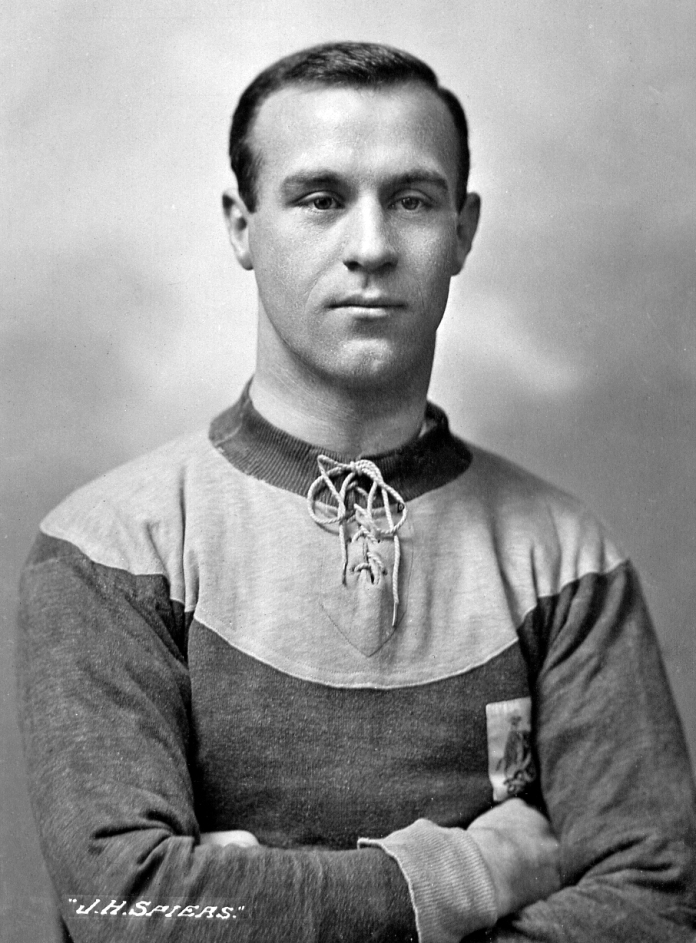
JimmySpeirs.jpg

Tomorrow marks the centenary of the death of Jimmy Hamilton Speirs, team captain and scorer of the winning goal when City defeated Newcastle United in the FA Cup Final replay at Old Trafford on 26 April, 1911. After the game he was cheered by 100,000 exultant Bradfordians in the city centre and yet six years later he faced death in a muddy shell-hole at the age of only 31, killed at Passchendale on 10th August, 1917.

Jimmy Speirs had formerly played for Rangers and Clyde before joining Bradford City in 1909. Whilst at Rangers he had been capped once for Scotland. In total he made 96 first team League and Cup appearances for City, scoring 33 goals before being sold to Leeds City on 27 December, 1912. At the time of his transfer he was the leading scorer at Valley Parade but faced with a collapse in form during the preceding two months, Peter O’Rourke needed funds to finance team strengthening. It proved impossible to refuse the £1,400 fee offered by Leeds City for the inside left which was a record transaction for both clubs. However it is questionable whether Bradford City ever recovered prior to the suspension of League football in 1915 from the loss of their talisman.

On their part, Leeds were prepared to pay a premium such that Jimmy Speirs would be registered in time to play in the FA Cup but it is notable that the player himself was reported to receive between £200-300 which would have provided financial security for his family. Indeed Speirs was known to be financially astute and it was said that in 1909 he had made a small fortune from trading rubber shares. We will never know whether he was unsettled at Valley Parade in 1912 and possibly tempted away by Leeds manager, Herbert Chapman.

Whilst Jimmy Speirs is remembered for his place in the history of the club, he could be defined by so much more. Not only was he an inspirational leader on the football pitch he was a popular NCO on the battlefield who led by example, awarded the Military Medal in May, 1917. He was also a family man with two young children. The loss of such a remarkable individual is the ultimate illustration of the futility of war. He is buried at Dochy Wood Cemetery in New Flanders and his grave is regularly attended by football supporters and family members.

In making the ultimate sacrifice, Speirs was one of 245,000 British soldiers killed at Passchendaele and an estimated 744,000 in the conflict as a whole. A total of four serving and six former Bradford City players were killed in action during the Great War and Bob Torrance was another member of the 1911 FA Cup winning team to be killed (April, 1918). Subsequent to the war Jimmy Speirs and others with a Valley Parade connection were remembered first and foremost as fallen soldiers among comrades in arms. So many men had been killed that there was a reluctance to differentiate former professional football players as deserving of unique attention and I believe that Jimmy, known as a team player would have concurred with this treatment.

Accordingly a memorial to the war dead of Bradford City was not erected at Valley Parade until 2015 (funded by a badge sale organised by Bantamspast) and prior generations tended to remember Jimmy Speirs as one of countless others who never returned. By contrast the distinct commemoration of footballers killed in action has been a more modern phenomenon.

I encourage readers to visit www.jimmy-speirs.co.uk to learn more about Jimmy.

John Dewhirst

The origins of Valley Parade and Midland Road

The following was published in the Bradford City match day programme on 8 August, 2017

Judged from its width alone, Midland Road conveys the status of a primary highway and yet it doesn’t go anywhere. Could the Victorians have really designed it solely for modern day street parking and to provide entertainment for future generations of traffic wardens? Surely there cannot be another road of its ilk in Bradford.

The original intention was for a road to Shipley from the Midland Station (what became Forster Square station, as renamed in 1924). The route can be detected from an aerial view on Google maps and you can’t help but think that it would have been a better option compared to either Manningham Lane or Canal Road. Indeed, our predecessors thought likewise. In particular, Valley Road was a cause of frustration for the Midland Railway as it was unable to accommodate the increase in traffic to its busy goods yard.

Passenger and goods traffic to and from Bradford was booming so the Midland looked to expand its warehouse and goods depot as well as increase capacity through additional sidings. The plans for the new ‘twenty yard’ road – a benchmark for primary highways of the era – fulfilled a couple of other objectives for the Midland by improving access to a new station at Frizinghall (opened 1875) and by encouraging the development of housing along the corridor.

The scale of development and the extent of the financial investment should not be underestimated but it was unfortunate that it coincided with a downturn in the property market in 1873. The reason why the Midland Road never extended to Shipley is understood to have been because property owners refused the sale of their land en route. In the depressed conditions, the Midland decided to terminate negotiations as well as the road project because a loss of appetite for property speculation in the town undermined the viability of the scheme. The Midland had other construction programmes at the time and was also digesting the cost of the Settle to Carlisle railway (which did not open to passenger traffic until April, 1876) and the construction of St. Pancras station in London. Hence it decided to conserve funds for use elsewhere. Thus Midland Road became something of a white elephant.

The Valley Parade site was originally intended to be a consignment warehouse by the Midland Railway who bought the land in anticipation of development in 1872. The railway company had intended to construct a bridge from the bottom of Cornwall Road to the railway yard in the valley below. A warehouse at Valley Parade would then have provided goods storage to and from the sidings.

Subsequent to the same property crash of 1873 the Valley Parade warehouse development did not proceed and the site remained in an undeveloped state with stone extracted for building and the area used to deposit a combination of building spoil and household waste. Although it would have been rough land there is reason to believe that it was adopted for stabling and in May, 1886 it was even reported to have staged a circus.

The following link narrates the early development of Valley Parade after 1886 and incorporates material that had been overlooked until the publication of my book ROOM AT THE TOP (Bantamspast, 2016).

John Dewhirst

*** The history of Valley Parade continued to be closely linked to that of Bradford’s railways. The story of the saga for a cross-town rail link in Bradford can be found from this link.

Construction of the Main Stand at Valley Parade, 1907

The following was published in the Bradford City AFC match day programme vs Blackpool, 5th August 2017…

In August, 1907 Valley Parade was in the midst of redevelopment with the extension of the main stand on South Parade that dated from 1904. The stand which burned down in May, 1985 was essentially the structure that was completed in 1907 and in this photograph taken at the beginning of the season the construction work can be seen underway.

teamgroup1907-08 - Copy

Facilities at Valley Parade were basic and subsequent to being elected to the Football League in 1903, limited resources had existed for Bradford City to invest in ground improvements. However the lack of security of tenure was an issue that deterred major investment and in 1907 the criteria was that any new stand should be of a transferable nature as a contingency measure in case the club was forced to relocate. Whilst it might seem incredible to us, the idea of a portable stand was not a new idea because the Manningham FC members were already familiar with moving a stand to a new ground (as had been the case in 1886 when the uncovered grandstand – what would better be described as a viewing platform – had been relocated to Valley Parade from Carlisle Road).

The risk of fire was clearly discounted when the main stand was erected. Or rather, the implicit assumption was that any risk of fire could be managed. It was not as if grandstand fires were unheard of, but what tended to encourage complacency was that incidences of fire had tended to be when grounds were unoccupied and therefore the risk was associated with sinister reasons rather than as an issue of crowd safety.

The stand was completed in time for the fixture with West Bromwich Albion in November, 1907 and thus provided a quick solution to the need for additional covered accommodation. It was claimed that it had a capacity of 12,000 of which 5,000 seated but the minimal facilities and lack of dressing rooms hardly made it worthy of being described as a grandstand. Even by contemporary standards in 1907 it would have been considered basic and the predominant use of wood was a cheaper (and transportable) option compared to concrete. The irony is that it was considered a temporary structure, constructed as cheaply and quickly as possible with the intention of eventual replacement by a cantilever stand.

In February, 1907 work on the new Kop had been completed, christened Nunn’s Kop after the name of the director responsible. A new stand on the Midland Road was constructed the following year.

The 1907/08 season proved to be a major turning point for Bradford City. After the rejection of merger with Bradford Park Avenue in May, 1907 twelve months later the club was crowned champions of Division Two. The architect of the transformation was manager Peter O’Rourke who had been appointed in 1905 (pictured far right). It was his signing of namesake Frank O’Rourke (seated front right – circled) and James McDonald (seated front left – circled) in April, 1907 that was said to have transformed his team into promotion winners.

Links from here to more content about the history of Valley Parade

John Dewhirst

You will find other features about the history of Bradford City AFC on this site (from the origins of the club crest through to archive photographs), book reviews and sundry features about the history of Bradford from the menu above. If you are interested in the history of Bradford, have a look at VINCIT: the online journal of Bradford Sport History.

Harry Garnett’s jug

A silver ewer presented to Harry Garnett of Bradford FC in November, 1880 is being auctioned next month…

Despite the fact that Bradford established an enviable reputation for sporting excellence in the last quarter of the nineteenth century, the achievements of its two principal rugby teams Bradford FC and Manningham FC (who later converted to soccer at Park Avenue and Valley Parade respectively) has tended to be overlooked. Artefacts from the era are few and far between and so it is particularly interesting to discover that this item exists and is being auctioned next month.

87143-1-0.jpg

The trophy was presented to Harry Garnett on the occasion of his retirement as captain of Bradford FC in November, 1880 occasioned by his marriage the following month. Garnett had been a leading member of the club in the second half of the 1870s and under his captaincy the club had become known as the strongest in Yorkshire. Otley based Garnett had also been the second player from the club to be awarded an England cap by the Rugby Union in 1877.

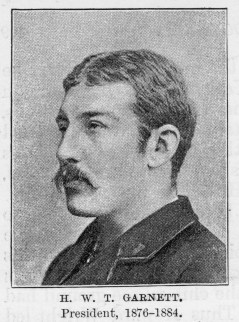
Garnett (1851-1928) is rightly credited for having pioneered rugby football in Bradford as well as in Yorkshire and he remained influential as a county administrator, president of the Yorkshire governing body between 1876-83 and in 1889 becoming the first Yorkshireman to become president of the RFU. He was also credited with having helped instigate the Yorkshire Challenge Cup competition that was first played for in the 1877/78 season. It says much about the developments at Park Avenue that he chose to sever his connections with Bradford FC completely in 1881, thereafter to all intents and purposes forgotten.

Garnett (2).jpg

Having previously been based at Apperley Bridge (at the field adjacent to the Stansfield Arms), Bradford FC moved to the newly constructed Park Avenue ground in 1880 following merger with Bradford Cricket Club. Although relocation brought a new era of sporting glory, Garnett had misgivings about changes that were taking place in the sport at the time. Garnett fell out with other members of Bradford FC and whilst the trophy was a generous gift it is notable that the presentation to him was poorly attended.

His marriage in December, 1880 at the age of 29 years was a high profile affair. Solemnised at the Chapel Royal, Savoy in London, the officiating clergyman was the chaplain-in-ordinary to Queen Victoria. Garnett was a gentleman and his marriage was the occasion for him to formally leave Bradford FC. However by then relations were already sour.

In November, 1880 the Leeds Times described a presentation to Garnett by ‘several members’ of the Bradford club at the Alexandra Hotel in Bradford – by which was meant that the event was attended by a minority of members. Garnett had made a rather pointed response to the effect that ‘no man played football with any hope of reward, and it was a pleasure to him to know that the club appreciated the services which he had rendered.’ The Bradford Daily Telegraph of 22 November, 1880 was more charitable: ‘There was a nice company of friends, a sumptuous dinner, and conviviality enough to make things pleasant and send home the diners in a happy frame of mind.’ Nonetheless, there is sufficient circumstantial evidence to suggest there having been a falling out. Although Garnett had been elected captain of the club in May, 1880 The Yorkshireman of 14 August, 1880 considered it surprising that ‘the respected captain of the former club was not invited to the Mayoral banquet which graced the inauguration of the new ground.’

Garnett appears to have played only a single game for Bradford FC in the 1880/81 season, as captain against York at Park Avenue in October, 1880 and this was his farewell appearance. According to The Leeds Mercury of 23 November, 1880 in that same month Garnett had spoken ‘on the subject of gate money, and contended that the tendency towards playing matches for the purpose of raising a large amount of gate money without any visible object would in time act prejudicially to the best interests of the game. He suggested that the surplus funds of a club at the close of a season be devoted to some charitable object, and thought that by doing so football would still continue to increase in popularity.’ On this evidence it is clear that Garnett was not in favour of developments at Bradford FC. Whether he was aware of monies being paid to Bradford FC players is unclear (such as the reimbursement of expenses for those new recruits travelling to Apperley Bridge in 1879/80).

There is more about Harry Garnett in my book Room at the Top.

Further details about the auction: http://www.thetelegraphandargus.co.uk/news/15352925.Piece_of_Bradford__39_s_sporting_history_to_go_under_hammer/